

In crypto, tokenomics is one of those topics people often skip when they’re new. Price looks exciting, charts look tempting, and supply numbers feel boring until they’re not. From experience, most long term mistakes traders make come from not understanding how a token actually works under the hood. Vanar’s VANRY token is a good example to study because its structure is relatively straightforward and easy for beginners to grasp.
What VANRY Is and Why It Matters
VANRY is the native token of Vanar Chain. Its role is similar to ETH on Ethereum. It’s used to pay transaction fees, run smart contracts, and support validators who keep the network running.
In simple terms, if people use Vanar Chain, they need VANRY. That connection between usage and demand is the foundation of any serious token economy.
For traders and developers, this matters because utility driven demand is very different from hype driven demand. One tends to fade quickly, the other can compound over time.
Understanding Max Supply and Circulating Supply
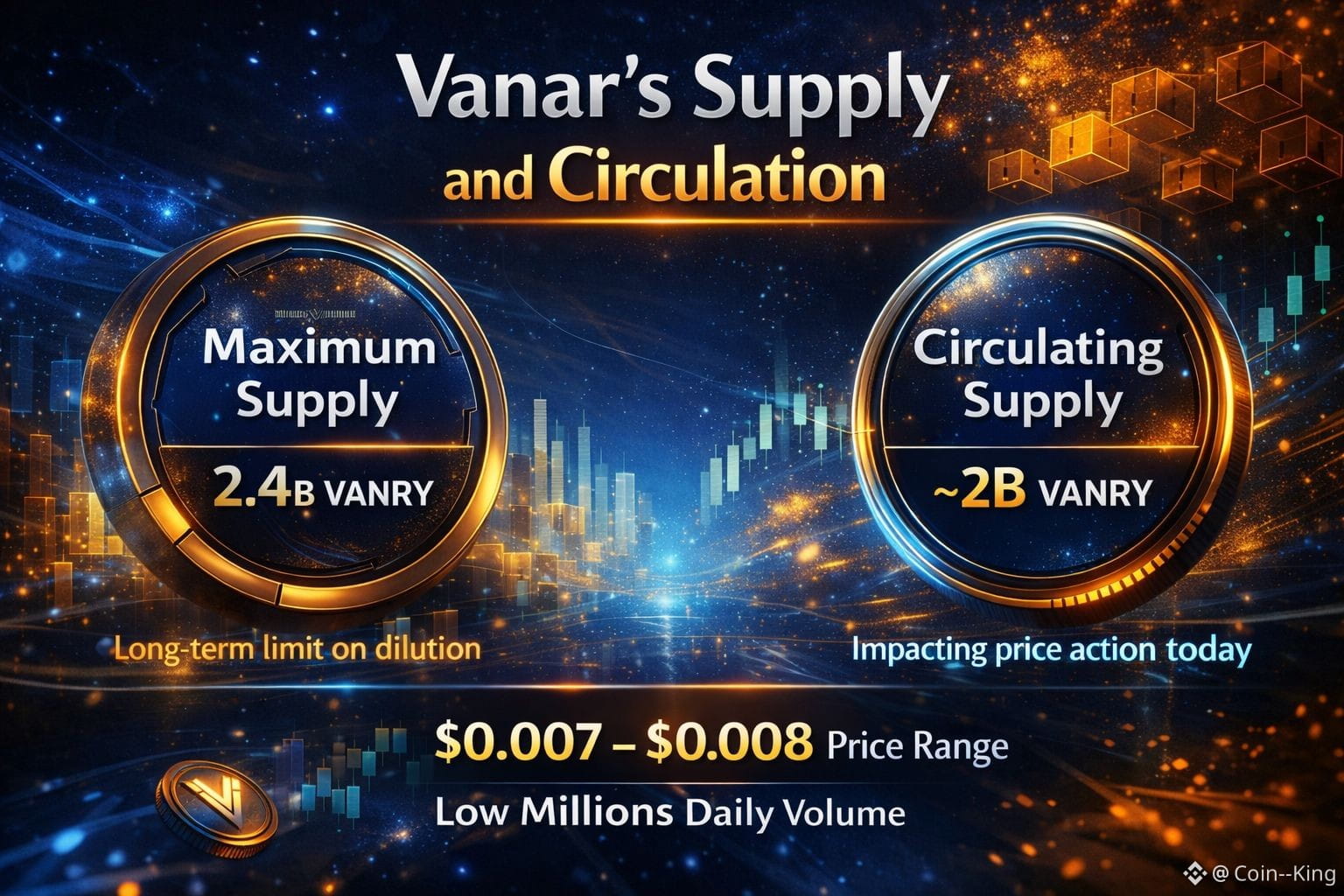
Vanar has a fixed maximum supply of 2.4 billion VANRY. This number sets the long term limit on dilution. But what affects price action today is circulating supply the amount of tokens actually available in the market.
By late January 2026, data platforms were showing roughly around 2 billion VANRY in circulation, with the token trading near the $0.007–$0.008 range. Daily trading volume was relatively modest, sitting in the low single-digit millions. From a trader’s perspective, this tells you liquidity is still developing, which means price can move sharply on relatively small shifts in demand or sentiment.
How VANRY Is Distributed
Distribution is where beginners often get burned. Vanar’s initial token allocation breaks down into a few main buckets. About 50% of the supply was minted at genesis for a 1:1 swap with the old TVK token. Another 41.5% is reserved for validator rewards, 6.5% for development incentives, and 2% for airdrops and community programs.
One thing worth noting is that the documentation does not assign a direct block reward allocation to a founding team wallet. That doesn’t eliminate sell pressure entirely, but it does reduce one of the more common risks traders watch for: constant team emissions hitting the market.
Emissions, Inflation, and Ongoing Supply
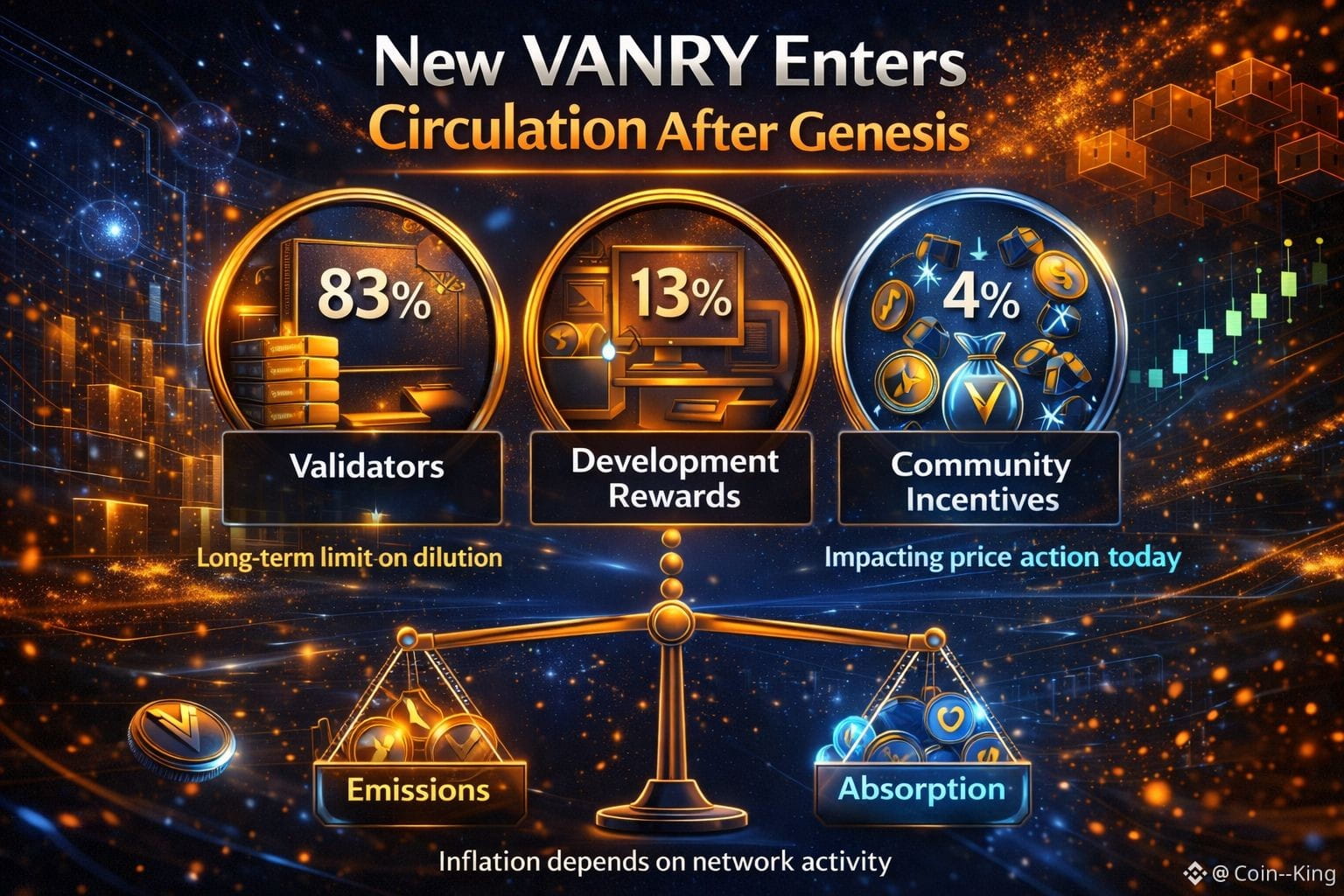
After genesis, new VANRY enters circulation through block rewards. These emissions are split roughly as follows: 83% goes to validators, 13% to development rewards, and 4% to community incentives like airdrops.
Inflation by itself isn’t automatically bad. The real question is whether network activity can absorb that new supply. If transaction fees, staking participation, and application usage grow, emissions can be balanced out. If they don’t, price pressure usually shows up sooner or later. This is one of the first things experienced traders monitor over time.
Where Real Demand for VANRY Comes From
VANRY isn’t designed to be just a speculative asset. It’s required for gas fees, staking, and participation in network-level decisions. Vanar has also discussed an ERC-20 wrapped version of VANRY, which allows the token to interact more easily with Ethereum-based DeFi platforms and liquidity pools.
From experience, interoperability often plays a quiet but important role. Tokens that can move across ecosystems tend to attract more consistent liquidity than those locked into a single chain.
Why Vanar Has Been Trending Recently
Since mid 2025, Vanar has increasingly positioned itself around AI-focused blockchain infrastructure. In January 2026, the project announced the launch of AI-native infrastructure components, building on earlier partnerships like GraphAI in 2025. Markets respond strongly to narratives, but they respond even more when those narratives are backed by visible progress.
That combination AI as a theme and actual development milestones is largely why VANRY has reappeared on many traders’ watchlists.
Final Thoughts for Beginners
Vanar’s tokenomics are not complicated, which is a good thing. Supply is capped, distribution is clearly defined, and demand depends largely on real network usage. If you’re new, don’t start with the price chart. Start with how tokens enter circulation, who receives them, and why someone would need the token in the first place.
Charts react fast, but tokenomics explains why they react at all.