


Dusk doesn't forget. People do.
A rule exists now that everyone follows. It’s not controversial. It does not get debated. It shows up in handovers as a given... don’t escalate this class of action late, don’t classify after execution, do not widen Dusk disclosure scope unless you’re ready to own it though.
No one remembers who decided that, because it was never written down.
It formed the way most durable rules form on Dusk... inside a role, under pressure, then passed forward quietly to whoever inherited the seat next. The moment that taught it never became something you could carry across teams without dragging a disclosure scope note along with it.
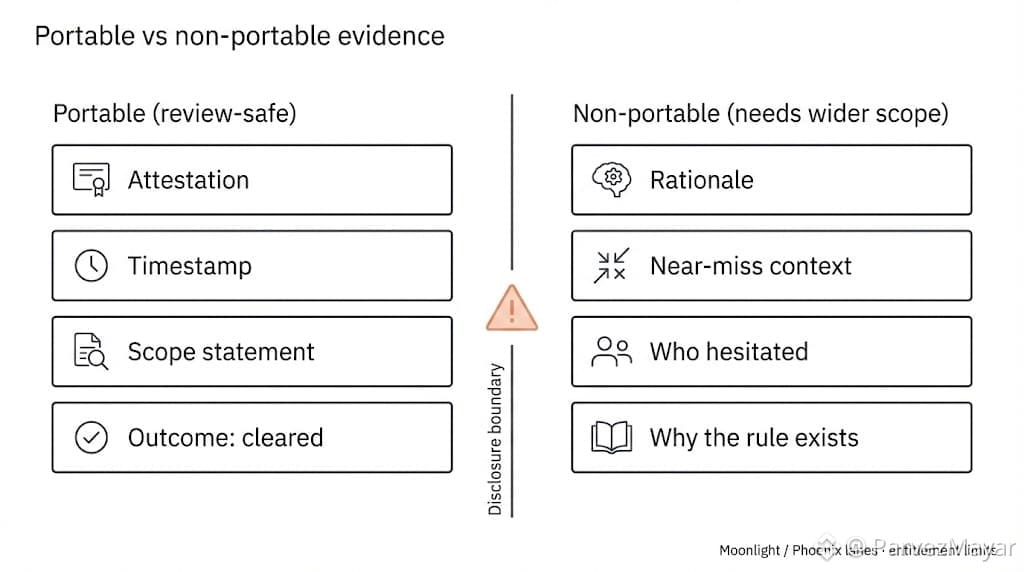
Moonlight the Dusk settlement model kept execution clean. Credential scopes held. Committees did exactly what they were meant to do. Finality landed... and the only thing that made it into the ticket was what could survive review, a Dusk:s committee attestation link, a timestamp, and “cleared within scope.”
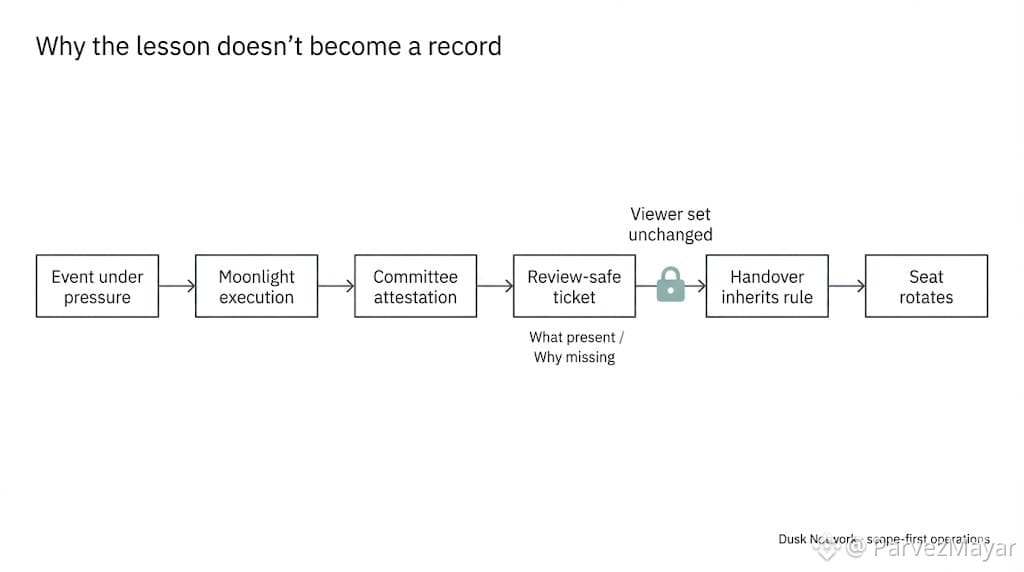
5:47pm. Close-out template open. “Rationale / release classification” still empty. Viewer set unchanged.
That’s it.
Someone new joins and notices the pause in the flow, right where nothing looks wrong. They ask why. The answer comes back practical and incomplete. "We don't do that this late". "That needs to be decided earlier'. "We donot say that out loud''.
Earlier than what?
The rest is a shrug you can hear in text. Because the rest lives with someone else. Or lived with someone who rotated out. Or lived in a conversation that was never safe to summarize without widening who could see what. Not secret. Just not portable.
So the rule stays, and the story doesn’t.
Handover doc... clean. 'What': present. 'Why': missing. The new operator learns the edge by watching what seniors refuse to paste from the Dusk's Moonlight slice. And by watching the disclosure owner type the same sentence again, like it's a normal line item..."not adding anyone else to the viewer set."
Nobody argues. Nobody wants to be the person who adds a name.
Three handovers later, the same edge shows up again. Different team. Same adjustment. Someone types, "We’ve seen this before", then stops. Because there is nowhere to point. No appendix. No incident report. No canonical lesson. Just that thin ticket trail... link, timestamp, "within scope"...and a close-out template where “rationale” stays blank on purpose.
Privacy did its job. Dusk foundation Confidential execution held. The system stayed defensible without turning itself into a public exhibit.
What disappears isn’t correctness. It’s the one thing you can reuse next time: what almost went wrong, stated without expanding the entitlement boundary.
You see it in habits, not logs. On public systems, people over-record and regret it later. Here, nobody wants to widen entitlements just to make a lesson legible. So the lesson stays inside the role that saw it, and handoff becomes the only transport it gets.
Then the seat rotates.
Someone tries to formalize the rule. Not a big meeting. A quiet suggestion in a doc. “Should we write this down?” The thread dies fast. To explain it properly, you’d have to name details that were intentionally never made portable.
So nothing gets cleaned. The rule stays unofficial, and it stays powerful.
New operators adapt faster than you’d expect. They don’t need the story to function. They just need to know where not to step. And the org keeps working while repeating the same near-lessons: link, timestamp, "cleared within scope", move on.
Dusk preserves state across time.
The reasons don’t always survive the handover. And the only sign you get is that familiar pause...right before someone decides it’s safer not to ask.