

@Vanarchain 's AI-First Architecture: Why Retrofitting AI Onto Blockchains Fails
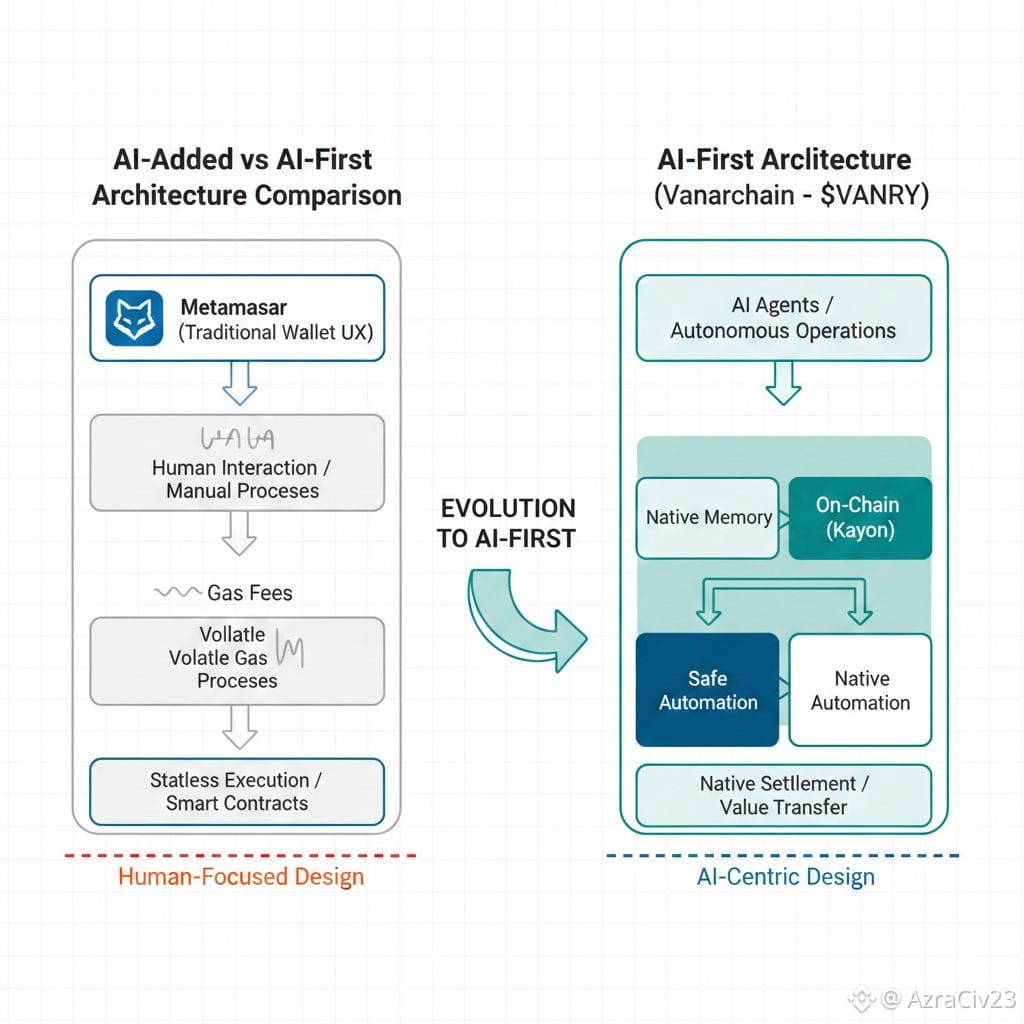
#vanar is built as AI-first ,not AI added.
Vanar built an AI operating system while most blockchains are adding AI features. That's not marketing language—it's a fundamental architectural difference that determines whether AI agents can actually function at scale.
The distinction matters because we're past the point where "AI integration" means anything. Every chain claims AI readiness. Few understand what AI systems actually require to operate autonomously in economic environments. Vanar does. And the proof isn't in promises—it's in live products solving real problems.
The Retrofitting Problem: Why AI-Added Infrastructure Breaks
When most chains approach AI today, they follow a predictable pattern: build a blockchain optimized for human users, then add AI as a feature layer on top. This creates immediate, unfixable problems.
AI agents don't use Metamask. They can't click pop-ups, manage seed phrases, or approve transactions manually. Traditional wallet UX assumes human interaction at every step. AI needs programmatic, autonomous access.
AI agents can't forecast volatile gas fees. A trading agent that can't calculate profit/loss because transaction costs fluctuate unpredictably cannot operate professionally. Volatility in execution costs breaks agent economics entirely.
AI agents need memory to learn and improve. Stateless execution—where each transaction forgets everything that came before—means agents cannot build knowledge over time. They react but never adapt.
AI agents require deterministic reasoning. If an agent makes a decision but cannot explain why, institutions cannot deploy it. Compliance, auditing, and trust all require explainability.
Most blockchains ignore these requirements because they weren't designed with AI as the primary user. They were designed for humans trading tokens, executing DeFi strategies, and managing NFTs. Adding "AI support" on top doesn't change the foundational architecture.
Vanar started from the opposite direction: design the infrastructure AI needs first, then make it accessible to humans second.
The Four AI Primitives (Memory, Reasoning, Automation, Settlement)
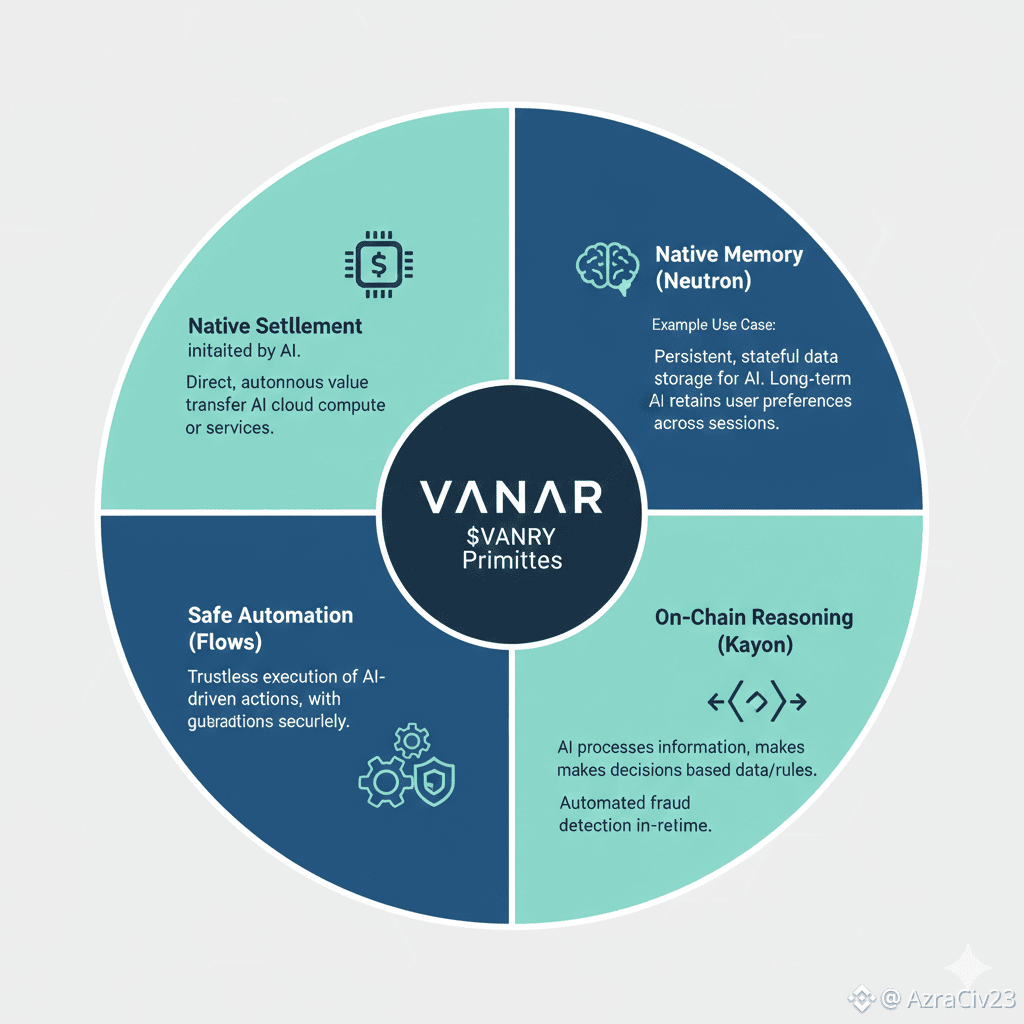
What AI-First Actually Means
AI-first infrastructure isn't about speed or TPS. Those metrics matter, but they're insufficient. AI-first means asking: "If autonomous agents were the primary users of this blockchain, what would the base layer need to provide?"
The answer breaks into four core primitives:
Native Memory (Neutron) – AI agents must remember past actions, outcomes, and context. Vanar's Neutron module provides this at the infrastructure level. Information is organized into Seeds—data structures stored off-chain for speed but anchored on-chain for verification. This gives AI agents trusted, persistent memory without requiring external databases or centralized services.
On-Chain Reasoning (Kayon) – Agents need to reason over data, make decisions, and explain why those decisions were made. Vanar's Kayon layer enables on-chain reasoning with explainability.
Safe Automation (Flows) – AI agents need to execute multi-step workflows autonomously. Flows provides secure, automated execution with built-in safety constraints.
Native Settlement and Payments – AI agents operate in economic environments and need to pay for resources, settle transactions, and interact with compliance frameworks—all programmatically.
When all four primitives exist at the base layer, AI agents can operate autonomously, transparently, and economically. Most chains provide zero or one of these. Vanar provides all four.
Product Proof Matrix (Neutron, Kayon, Flows capabilities)
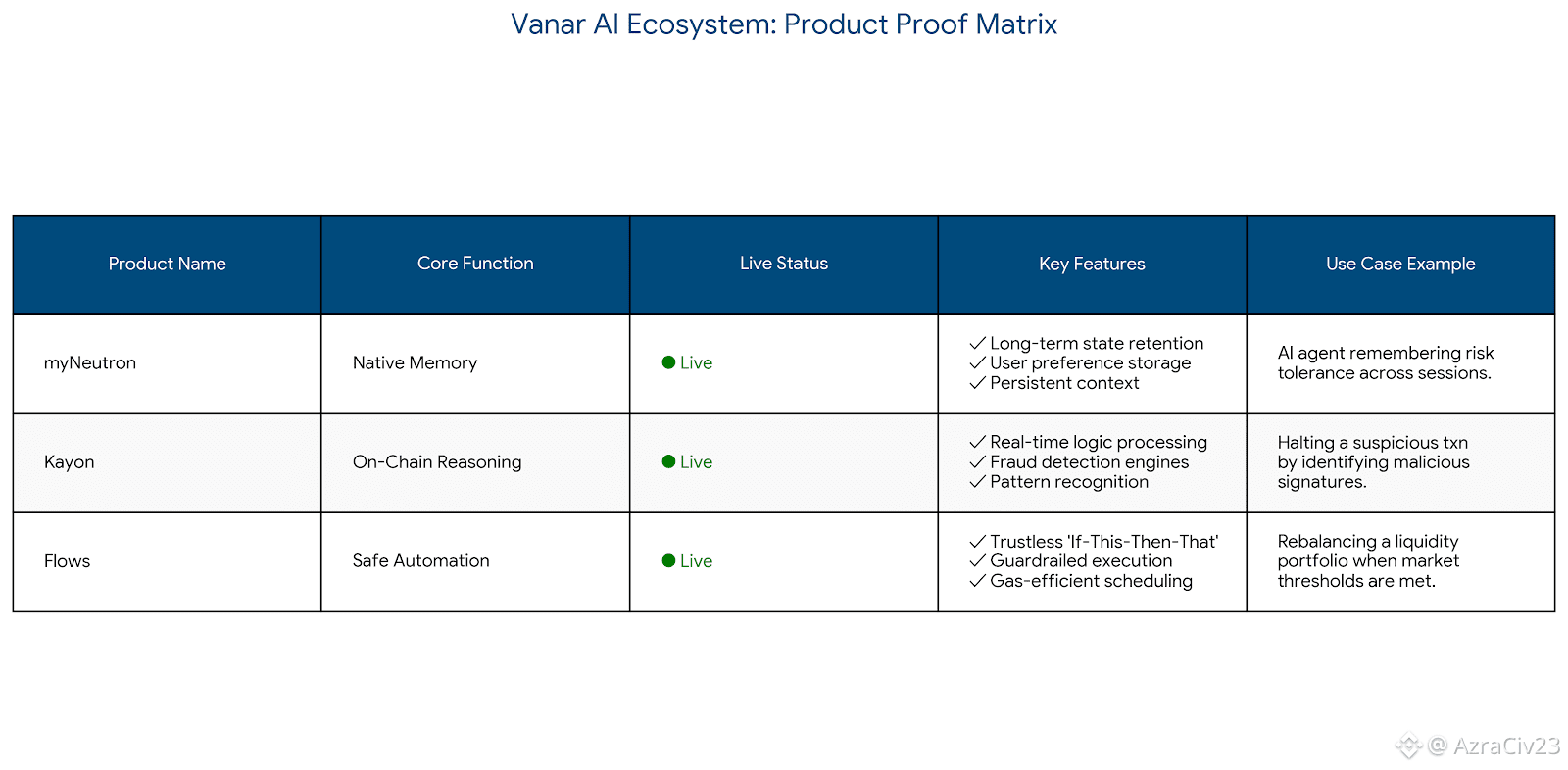
The Live Products That Prove AI-First Design
Infrastructure claims mean nothing without real products demonstrating the design philosophy in action. Vanar has three:
myNeutron: Proof of Native Memory – Allows agents to store, retrieve, and build on persistent memory.
Kayon: Proof of On-Chain Reasoning – Demonstrates AI reasoning with full explainability.
Flows: Proof of Safe Automation – Executes complex workflows autonomously with safety guarantees.
These aren't vaporware. They're live, functional products proving that Vanar's AI-first architecture works in practice.
Cross-Chain Expansion Impact (Vanar + Base reach)
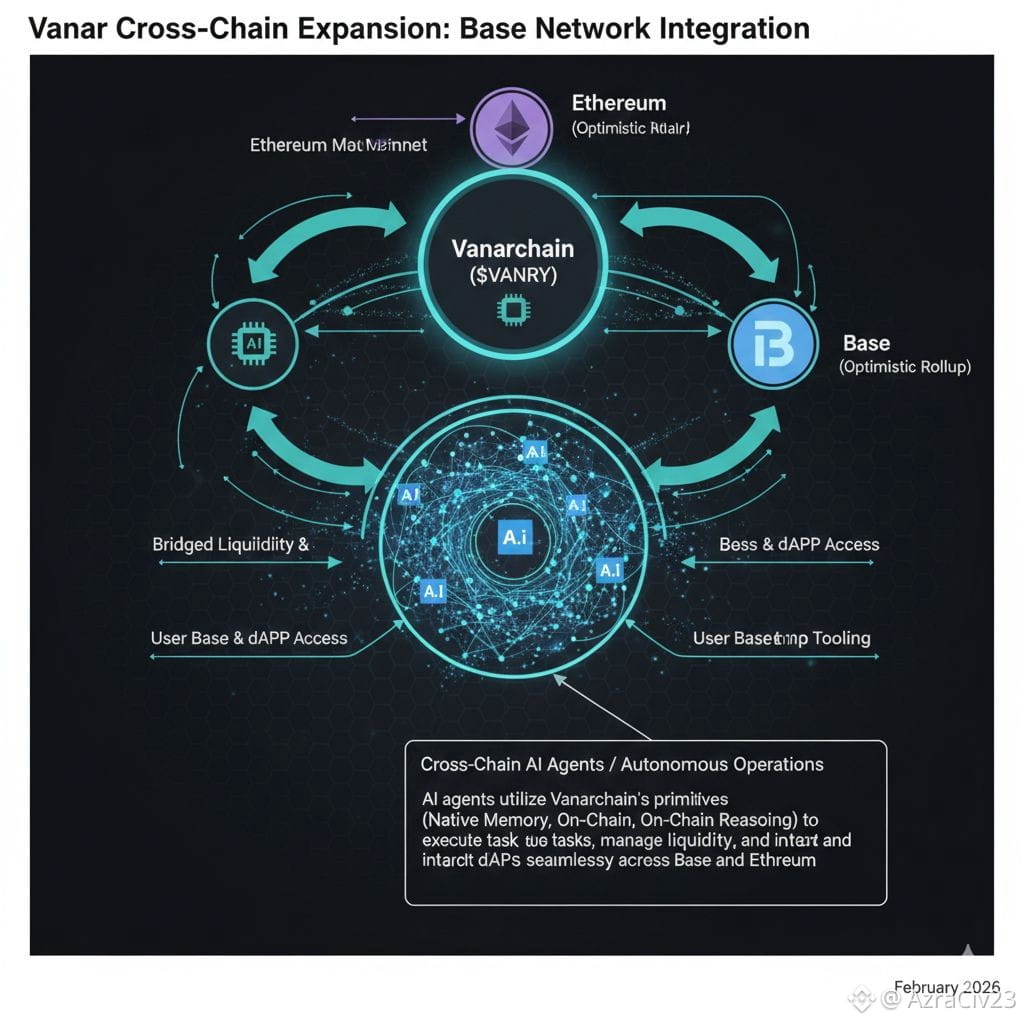
Cross-Chain Availability on Base: Scale Without Isolation
Single-chain AI infrastructure is self-limiting. Users, liquidity, and developers already exist across ecosystems. Isolating AI agents to one network cuts them off from the environments they need to operate in.
Vanar's cross-chain availability on Base changes this.
Why Base matters:
Established DeFi protocols with deep liquidity
Large user bases already onboarded to blockchain
Developer tooling and infrastructure maturity
Cross-chain interoperability with Ethereum mainnet
What this unlocks for AI: Agents operate where users and capital already exist, not in a siloed ecosystem.
Impact on VANRY: Cross-chain availability expands VANRY's utility beyond one network. Every AI agent operation, memory write, reasoning execution, and automated workflow—across Base, Vanar, and future integrations—flows through the token.
Market Differentiation Heatmap (Vanar vs competitors)
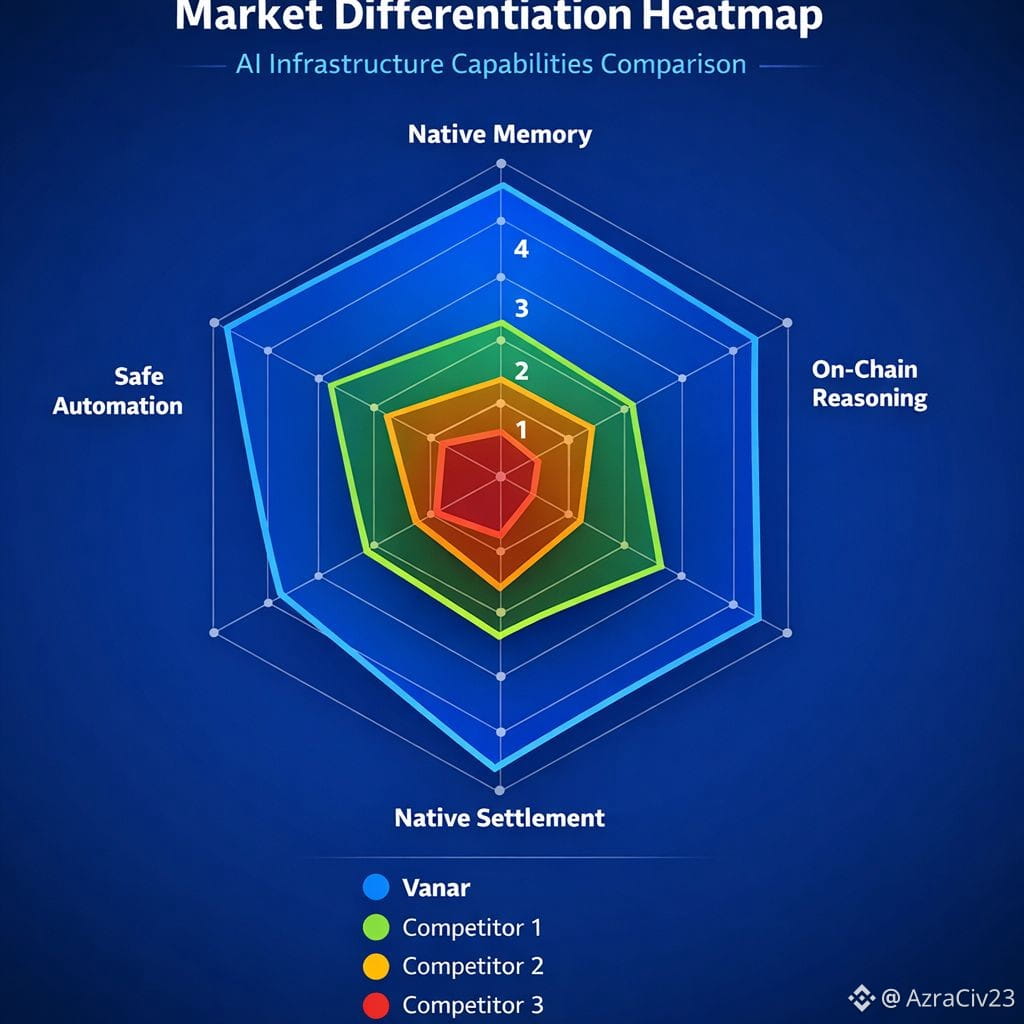
What Separates AI-First From AI-Added
The difference between Vanar and most chains isn't speed, cost, or marketing. It's whether the infrastructure was designed for AI from day one—or retrofitted onto systems built for something else.
AI-added chains: Build for humans, add AI features later, provide zero or one AI primitive, lack live products, rely on narrative.
AI-first chains (Vanar): Design for agents first, provide all four AI primitives, ship live products, demonstrate operational readiness.
The market will separate these approaches clearly. Agents need infrastructure that works—not infrastructure that promises it will work.
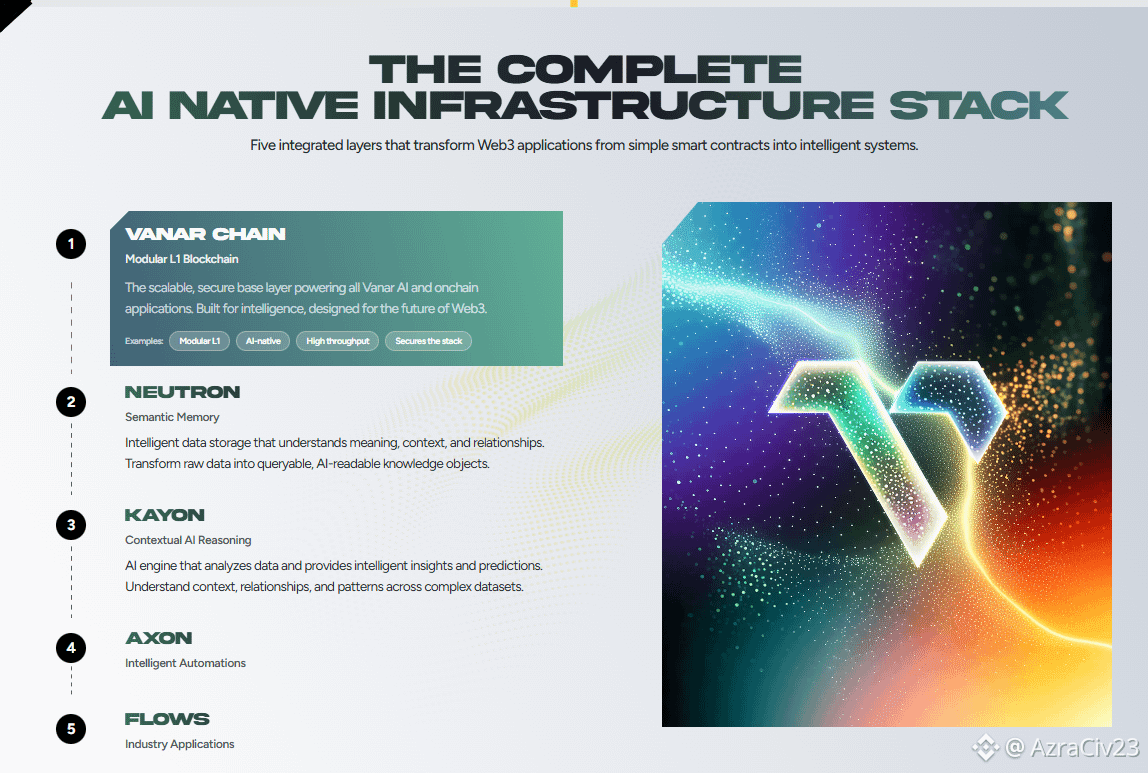
Vanar ships products. Neutron, Kayon, and Flows are live. Cross-chain availability is expanding. Real agents are operating on real infrastructure. That's the difference between AI-first and AI-added—and why $VANRY is positioned for AI infrastructure demand, not narrative hype.
