


The rotation notice comes in while stablecoin payments are already moving on Plasma.
Nothing urgent in the message. A validator set change queued. Operators rotating. Capacity expected unchanged. On paper, it's routine. PlasmaBFT is built for this. Quorum doesn't blink just because a few operators step out and others step in.
That's the theory.
A corridor is already hot when the notice lands. USDT keeps clearing anyway, because nobody on the merchant side knows... or cares what set is mid-change inside Plasma Network.
From the infra side, what is crucial is not whether the chain keeps producing blocks. It does. What matters is how much margin disappears while it happens. Validator turnover on a layer-1 payment chain like Plasma doesn't feel like downtime risk. It feels like running with fewer excuses.
Transactions keep landing. Gasless USDT flows on Plasma Network don't slow to ask whether the voting set is mid-shuffle. Retail terminals don't care who signed the last block. They just submit again. And Plasma keeps accepting them, because uptime is the expectation here.
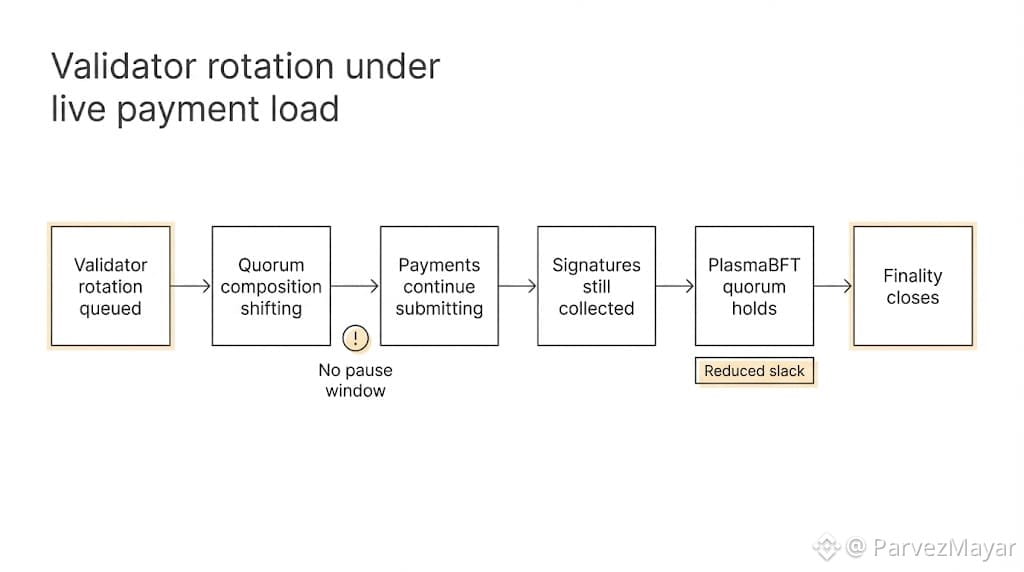
You watch the dashboards more closely than usual. Not because you expect a failure, but because there's less slack to hide behind. PlasmaBFT voting continues, but you're aware of who just rotated out and who hasn't fully settled in yet.
Callbacks keep arriving. Receipts keep printing. The 'paid' events do not pause.
Validator churn on a payments rail doesn't announce itself. No maintenance banner. No grace period where merchants politely pause. Stablecoin settlement keeps pushing through the same corridors it always does. If something slips, it slips under load.
Nothing looks different at the counter. In the ops view, every confirmation feels slightly heavier. You're counting signatures without counting them. You're watching quorum continuity because you have to, not because it's interesting.
You call it routine. It isn't. Not when money is mid-flight.
Quorum either holds or it doesn't... and in Plasma network, the PlasmaBFT doesn't wait for anyone to feel ready. When it holds, finality lands. When it doesn't, you feel it fast... and everyone else does too. There isn't much of a soft failure mode where payments degrade gently.
That's the real pressure surface validator rotation creates. Not fragility, but exposure.
A new validator comes online. Old ones step back. The set shifts. PlasmaBFT keeps closing states with the same determinism as before. Merchants keep getting receipts.
You watch for tickets. You watch for reconciliation noise. Most days, it stays quiet.
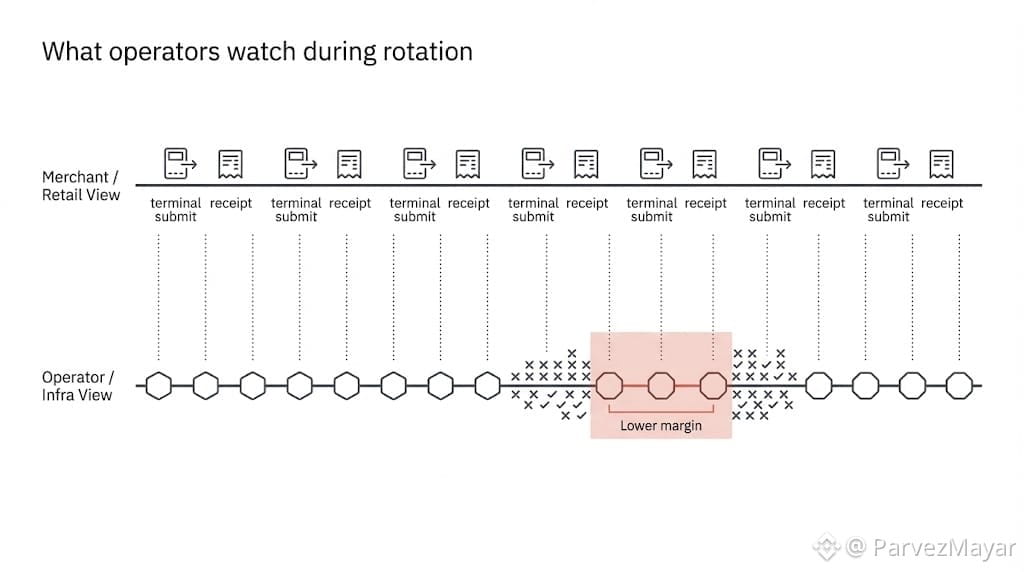
Internally, though, you don't take your eyes off it. Because validator turnover isn't about whether the system works. It's about whether it keeps working while nobody can intervene in the moment, on Plasma, while settlement is already closing.
Other systems buy time with softness. On Plasma, you don't get that. Uptime is expected to be continuous, not eventually consistent. Coordination failures can show up as delayed confirmations, missed beats, a merchant asking why a payment didn't finalize when it always does.
Nothing breaks during the rotation. That's the point. But nothing feels relaxed either. Everyone knows that the moment PlasmaBFT misses quorum, the story changes from "routine ops" to "visible failure," and there's no buffer to talk your way out of it.
When the rotation completes, there's no celebration. No status update worth sending. On Plasma, Payments never stopped. Finality never visibly slowed.
You just notice the dashboards feel quieter again.
And you keep watching anyway.