
I recently experienced something that felt trivial at first. I tried to send a small amount of stablecoins to someone and encountered an error. It wasn't a lack of funds or a network malfunction; it was that I didn't have the right gas token. In fact, I did have the USD on my blockchain, but I couldn't transfer it. This pause—checking the balance, changing the token, and trying again—lasted only a few minutes, but the unsettling feeling lingered.
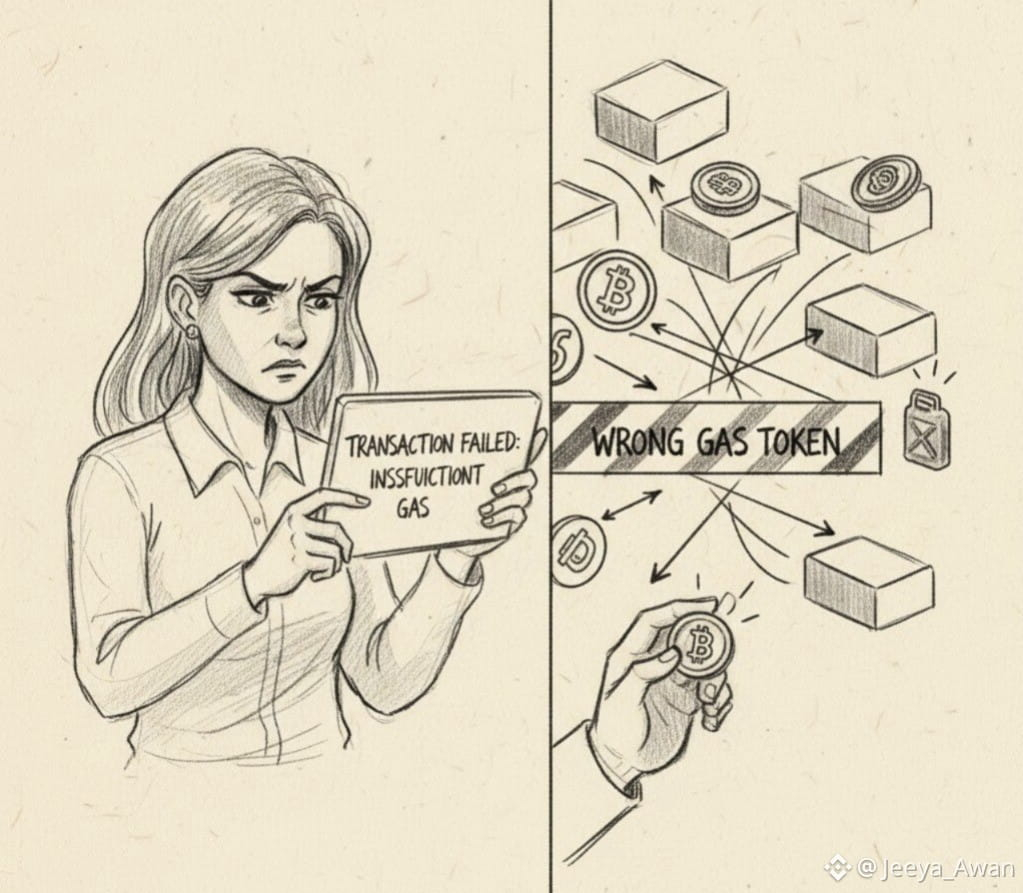
This situation reminded me of many of the difficulties we take for granted.
Then i looked at the XPL chart, The chart showed a classic "Break and Reject" scenario.
I noticed that the price successfully pushed above the previous resistance level (near $0.1040) with a massive green candle.
Then i noted the rejection point. Almost immediately, the price hit a wall at $0.1073. The long "wick" on that candle indicates that sellers jumped in quickly to lock in profits, pushing the price back down. At that time, the price was hovering at the breakout line ($0.1048).
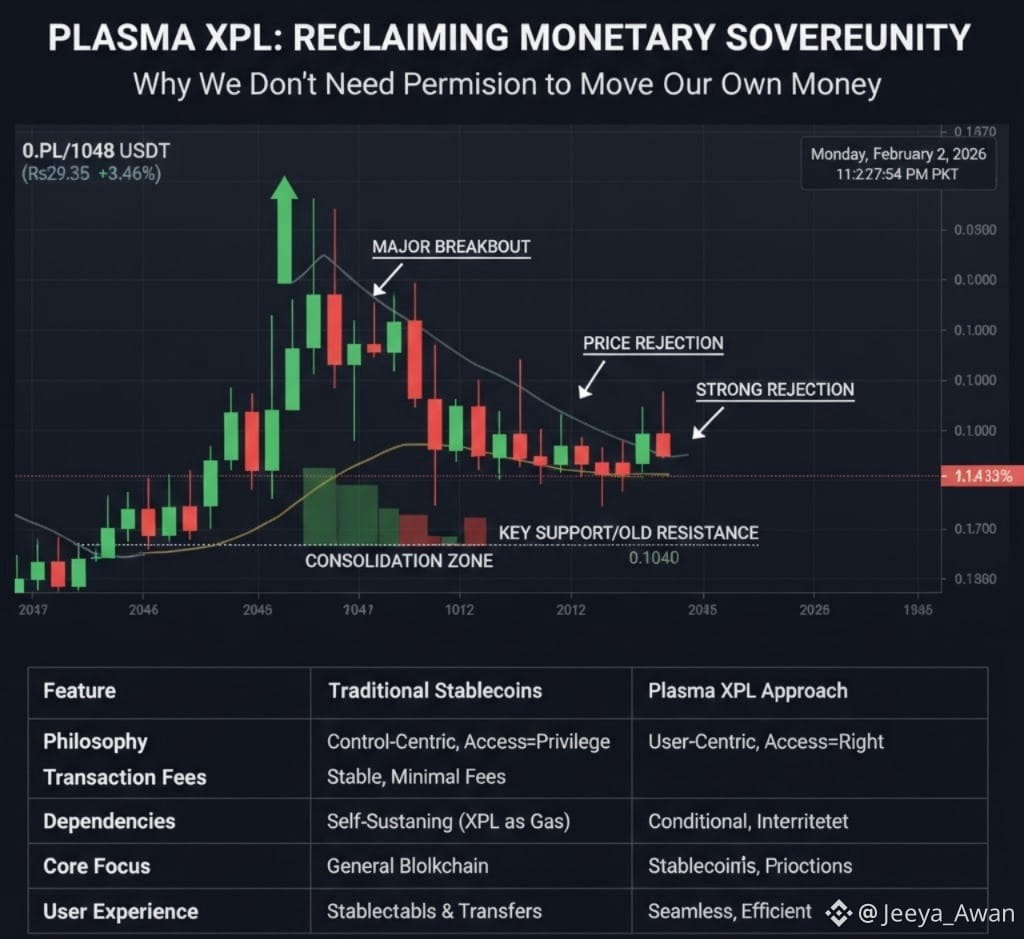
I took a deep breath as my central argument was Why Do We Still Need Permission to Move Our Own Money?
It is because the financial system still prioritizes control over users, it views access as a privilege rather than a right.
Stablecoins are among the most successful crypto products. Trillions of dollars are transacted on the blockchain annually. Yet, their use still feels somewhat unreliable. Transaction fees fluctuate suddenly and without warning. Final confirmation of transactions also seems to be conditional. And often, transfers require holding assets we don't actually want—just to keep the system running.
#Plasma takes a different approach. Instead of exploring how to build a blockchain that meets all needs, it considers what the infrastructure would look like if stablecoins were the primary reason for the existence of the network. This simple assumption reshaped the entire design.
On the Plasma platform, USDT is the top-level infrastructure. The free basic transfers aren't about generosity, but consistency. Paying stablecoin transaction fees isn't just about improving user experience, but about compliance. Payments must be seamless—predictable, silent, and repeatable. If users can't send funds they already have, it's not a learning curve, it's a systemic flaw.
Plasma fundamentally changes the concept of yield. Through institutional lending platforms like Maple, Plasma explores a model where yield is the default behavior of stablecoins. No staking dashboards, no mining rites. In short, dollars are earned automatically. Funds are no longer static ledger entries, but begin to function as capital again.
This goes far beyond a single transaction. For fintech companies and digital banks, traditional yield payments require dedicated teams handling funds management, bonds, repurchase agreements, and counterparties. Plasma simplifies this complexity into a single, integrated infrastructure. Payments and yields are merged, transforming the network from a mere settlement layer into a comprehensive payment and yield engine.
The market still tends to view XPL as a general-purpose base layer, comparing it to Total Value Locked (TVL) and volatility in trading activity. But this ignores the real comparison. If Plasma succeeds, the benchmark will not be other chains, but its underlying capital market infrastructure, where trust, redundancy, and capital stability are more important than any amount of hype.
Plasma doesn't rely on media hype; it scales down and reduces its commitment to consistent performance. This restraint curbs excessive media attention but enhances system stability.
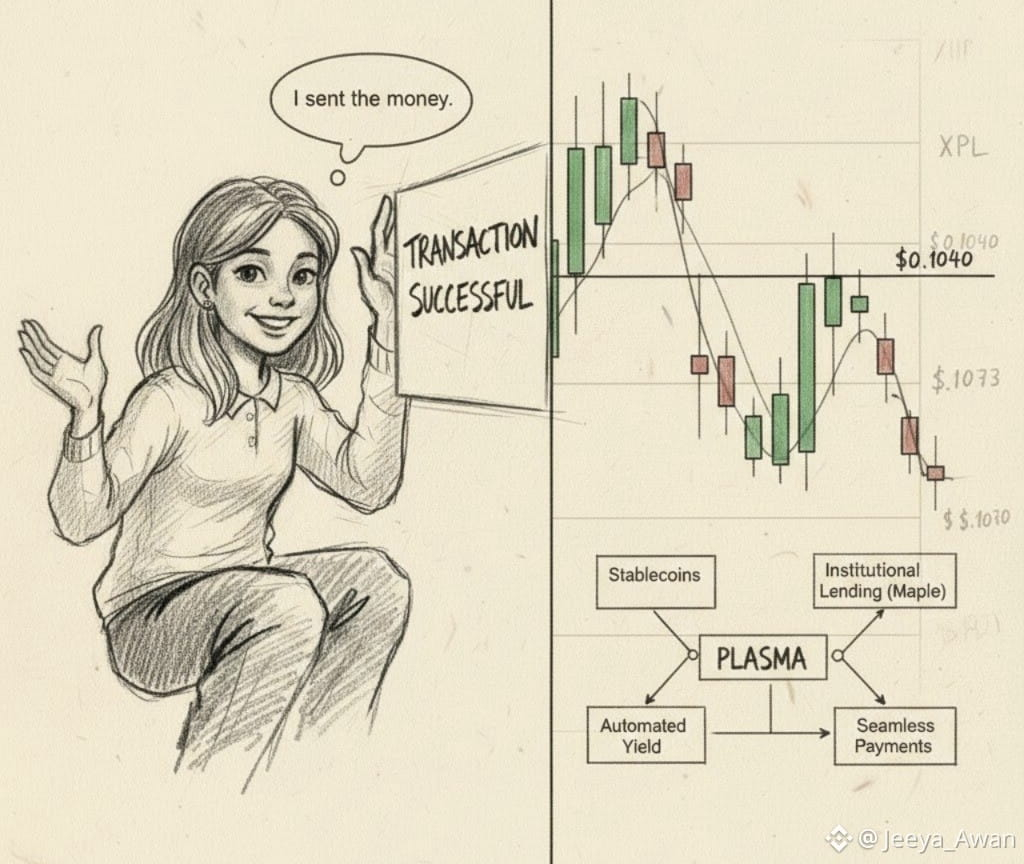
If Plasma succeeds, the clearest evidence won't be headlines, but silence. When people stop saying "I used plasma" and simply say "I sent the money."

