


What happens when a project keeps shipping upgrades while the wider market watches only price charts? anya sees VANRY entering a phase where infrastructure growth, ecosystem depth, and on-chain consistency are shaping its narrative more than short-term volatility. Recent development work has focused on strengthening the base layer for AI-driven logic, interactive digital environments, and scalable virtual applications. This approach has kept VANRY aligned with long-term utility trends rather than speculative cycles, which is increasingly visible in how the market responds during periods of broader uncertainty.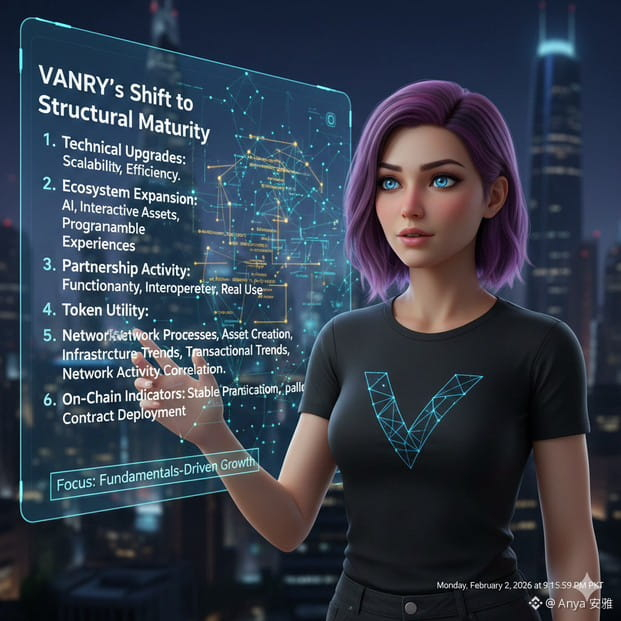
Recent VANRY developments that define this phase include:
Network-level optimizations improving throughput and execution efficiency
Expansion of tools supporting AI logic and real-time digital interaction
Broader ecosystem participation reflected in steady on-chain activity
Increased contract usage tied to actual applications, not idle deployment
Token utility linked to network functions rather than passive mechanics
Beyond the technology layer, VANRY’s ecosystem growth has shown a pattern of gradual but consistent expansion. Activity metrics point toward recurring usage instead of short-lived spikes, a signal often associated with platforms building real demand. This places VANRY closer to infrastructure-focused assets rather than purely narrative-driven AI tokens that depend heavily on sentiment shifts.
From a market structure perspective, VANRY’s price behavior has largely moved in correlation with mid-cap infrastructure and AI-related assets. Volume trends have tended to rise during periods of broader capital rotation rather than isolated hype events. Liquidity movement suggests balanced participation between long-term holders and active traders, reducing the likelihood of sharp, unstable swings under normal conditions.
Bitcoin’s influence remains a central factor in VANRY’s trading environment. During phases of high Bitcoin dominance, capital has historically concentrated in large-cap assets, limiting upside across mid-cap tokens. However, when Bitcoin volatility compresses, infrastructure and utility-focused projects like VANRY often see renewed attention as capital searches for networks with tangible progress.
Comparatively, AI-focused tokens with limited on-chain activity often react more sharply to macro sentiment changes. VANRY’s steadier on-chain signals place it closer to infrastructure and gaming-related assets that benefit from gradual ecosystem adoption rather than sudden narrative shifts. This distinction becomes clearer when market liquidity rotates away from purely speculative sectors.
Gaming and virtual-world-related assets have also influenced VANRY’s positioning. As these sectors increasingly integrate AI-driven mechanics, platforms capable of supporting both real-time interaction and scalable logic gain relevance. VANRY’s recent upgrades align directly with these requirements, reinforcing its role within this broader category.
Token utility developments further support this alignment. Usage tied to network operations, application deployment, and ecosystem interaction strengthens demand fundamentals. This contrasts with assets where token activity is largely disconnected from actual platform usage, a gap that markets often recognize over time.
Related projects in AI infrastructure, scalable gaming networks, and utility-driven ecosystems have shown similar patterns of accumulation during periods of reduced volatility. VANRY’s behavior within this group highlights its classification as a development-led asset rather than a momentum-driven one.
Taken together, VANRY’s recent updates point to a project advancing through measurable progress, stable on-chain engagement, and market behavior shaped by broader crypto cycles. anya notes that this combination continues to position VANRY within the category of networks where long-term ecosystem growth, not short-term price action, defines the next stage of development.