
Dusk, in a more human voice
I get why you want this humanized. A lot of crypto writing sounds like a robot reading a brochure. So let me explain Dusk the way I’d explain it to a friend over chai, slowly, with the “why” included, not just the “what.”
What Dusk is really trying to fix
Think about money in real life. When you pay someone, you don’t shout the amount to the whole street. When a company trades a position, it doesn’t publish its strategy to competitors. Privacy is normal in finance. But on most blockchains, privacy is not normal. Everything is open by default, and anyone can watch. That’s great for transparency, but it can also be brutal, because it exposes people and businesses in ways that traditional finance never would.
Now flip it. If everything becomes private, regulators and auditors can’t verify anything. Then you’re back to “trust me,” which is exactly what blockchain was supposed to reduce.
Dusk exists in the tension between those two worlds. It was founded in 2018 with a clear goal: build a Layer 1 that can support regulated financial activity while still protecting privacy. Not fake privacy. Not marketing privacy. Real privacy that doesn’t break the rules of the world institutions actually live in. (dusk.network)
And that’s why Dusk isn’t trying to be everything for everyone. It’s trying to be the chain that finance can actually use without feeling naked, and without regulators feeling blind.
The big idea, without the scary words
Dusk’s big idea is selective disclosure.
In human terms: you keep your financial activity private by default, but when you must prove something, you can prove it without exposing your entire life.
That’s the core “compliance becomes composable cryptography” idea you wrote. It’s a fancy way of saying: compliance shouldn’t force full transparency. It should be possible to show the exact proof that’s required, and nothing more.
This sounds like a small shift. It isn’t. It changes what it means to build markets on-chain.
How Dusk is built, step by step
Let’s walk through the system like we’re building it together.
First, Dusk separates the foundation from the applications.
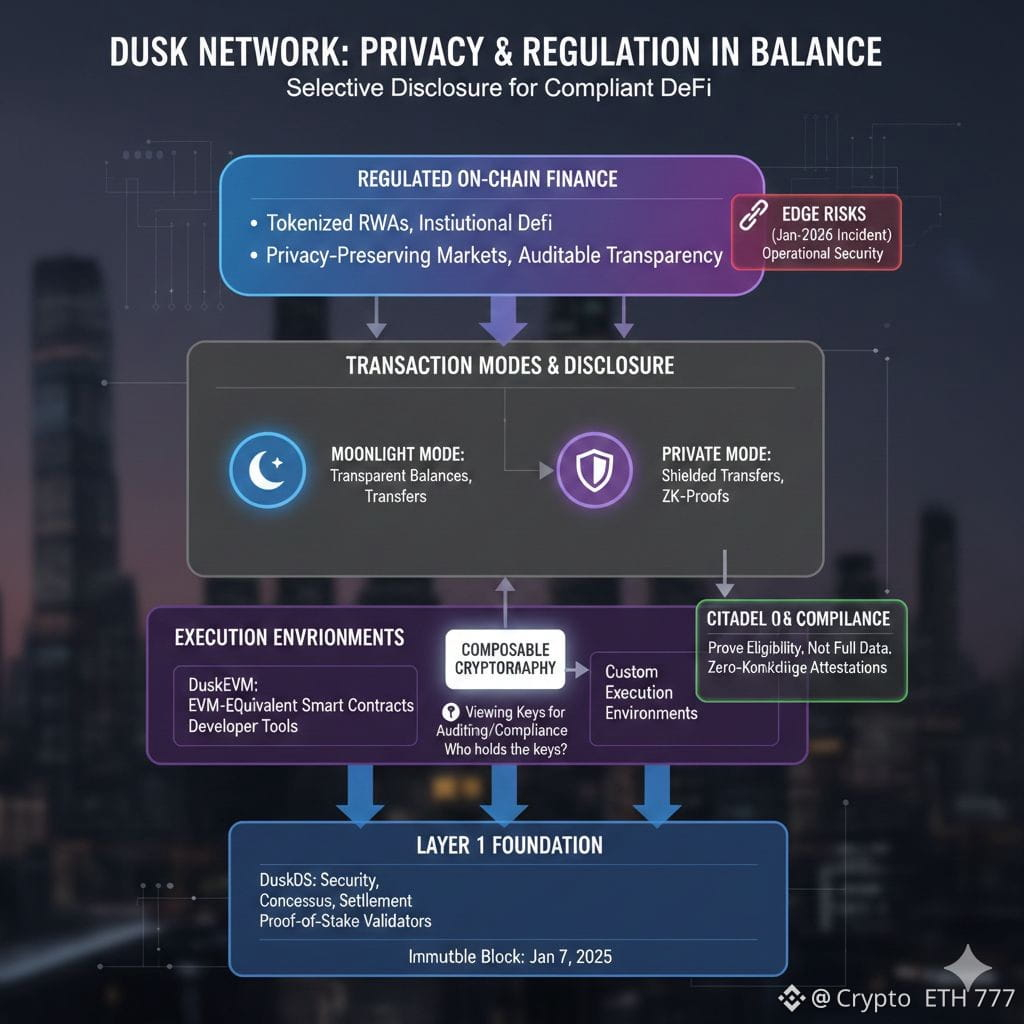
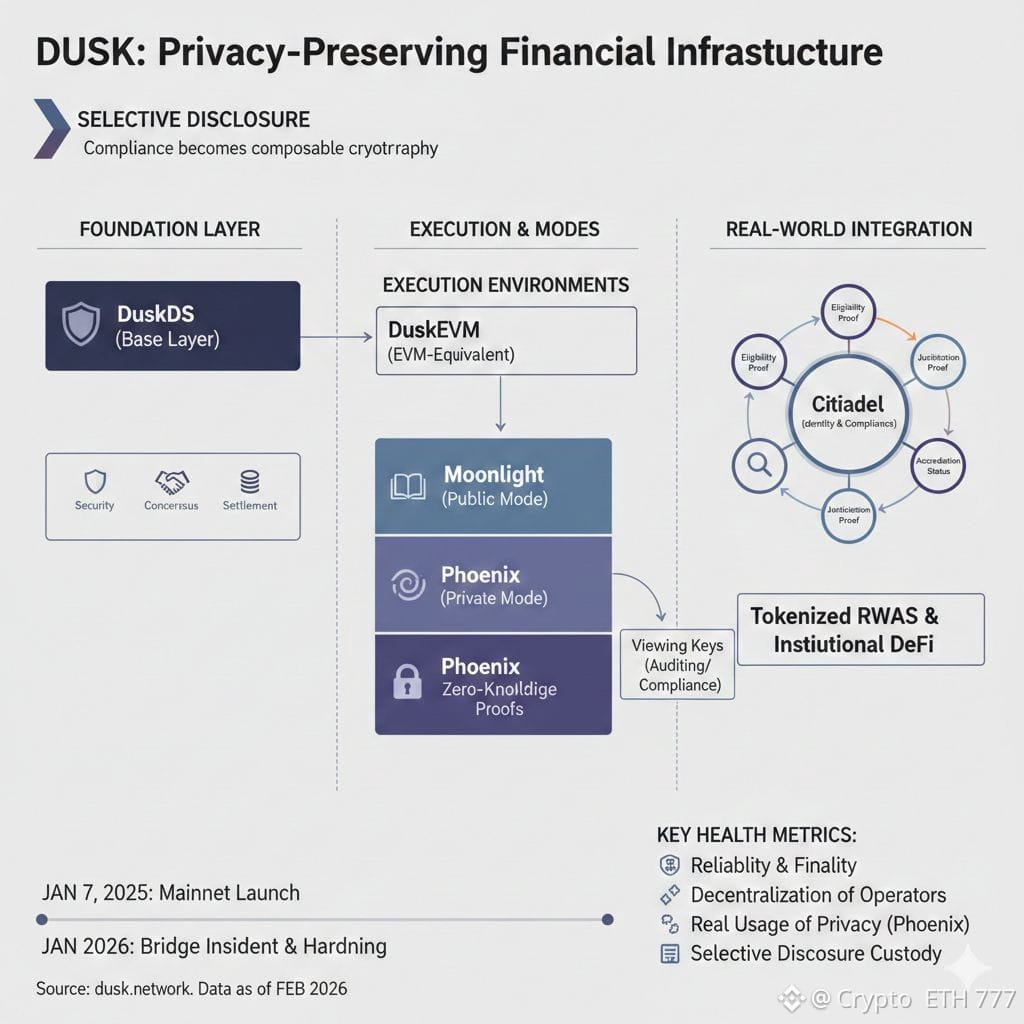
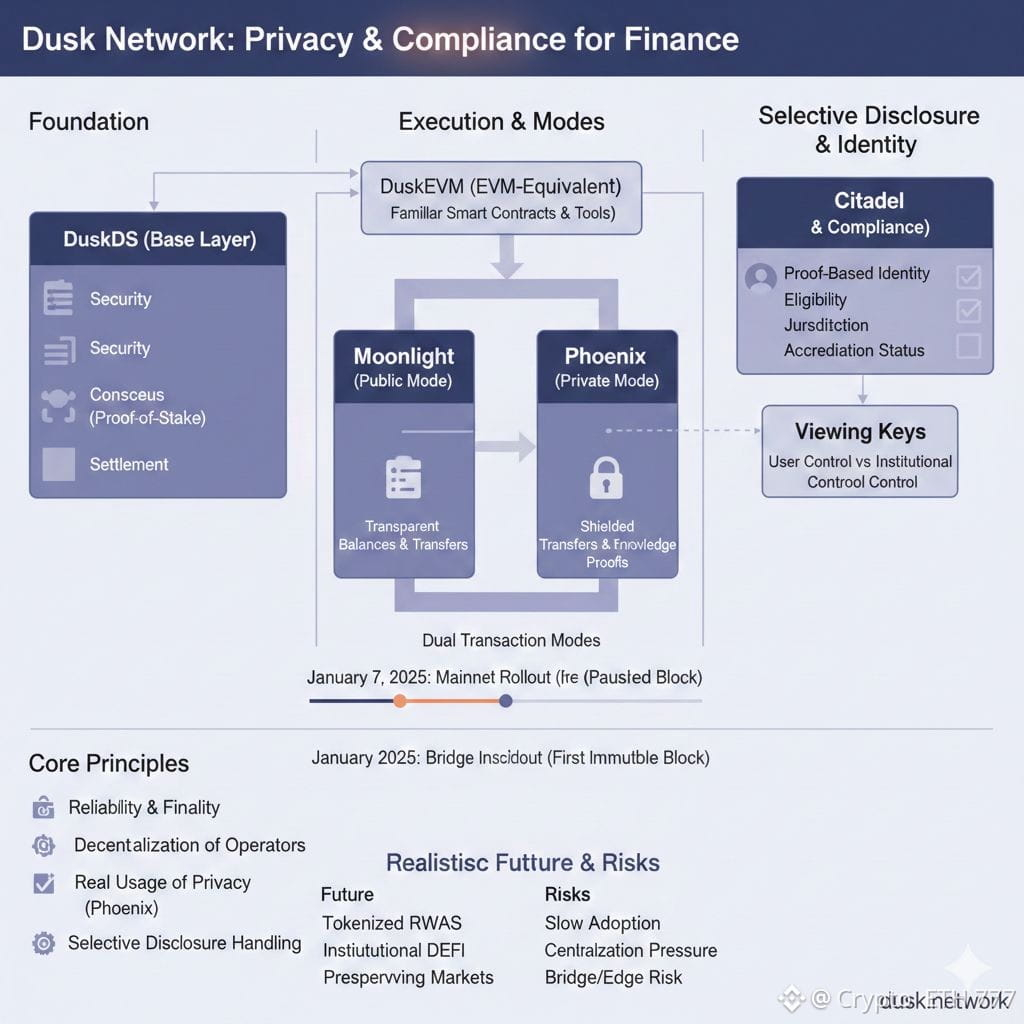
The base layer is called DuskDS, and it’s responsible for security, consensus, and settlement. In plain words: it’s the layer that makes sure the chain agrees on what happened, and that what happened can’t be easily rewritten. (docs.dusk.network)
Then above that, Dusk supports execution environments.
One of the big ones is DuskEVM, which is described as EVM-equivalent. That matters because it means developers can use familiar Ethereum-style tools and smart contracts, while Dusk provides the settlement foundation underneath. If It becomes easy for builders to move over, the ecosystem can grow without forcing everyone to learn a completely new language first. (docs.dusk.network)
Second, Dusk gives you two “modes” for transactions.
This is one of the most human design choices in the whole project, because it accepts reality: not everything should be private, and not everything should be public.
Moonlight is the public mode.
It works like the normal account-style system: transparent balances and transfers.
Phoenix is the private mode.
It uses shielded transfers and zero-knowledge proofs so a transaction can be valid without revealing the sensitive details to everyone. (docs.dusk.network)
This dual design is important because regulated finance is not one color. Some flows need transparency. Some need confidentiality. Some need confidentiality today and proof tomorrow.
Third, selective disclosure is where the “real world” enters.
Phoenix supports the idea of viewing keys, which allow selective disclosure when needed for auditing or compliance. (docs.dusk.network)
And here’s where your best insight lands: the moment you introduce disclosure, you introduce a question of custody and power.
Who holds the keys.
Who decides when disclosure is required.
Whether users control it, or institutions control it, or a service provider quietly controls it.
This is not a small detail. It’s the part that decides whether Dusk becomes a privacy-friendly finance network… or whether it becomes traditional finance wearing a cryptography mask.
Identity without oversharing: Citadel
Now let’s talk about compliance without turning people into files.
Dusk talks about Citadel as a way to handle identity and compliance checks through proofs rather than full data exposure. Instead of handing over everything, you prove what matters: eligibility, jurisdiction, accreditation status, or whatever requirement exists. (dusk.network)
This is one of those ideas that feels almost obvious once you hear it. Like, why should every app know your whole identity if it only needs to know you meet one rule.
We’re seeing this shift across the industry: prove a claim, not the entire person. And if Dusk makes that easy to use, it makes regulated on-chain finance feel less invasive and more respectful.
Mainnet reality: when it stopped being theory
One of the fairest ways to judge a project is to look at when it became real.
Dusk announced its mainnet rollout and said the first immutable block was produced on January 7, 2025. That’s when the story moved from “we’re building” to “we’re operating.” (dusk.network)
And then there’s the tough part: incidents.
In January 2026, Dusk published a bridge incident notice describing unusual activity involving a team-managed wallet used in bridge operations, and they paused bridge services as a precaution. (dusk.network)
I’m not bringing that up to be negative. I’m bringing it up because this is where maturity shows. In crypto, the base chain can be solid, but bridges and external rails are where pain often happens. What matters is how quickly issues are identified, how transparently they’re communicated, and how the system is hardened afterward.
What matters for judging Dusk’s health
If you want to judge Dusk like a serious infrastructure project, focus on the signals that actually reflect infrastructure.
First, reliability and finality.
Does it consistently produce blocks and settle transactions in a predictable way. That is the heartbeat of a settlement layer.
Second, decentralization of operators.
A proof-of-stake network is only as strong as the diversity and health of its validator or provisioner set. (docs.dusk.network)
Third, real usage of privacy.
Is Phoenix actually used in real applications, or does everything stay public because privacy tools are too hard or too costly. Adoption here is a product challenge as much as it is a research challenge.
Fourth, and most important: how selective disclosure is handled in practice.
This is the world you described: where trust quietly re-enters through disclosure-key custody, permissioning, and upgrade authority. Those aren’t “side topics.” They are the main topics for a chain that claims to be the bridge between privacy and regulation.
Risks and weaknesses, said honestly
Dusk has real risks. It’s better to name them clearly than to pretend they don’t exist.
One risk is slow adoption. Regulated markets move carefully. Even strong tech can take time to get traction.
Another risk is complexity. Privacy systems and compliance systems are hard. The more moving parts, the more places things can go wrong.
Another risk is centralization pressure. Institutions often prefer clear control points. If those control points become too powerful, the chain can drift toward the old world, just with prettier tools.
And edge risk is real. Bridges and service infrastructure can become the weakest link, even when the base chain is healthy. The 2026 notice is a reminder that operational security matters just as much as protocol design. (dusk.network)
A realistic future that doesn’t rely on hype
The realistic future for Dusk isn’t that it becomes the only chain. The realistic future is that it becomes a trusted place where regulated assets and compliant DeFi can exist without exposing everything to the public internet.
That means tokenized RWAs, institutional-grade applications, and privacy-preserving markets where audits can happen without surveillance becoming the default.
If It becomes normal for users to control their privacy while still being able to prove compliance when required, that’s a real shift. That’s a new kind of financial dignity.
Closing: why this matters beyond price
I’ll end it like this. The best technology doesn’t just make things faster. It makes life feel safer.
Dusk is trying to build a world where financial participation doesn’t require public exposure, and accountability doesn’t require constant surveillance. They’re aiming for a balance that most systems don’t even attempt. I’m not saying it will be easy. I’m saying it’s meaningful.
And if Dusk keeps treating privacy as a human right inside finance, while building the tools for lawful verification instead of blind trust, then it can become something rare in crypto: infrastructure that helps people breathe, not just speculate.
