
January delivered a number that’s hard to ignore. Stablecoin transaction volume reached roughly $10.3 trillion in a single month. For perspective, total stablecoin volume for all of last year came in around $33 trillion. In just 30 days, the market processed nearly a third of that entire annual figure.
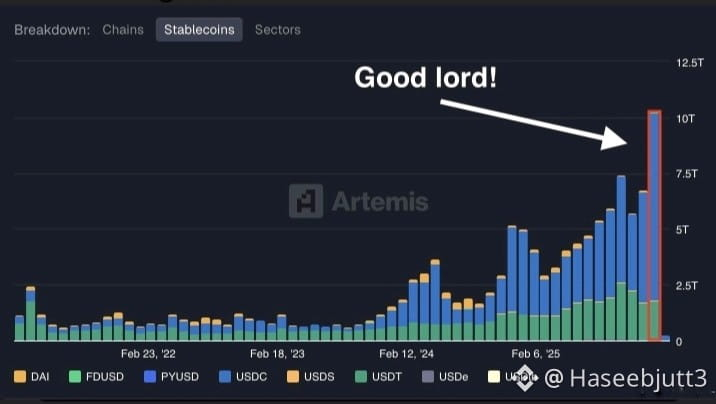
Even more striking is where that volume concentrated. USDC alone moved about $8.4 trillion during January. That’s more than double the roughly $4 trillion processed by Visa in its most recent quarterly payment volume. USDT added another $1.8 trillion, while DAI and USDS each contributed just under $60 billion. Individually, those smaller numbers don’t steal the spotlight, but together they reinforce the same message: tokenized dollars are scaling at a pace most people didn’t expect.
At first glance, it’s tempting to shrug this off. Stablecoins are stable by design, which makes them easy to label as boring. But this story isn’t really about stablecoins themselves. It’s about the infrastructure underneath them.
The Pipes Are What Matter
Stablecoins are becoming the default settlement layer for crypto-native finance and an increasing share of global value transfer. Every transaction represents real demand for blockspace, execution, and security. That’s why this surge matters far beyond the tokens involved.
This is where real-world assets, or RWAs, enter the picture. As more financial activity moves on-chain, stablecoins act as the connective tissue between traditional finance and decentralized rails. The higher RWAs climb, the more of global finance becomes tokenized. And the more that gets tokenized, the greater the structural demand for the networks processing those transactions.
That demand doesn’t disappear into abstraction. It shows up directly in fees paid to the chains themselves, and by extension, in demand for their native tokens.
Which Chains Captured the Flow
January’s data makes it clear where activity concentrated. Base led the pack with approximately $5.8 trillion in stablecoin volume, relying on Ethereum for gas settlement. Ethereum itself followed with around $2.2 trillion. Tron processed roughly $672 billion, while Solana handled about $490 billion. BNB Chain rounded out the top group with close to $389 billion.
Different ecosystems, different design choices, same underlying theme: massive volumes of dollar-denominated value are now moving natively on-chain, day after day.
Why This Changes the Narrative
For years, critics have leaned on the claim that crypto lacks real-world use cases. That argument gets harder to sustain when trillions of dollars are being transferred monthly through tokenized dollars, used for settlement, trading, payments, and cross-border flows.
The open question now isn’t whether this infrastructure works. It clearly does. The question is whether February sustains anything close to January’s pace. If it does, the shift won’t just be statistical-it will be psychological. At that point, dismissing crypto as disconnected from the real economy will start to look increasingly outdated.
What’s unfolding isn’t a hype cycle around stablecoins. It’s the quiet normalization of on-chain finance at global scale. And once those pipes are in place, they tend to get used.
Follow Wendy for more latest updates
#Binance #wendy $BTC $ETH $BNB

