
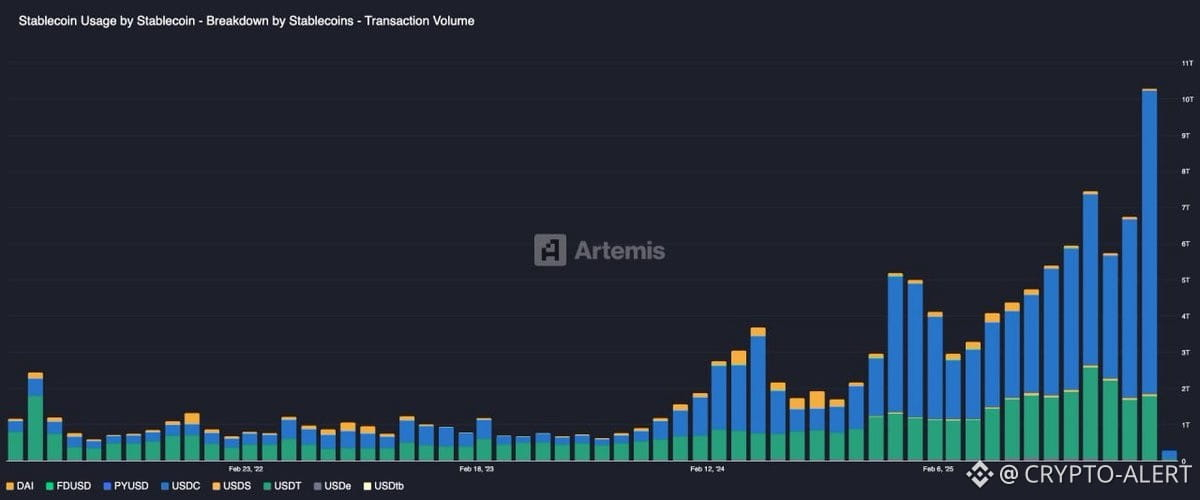
January 2026 just delivered a number that’s impossible to ignore: $10.3 Trillion. 🤯
To put that in perspective, the total stablecoin volume for the entirety of last year was roughly $33 trillion. In just 30 days, the market processed nearly a third of that annual figure. The "boring" side of crypto is officially moving at warp speed. ⚡
📊 The Heavy Hitters
While the market is diverse, the concentration of volume tells a fascinating story:
USDC: Lead the charge with a staggering $8.4 trillion in January. That is more than double the volume processed by Visa in its most recent quarterly payment report! 💳
USDT: Added another $1.8 trillion.
DAI & USDS: Contributed just under $60 billion each.
🏗️ It’s About the Infrastructure, Not Just the Tokens
Stablecoins are becoming the default settlement layer for both crypto-native finance and global value transfers. This isn't just a "hype cycle"; it's the quiet normalization of on-chain finance. 🏦
As Real-World Assets (RWAs) continue to climb, stablecoins act as the connective tissue between traditional finance (TradFi) and decentralized rails. Every transaction generates demand for blockspace, execution, and security—driving real value back to the networks.
 🌍 Which Chains Are Winning?
The data shows exactly where the "digital pipes" are busiest:
Base: $5.8 Trillion (Massive lead!) 🔵
Ethereum: $2.2 Trillion 💎
Tron: $672 Billion 🔴
Solana: $490 Billion ☀️
BNB Chain: $389 Billion 🔶
💡 Why This Changes the Narrative
Critics often claim crypto lacks "real-world use cases." That argument is becoming obsolete. When trillions of dollars move monthly for settlement, trading, and cross-border payments, the infrastructure isn't just "working"—it’s thriving. 📈
If February sustains this pace, the shift will move from statistical to psychological. Dismissing crypto as "disconnected" from the real economy is officially an outdated take.
Follow for more daily insights on the evolving crypto landscape! 🔔


