
There’s a moment that happens when you stop looking at blockchains as products and start seeing them as environments. Not ecosystems in the marketing sense, but actual places where things either function smoothly or constantly break in small, irritating ways. Vanar Chain feels like it was built by people who’ve spent time noticing those breaks.
Most infrastructure today still assumes a human is present. Someone to approve transactions, reconnect wallets, refresh sessions, correct mistakes. But intelligent systems don’t work like that. They don’t pause politely when context disappears. They don’t tolerate friction well. Vanar Chain seems to start from that simple observation and then build outward.
What stands out about Vanar Chain is how little it relies on spectacle. There’s no obsession with outperforming every chain on raw speed, no dramatic claims about replacing everything that came before. Vanar Chain focuses instead on continuity. Memory that doesn’t reset. Reasoning that doesn’t vanish off-chain. Automation that doesn’t feel reckless. These choices sound subtle, but over time they change how software behaves.
A useful way to think about Vanar Chain is as infrastructure that expects intelligence to stick around. Systems that learn need to remember. Systems that decide need to explain themselves. Systems that act need guardrails. Vanar Chain treats these needs as structural, not optional. That’s why Vanar Chain talks less about features and more about foundations.
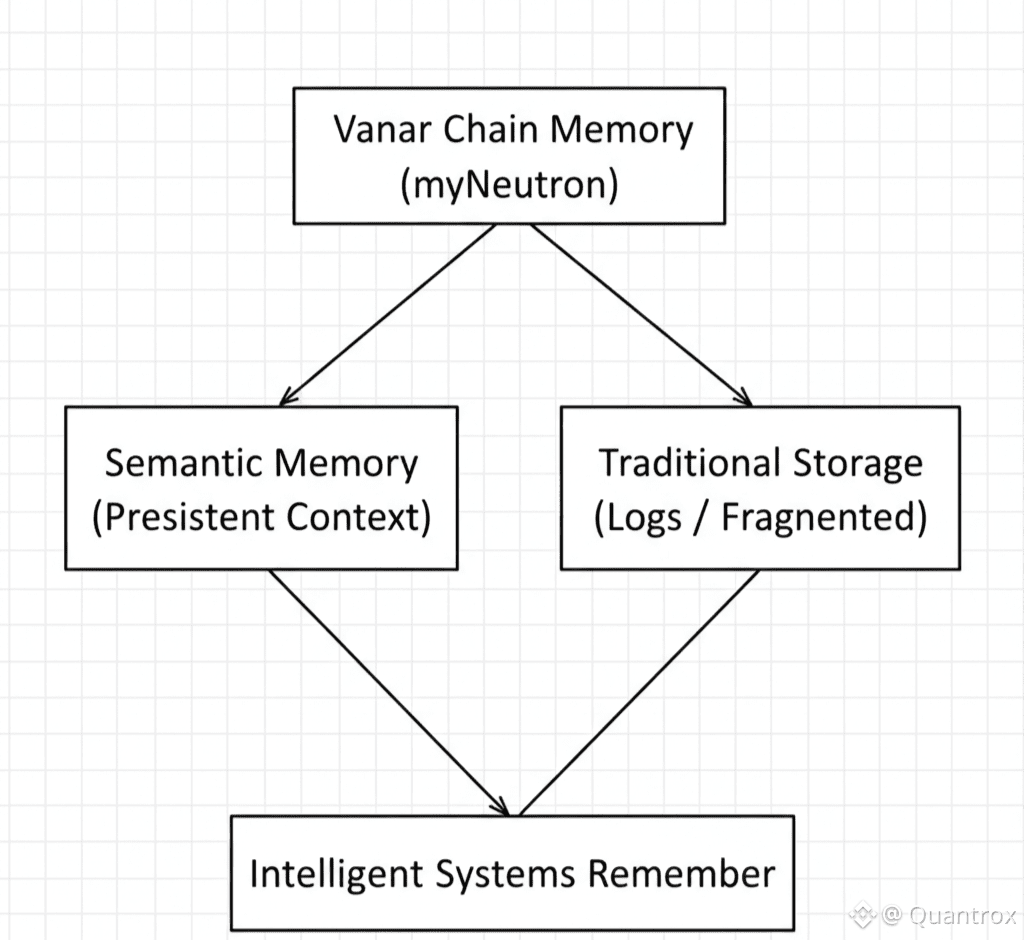
Take memory. On most networks, data is stored, but meaning is not. Context gets lost, fragmented, or pushed into external systems. Vanar Chain approaches this differently. With myNeutron, Vanar Chain treats memory as something semantic, not just archival. It’s closer to how humans remember conversations rather than how databases store logs. That difference becomes important when intelligence is persistent instead of episodic.
Reasoning is another quiet divider. Many chains allow decisions to be made, but not understood. Logic happens elsewhere, behind layers of abstraction. Vanar Chain doesn’t seem comfortable with that. Through Kayon, Vanar Chain makes reasoning visible. You can follow how a conclusion was reached, not just accept that it was. For AI-driven systems, this isn’t philosophical. It’s practical. Trust depends on explainability.
Then there’s execution. Intelligence that can’t act is incomplete, but intelligence that acts without restraint is dangerous. Vanar Chain navigates that space carefully. Flows exist to translate intent into action without letting automation spiral out of control. It’s not flashy, but it’s the kind of design you only appreciate once things scale.
Payments sit quietly underneath all of this. AI agents don’t navigate interfaces or think about wallet UX. They just need settlement to work, globally and consistently. Vanar Chain treats payments as infrastructure, not an experiment. That’s where vanry becomes relevant, not as a speculative hook, but as part of the economic plumbing that keeps intelligent systems running.
Another interesting aspect of Vanar Chain is its refusal to stay isolated. Intelligence doesn’t respect chain boundaries. Users, data, and liquidity already exist elsewhere. By extending Vanar Chain capabilities cross-chain, starting with Base, Vanar Chain acknowledges that relevance comes from meeting reality where it already is. Scale isn’t created in a vacuum.
This also highlights why launching brand-new L1s is becoming harder. The problem isn’t blockspace anymore. It’s usefulness. Vanar Chain doesn’t try to solve everything at once. Instead, Vanar Chain shows proof through working products. Memory exists. Reasoning exists. Automation exists. Settlement exists. Together, they form something coherent rather than theoretical.
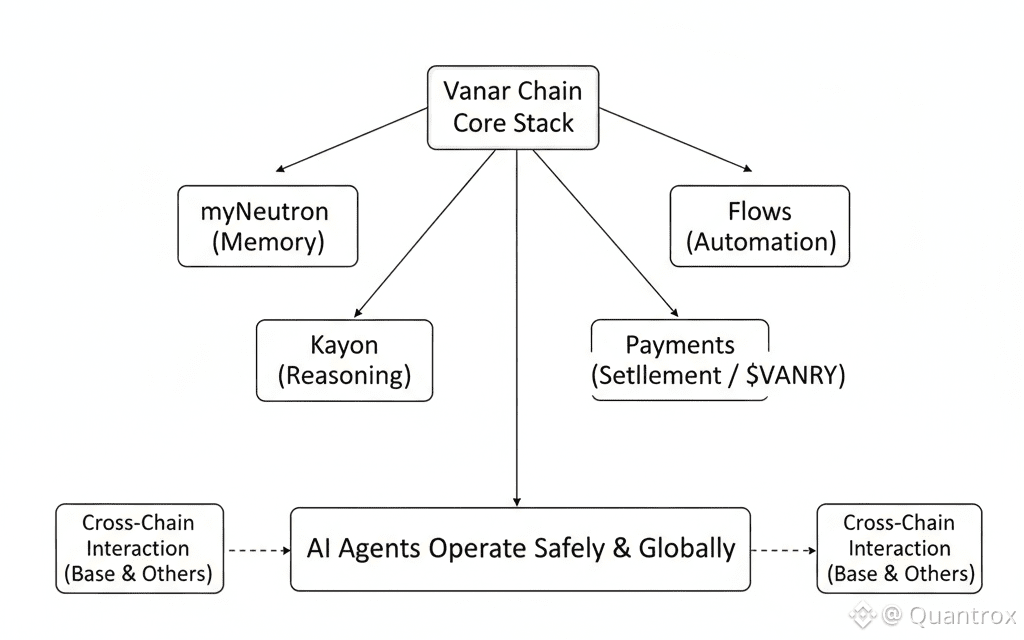
vanry fits naturally into this structure. Its role isn’t to carry the story, but to support usage as intelligence actually operates across the stack. As systems use memory, reasoning, automation, and payments, demand forms quietly. Not because of narratives, but because the infrastructure is being used.
What makes Vanar Chain interesting isn’t that it predicts an AI future. Many projects do that. Vanar Chain behaves as if that future is already arriving, slowly, unevenly, and without much drama. It builds accordingly.
There’s something reassuring about infrastructure that doesn’t rush. Vanar Chain feels like it’s designed for systems that run continuously, not campaigns that peak briefly. In a space that often confuses attention with progress, Vanar Chain seems comfortable focusing on the less visible work.
And sometimes, that’s exactly how lasting systems are built.
