
I've been watching applications using Walrus through this token volatility and realized something that completely changes how storage economics work. WAL sits at $0.0896 today with RSI at 22.41—extreme capitulation territory where everything should be chaos. Volume spiked to $1.71M as price got rejected from $0.0984 and crashed back to lows. But here's what's fascinating—applications that locked in Walrus storage pricing at the start of the current epoch aren't affected by today's crash at all. They're paying rates set when WAL was higher and their costs stay fixed for the entire two-week period.
That epoch-based pricing isolation from volatility is infrastructure genius most people completely miss.
Most decentralized services price continuously. Token goes up, service gets cheaper. Token crashes, service gets more expensive. You're constantly exposed to volatility even if you're just trying to use infrastructure. Every price swing affects your costs immediately. That makes budgeting impossible and planning pointless. You can't commit to anything when expenses fluctuate 20% based on hourly token moves.
Walrus doesn't work that way. And that difference matters more at $0.089 than it ever did at higher prices.
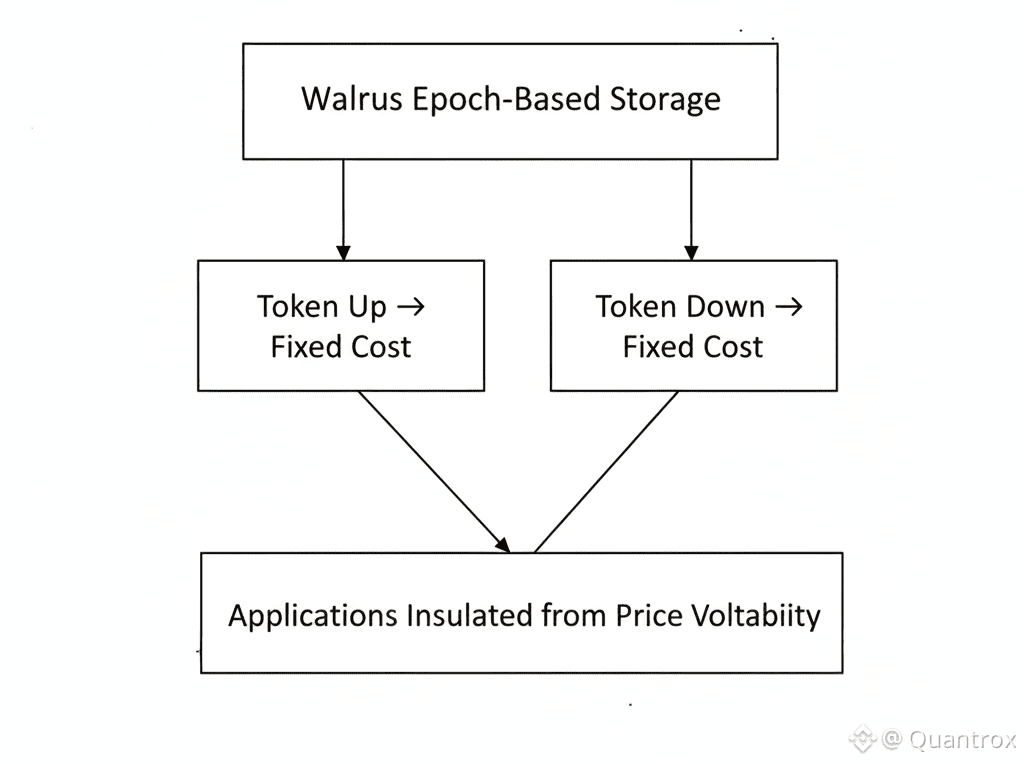
Here's what caught my attention. An application told me they renewed their Walrus storage allocation at the epoch boundary ten days ago. WAL was trading around $0.098 at the time. They evaluated the storage costs in fiat terms, decided it was acceptable, paid for capacity through the next epoch. Since then, WAL has crashed to $0.0896. Their storage costs didn't change. They're still paying the WAL amount determined at the epoch start even though the token is worth less now.
From their perspective, they got a discount. They locked in pricing at $0.098 rates but the token they paid with is now worth $0.0896. The storage capacity they secured costs them less in fiat terms than they budgeted for. That's backwards from how most decentralized services work where token crashes make services more expensive.
The circulating supply of 1.58 billion WAL out of 5 billion max means volatility isn't going away. More unlocks coming. More potential selling pressure. Applications using Walrus for critical infrastructure can't afford to have their storage costs swing wildly based on speculation. Epoch-based pricing gives them exactly what enterprise infrastructure requires—predictability.
Walrus processed over 12 terabytes during testnet when developers were validating that epoch mechanics worked operationally. The question wasn't just whether storage functioned but whether pricing coordination could happen smoothly every two weeks. Did operators vote rationally? Did consensus emerge naturally? Could applications plan around boundaries? Five months of testing proved the epoch system was production-ready before real money was involved.
Now mainnet has been running since March 2025 through multiple token cycles. Epochs keep turning over. Pricing keeps getting set through operator consensus at the 66.67th percentile. And applications keep getting cost predictability that's rare in decentralized infrastructure.
Here's a concrete example of what this predictability enables. A gaming project is planning a major content update that will triple their storage requirements. They're coordinating the update to deploy right after the next epoch boundary so they can lock in expanded capacity at known prices for the following two weeks. That lets them budget marketing costs, server expenses, development time—everything that depends on predictable infrastructure costs.
If Walrus used continuous pricing that updated hourly with token moves, that planning would be impossible. They couldn't commit to update timelines. Couldn't promise players new content on specific dates. Couldn't budget expansion costs with any confidence. The epoch system gives them certainty that storage costs won't surprise them mid-deployment.
My gut says this predictability is undervalued by everyone focused on token price. Applications don't care if WAL is $0.089 or $0.098 when they're making infrastructure decisions. They care whether costs stay predictable long enough to plan around. Two weeks isn't perfect—they'd probably prefer monthly or quarterly pricing—but it's enough to enable real planning that continuous pricing doesn't allow.
The RSI at 22.41 indicates extreme oversold conditions that usually precede capitulation or reversal. But applications locked into current epoch pricing don't care about RSI. Their costs are fixed. Whether RSI is 22 or 50 or 80 doesn't affect what they're paying for storage this week. That insulation from market psychology is exactly what infrastructure needs.
Volume of $1.71M during the past 24 hours shows significant selling pressure. Real conviction behind the move down. But storage activity on Walrus doesn't correlate with trading volume or price direction. Applications keep uploading data. Keep serving users. Keep operating like the token volatility doesn't exist. Because for applications inside an epoch, it effectively doesn't.
This is where Walrus epoch design solves a problem most decentralized protocols don't even acknowledge. You can't build reliable infrastructure on top of wildly volatile pricing. Applications need to know what things cost long enough to plan, budget, commit. Continuous pricing means you're constantly gambling on token stability. Epoch pricing means you lock in costs and forget about tokens for two weeks.
Walrus: applications choosing epoch-based storage over continuous pricing competitors reveals how much predictability matters for real infrastructure.
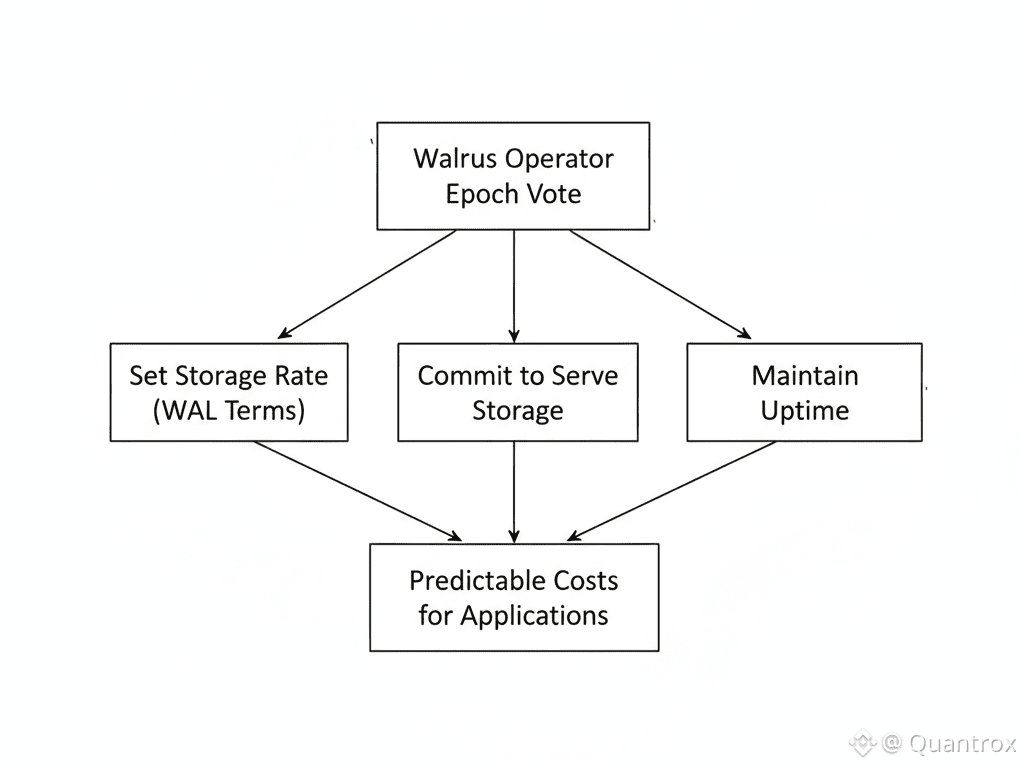
The 105 operators running Walrus nodes vote on pricing every epoch. They're trying to target fiat stability even though they're voting in WAL terms. When they vote at an epoch boundary, they're committing to serve storage at those rates regardless of what WAL does during the epoch. That commitment creates the predictability applications need.
At $0.0896 with RSI at 22.41, some operators might be regretting their pricing votes from the last boundary. They committed to rates expecting WAL around $0.095-$0.098 and it crashed to $0.089. Their fiat revenue is lower than anticipated. But they're honoring the commitment. Serving the storage. Maintaining uptime. Because the epoch system depends on operators following through regardless of token moves.
Time will tell whether Walrus epoch pricing is sufficient protection from volatility or whether applications eventually need longer stability windows. But the fundamental design choice—discrete pricing periods that insulate from continuous chaos—that's infrastructure thinking. Most DeFi protocols optimize for traders who want continuous price discovery. Walrus optimized for applications who want cost predictability. At $0.089, that optimization is proving its value.

