
Dusk didn’t show up to win a popularity contest, it showed up because there’s a deep problem in modern finance that most people feel but rarely say out loud, which is that markets need privacy to function with dignity and safety, yet they also need accountability to function with trust, and most blockchains force you to choose only one side of that reality. I’m looking at DUSK through two lenses at the same time, the builder lens that asks what this network is actually designed to do, and the pro-trader lens that asks what kind of market behavior that design tends to produce when liquidity, narrative, and adoption collide, because those two worlds are not separate anymore, they’re connected, and we’re seeing the best trades appear when fundamentals and flow begin to rhyme. Dusk is described as a layer 1 built for regulated and privacy-focused financial infrastructure, meaning it aims to support institutions and serious financial products without turning every user and every position into public entertainment, and that single sentence tells you why the project exists, why it was built in the first place, and why the market keeps returning to it when privacy, tokenization, and compliant finance become hot topics again.
To understand how Dusk works, it helps to picture the network as a settlement foundation that tries to stay calm under pressure, because in real finance, settlement cannot be a guessing game. At the base, Dusk focuses on proof of stake style security, validator participation, and fast, confident finality, and the emotional reason this matters is simple, traders and institutions don’t fear volatility as much as they fear uncertainty, so a chain that aims for deterministic finality is basically saying, “When a transaction is final, it’s final,” and that promise becomes a product feature when you’re building anything that looks like institutional-grade infrastructure. On top of that settlement foundation, the project has been moving toward a modular architecture, which in plain terms means different layers can specialize, one layer secures and finalizes, another layer executes application logic, and another can focus on privacy-heavy computation, and this is not just engineering vanity, it’s a practical choice meant to make integrations easier, make upgrades less chaotic, and let the network evolve without constantly rewriting everything from scratch.
Now the most important step, and the one that separates Dusk from most generic smart-contract chains, is the way it handles transactions and privacy. Dusk supports two transaction styles that can coexist on the same network, and this duality is not a gimmick, it’s a recognition that regulated finance is not one uniform use case. One mode is public and account-like, which is useful when visibility is a feature and when reporting is straightforward, and the other mode is shielded and note-like, which is useful when confidentiality is required because amounts, balances, and linkages cannot be broadcast to the world without causing real harm. In the shielded design, value moves as cryptographic “notes” rather than openly visible balances, and the network verifies correctness using zero-knowledge proofs, so the chain can enforce rules like ownership and non double-spending without exposing the sensitive details to everyone watching. If it becomes widely used, this matters more than people realize, because privacy here is not just hiding a number, it is changing the accounting model so that confidentiality is native while auditability can still exist through selective disclosure when authorized parties legitimately need it.
This is where the “regulated” part stops being a marketing adjective and starts being the hard requirement that shapes every technical choice. In regulated markets, privacy alone is not enough, because privacy without accountability turns into suspicion, and accountability without privacy turns into surveillance, so Dusk’s direction is essentially aiming at controlled confidentiality, where the system can keep the public out of private financial narratives while still enabling proofs, attestations, and disclosure pathways that satisfy audits, compliance, and legal obligations. That’s why the project’s focus on institutional-grade applications, compliant DeFi, and tokenized real-world assets is not random, it’s connected, because tokenization is not just minting a token, it’s managing ownership, transfer rules, disclosures, and lifecycle events in a way that real institutions can defend to stakeholders. They’re trying to build infrastructure where a tokenized asset can exist with private ownership flow when necessary, but with compliant rule enforcement and verifiable correctness, and this is the kind of architecture that can take time to mature but can also create stickier, repeatable demand once it clicks, because institutions don’t chase every narrative, they repeat the workflows that work.
Let’s talk about DUSK the asset in a trader’s language, because price does not move on ideals, it moves on positioning, liquidity, and expectations. DUSK is listed on Binance, and that alone changes the market microstructure because it concentrates liquidity, accelerates discovery, and creates a venue where rotation can happen quickly when momentum traders wake up, when macro sentiment shifts, or when the broader privacy and RWA narratives catch a bid. In a market like this, I’m not only watching the chart, I’m watching behavior, because DUSK often trades like an instrument that can compress quietly and then expand violently when the crowd notices it again, and those expansions tend to be fueled by the same ingredients every pro trader respects, rising volume that confirms intent, tightening spreads that signal confidence, and a clean response to key levels where buyers defend rather than hesitate. When the order book is healthy and the tape is consistent, you can trade it with structure, but when liquidity thins and volatility spikes, it becomes a different animal, and that’s where discipline matters, because thin liquidity turns emotions into slippage, and slippage is where good ideas become bad trades.
From a fundamentals-meets-flow perspective, the metrics that matter are the ones that tell you whether the network is becoming real usage infrastructure or staying a mostly narrative-driven asset. On-chain, I’m watching whether transaction activity grows steadily rather than only during hype bursts, whether fees and throughput remain stable under load, and whether the network’s privacy features are actually used in meaningful volume instead of being a nice story that sits on the shelf. The ratio of shielded-style activity to public-style activity can be a subtle signal, not because one is “better,” but because real adoption tends to show up as consistent patterns, not random spikes. I’m also watching validator participation and staking dynamics, because staking can be both a security measure and a liquidity lever, and when large amounts of supply are staked, liquid float tightens, which can amplify moves, while when supply unstakes into weak sentiment, it can add pressure at exactly the wrong time. In the market, I’m tracking liquidity depth, volume quality, and volatility regime, because DUSK can move quickly, and pro trading is about matching your strategy to the regime you are in, not the regime you wish you were in, and we’re seeing too many traders blow up by assuming every breakout will trend when the tape is actually mean-reverting.
The risks are real, and they’re the kind of risks that serious traders and long-term believers should admit without flinching, because denial is how you get blindsided. The biggest risk is that building for regulated finance is slow, because compliance, integrations, audits, and institutional onboarding have timelines that do not care about crypto cycles, and a slow real-world rollout can leave the token vulnerable to sentiment droughts when the market moves on to the next shiny thing. Privacy technology also carries complexity risk, because zero-knowledge systems are powerful but demanding, and demanding systems require careful engineering and rigorous testing, and any meaningful flaw in privacy logic can damage trust quickly even if it is fixable. The modular approach can be a strength, but it also introduces coordination surfaces, meaning different layers and components must work together cleanly, and user experience must remain smooth, because in markets, friction is not neutral, friction is rejection. Then there’s the pure market risk, the reality that even a strong project can be underpriced in a bear phase and overpriced in a hype phase, because the market is not a judge of truth, it’s a machine that prices attention and liquidity first, and fundamentals later.
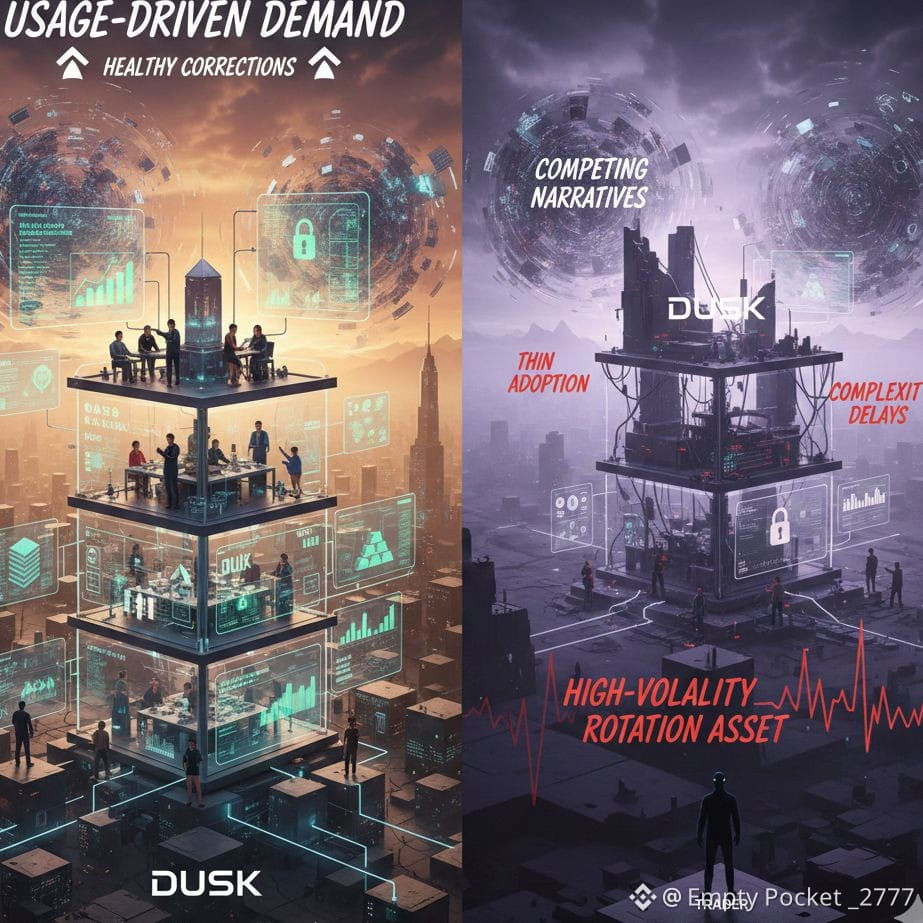
So how might the future unfold, in a way that respects both the promise and the uncertainty. The bullish path is not one announcement, it’s a sequence of visible proof points that slowly changes how the market categorizes DUSK, from a speculative privacy L1 into a settlement and issuance network that builders and institutions actually lean on. If Dusk’s modular execution layers bring in developers faster, if privacy and auditability features become normal tools rather than exotic experiments, and if tokenized real-world assets and compliant financial apps begin to generate repeatable activity, then the demand story evolves from hype-driven to usage-driven, and that is when trends can last longer and corrections can become healthier instead of destructive. The bearish path is simpler, if adoption stays thin, if complexity delays delivery, or if competing narratives absorb the spotlight, then DUSK can remain a high-volatility rotation asset that pumps hard and fades fast, and the winners will be the traders who respect liquidity and timing rather than marrying the story.
In the end, what pulls me back to Dusk is that it tries to honor a truth most people feel in their gut, that privacy and compliance do not have to be enemies if the system is designed with both in mind, and that kind of design is rare because it’s harder than chasing a trend. They’re building in a direction that asks for patience, but patience is not passive, it’s active attention, it’s watching the right metrics, managing risk like a professional, and staying open to being wrong without losing your conviction in good process. If it becomes what it is aiming to become, we’re not just watching another coin move on a chart, we’re watching a piece of financial infrastructure quietly learn how to carry real value with real responsibility, and that is the kind of story that can grow slowly, honestly, and then all at once, in a way that leaves you feeling less like you gambled, and more like you understood something early and held it with care.