
DUSK is the kind of coin that doesn’t beg for attention, and that’s exactly why it can surprise people when the market finally notices what it is trying to build, because this network was designed around a reality most traders feel but rarely say out loud: real money doesn’t want to live in a glass house, yet real finance still needs rules, reporting, and accountability when it matters. Dusk was built as a layer-1 meant for regulated and privacy-focused financial infrastructure, and when I look at it through a trader’s lens, I don’t see a typical “app chain” story, I see a settlement and compliance story, and those stories tend to move differently in cycles because they’re less about hype and more about whether the chain can earn trust under pressure. If you’ve ever watched a market maker defend a level, or seen a fund quietly accumulate without advertising it, you already understand the emotional core of this thesis: privacy is not about hiding wrongdoing, it’s about protecting legitimate strategies, counterparties, and positions from being exploited, and Dusk is trying to make that protection compatible with audits and regulation instead of treating regulators like an enemy.
To understand how Dusk works, step by step, I start at the bottom where final settlement happens, because in serious finance the settlement layer is the truth machine and everything else is just performance on top of it. Dusk’s design separates settlement and data availability from execution, which means the base layer is responsible for consensus, finality, and making sure transactions become irreversible in a predictable way, while execution environments can be modular and developer-friendly without constantly rewriting the chain’s core rules. This is where their architecture becomes more than a buzzword, because you can have an execution environment that feels familiar to Ethereum developers while still anchoring final settlement to Dusk’s own base layer, and for institutions that care about stable settlement guarantees, that separation matters. They’re basically saying, “We’ll keep the settlement engine disciplined and dependable, and we’ll let the execution layer evolve without turning the whole system into a moving target.” When It becomes real in production, that’s when traders start treating a network less like a speculative toy and more like infrastructure with a valuation floor.
Now zoom into the privacy and compliance mechanism, because this is the heart of what makes DUSK different from a generic smart contract token. Dusk supports different transaction styles that can live on the same chain, and that simple idea is powerful because finance does not have one universal disclosure rule. Some flows should be public by default, especially when transparency is required, and some flows should be private by default, especially when revealing them creates manipulation risk or violates confidentiality obligations. In practice, this means the network can support transparent transfers when that’s the right tool, and confidential transfers when that’s the right tool, and the key is selective disclosure: you can keep information confidential to the public while still being able to prove correctness and compliance to the parties that legitimately need to see it. That’s why they put privacy and auditability in the same sentence, and it’s also why this project tends to attract people who think in terms of market structure, not just in terms of short-term narratives. They’re building a chain where confidentiality is not a loophole, it’s a feature that’s meant to coexist with regulation, and that tension is exactly where the hardest engineering and the biggest potential payoff live.
Consensus is the next step, and I’m going to keep it simple, because traders don’t need academic poetry, they need to know what failure looks like. Dusk uses a proof-of-stake approach with committee-style validation and strong finality goals, which means blocks are proposed, checked by a selected group, and then finalized in a way designed to reduce fork risk and uncertainty. The reason this matters emotionally is that markets hate ambiguity, and a chain that can offer fast, dependable finality has a different psychological profile than a chain that feels like it can reorganize during stress. In infrastructure terms, they’re aiming for a system where “final” feels like settlement, not like a suggestion. If you’re trading DUSK with size, this becomes part of your risk model because finality quality affects exchange confidence, bridge confidence, and the willingness of serious capital to build on top. We’re seeing a lot of traders ignore finality until something breaks, and the ones who don’t ignore it tend to survive longer.
Then there’s the token itself, and this is where pro traders stop pretending fundamentals are boring, because supply behavior is not a philosophy, it’s flow. DUSK is the fuel for the network and the incentive for staking and participation, so the token’s role is tightly tied to security and network health, not only to speculation. A long-horizon emission plan can support security without creating a constant “sell the rewards” death spiral, but it also means you must watch staking participation and circulating liquidity like a hawk, because those two numbers quietly shape volatility. When staking participation rises, liquid supply tightens and moves can become sharper, and when staking participation falls, the market often gets heavier and more reactive to negative sentiment. They’re not building a story where the token is optional, they’re building a story where the token is the network’s heartbeat, and heartbeat changes show up in price action long before people write posts about it.
If you want to trade DUSK like a professional instead of a tourist, you watch a different set of signals, and you watch them with patience because this coin can punish impatience in both directions. First, you track whether liquidity on Binance is deep enough to absorb real size without creating ugly slippage, because a coin can look “active” and still be thin when you actually push it. Second, you watch volatility regimes, not just candles, because mid-caps often flip from calm to violent and back again, and that flip is where most accounts blow up. Third, you watch the relationship between price moves and participation, meaning you look for whether rallies are accompanied by durable volume and stable order flow or whether they feel like thin air that disappears the moment buyers pause. Fourth, you keep an eye on staking and network participation trends, because security incentives and participation health feed into confidence, and confidence feeds into valuations in a way that is slow until it suddenly isn’t. And finally, you stay emotionally honest about one uncomfortable truth: in coins like DUSK, the best entries often feel boring and the worst entries often feel urgent, so If you feel rushed, that alone can be your signal that you’re late to a move rather than early to a trend.
Risks deserve respect here, because this project is not playing on easy mode. The first risk is adoption speed, because regulated finance moves slowly and demands proof, audits, and reliability, and that can create long quiet phases where traders get impatient and leave right before progress becomes visible. The second risk is complexity, because privacy systems and selective disclosure are hard to engineer and hard to communicate, and when communication is hard, narratives get simplified, and when narratives get simplified, markets misunderstand what they’re buying. The third risk is market structure, because mid-cap coins can be pushed around by leverage and emotion, and you can be right on the thesis and still get wrecked on timing and sizing. The fourth risk is perception risk, because anything with “privacy” in its identity can get painted with a broad brush in public conversations, even when the goal is regulated privacy with auditability, and that perception can affect listings, liquidity, and sentiment in ways that have nothing to do with code quality. They’re building something that makes sense, but sense is not the same thing as safety in a market that trades feelings as much as facts.
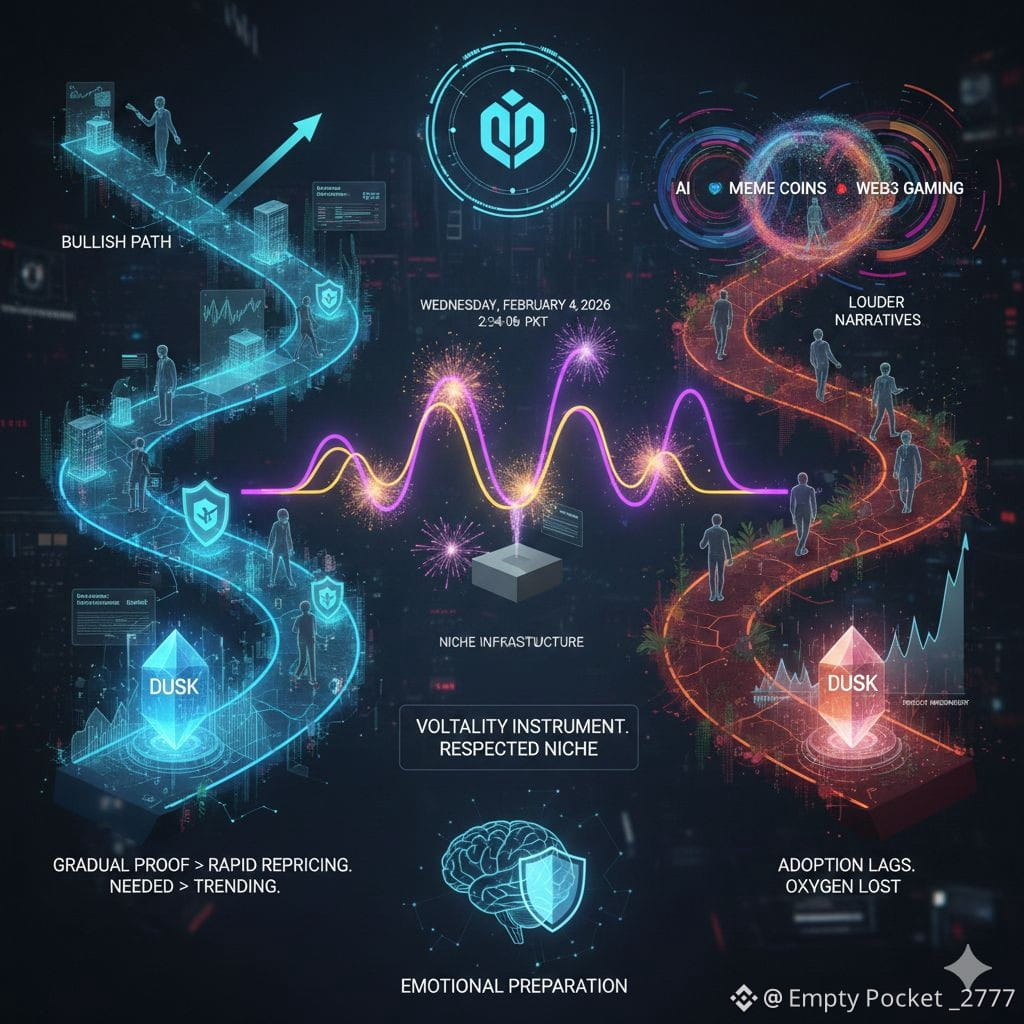
So how might the future unfold, and what should you emotionally prepare for if you want to trade or hold DUSK without losing your mind. The bullish path is not a single viral moment, it’s a gradual proving process where the chain shows that privacy and compliance can coexist without sacrificing settlement quality, and where developers and institutions actually use those capabilities instead of just talking about them. The market usually undervalues that kind of progress until it is obvious, and then it reprices it fast, which is why this coin can feel dead right before it feels unstoppable. The neutral path is that Dusk remains a respected niche infrastructure project with periodic speculative waves, meaning you trade it like a volatility instrument rather than a forever story. The bearish path is not necessarily that the tech fails, it’s that adoption takes too long while louder narratives take the cycle’s oxygen, and traders who can’t wait rotate out, leaving price to drift even while the product improves. If It becomes the kind of chain that regulated issuers and compliant DeFi builders trust, we’re seeing a world where the valuation story changes from “Is this trending” to “Is this needed,” and needed is the kind of word that survives multiple cycles.
And that’s the quiet power here: DUSK is not trying to win the internet, it’s trying to win the part of finance that actually settles value and obeys rules while still protecting legitimate confidentiality. I’m not telling you to blind buy it, I’m saying that if you’re going to trade it, trade it with respect for what it is: a market structure thesis wrapped inside a mid-cap token that can swing hard and test your discipline. They’re building a bridge between privacy and compliance that most chains either avoid or oversimplify, and if you can stay patient and watch the real signals instead of chasing noise, you might find yourself holding a position that feels calm even when the candles are not, because you understand why the machine exists. We’re seeing more of the world demand privacy that is accountable rather than privacy that is chaotic, and if Dusk keeps executing, that demand can slowly turn into the kind of adoption that doesn’t need shouting, because the work speaks for itself, and the market eventually listens.