Every generation of the internet faces a moment where its limits become impossible to ignore. For Web3, that moment is storage. We can build fast blockchains, elegant smart contracts, and global financial systems without intermediaries, yet the moment data grows large, human, and meaningful, the system begins to crack. Images, videos, AI datasets, application history, and digital memories do not fit neatly into traditional blockchains. Walrus on Sui was created precisely at this breaking point, not as a temporary fix, but as a long-term answer.
At its heart, Walrus is a decentralized storage protocol, but emotionally it is something deeper. It represents the idea that data should not be fragile, expensive, or controlled by invisible gatekeepers. By building directly on the Sui blockchain, Walrus takes advantage of a high-performance foundation designed for real-world scale. Sui was never meant to be just another ledger. It was built to move fast, think in parallel, and treat digital objects as living entities. Walrus uses this strength to give data a home that feels permanent, reliable, and fair.
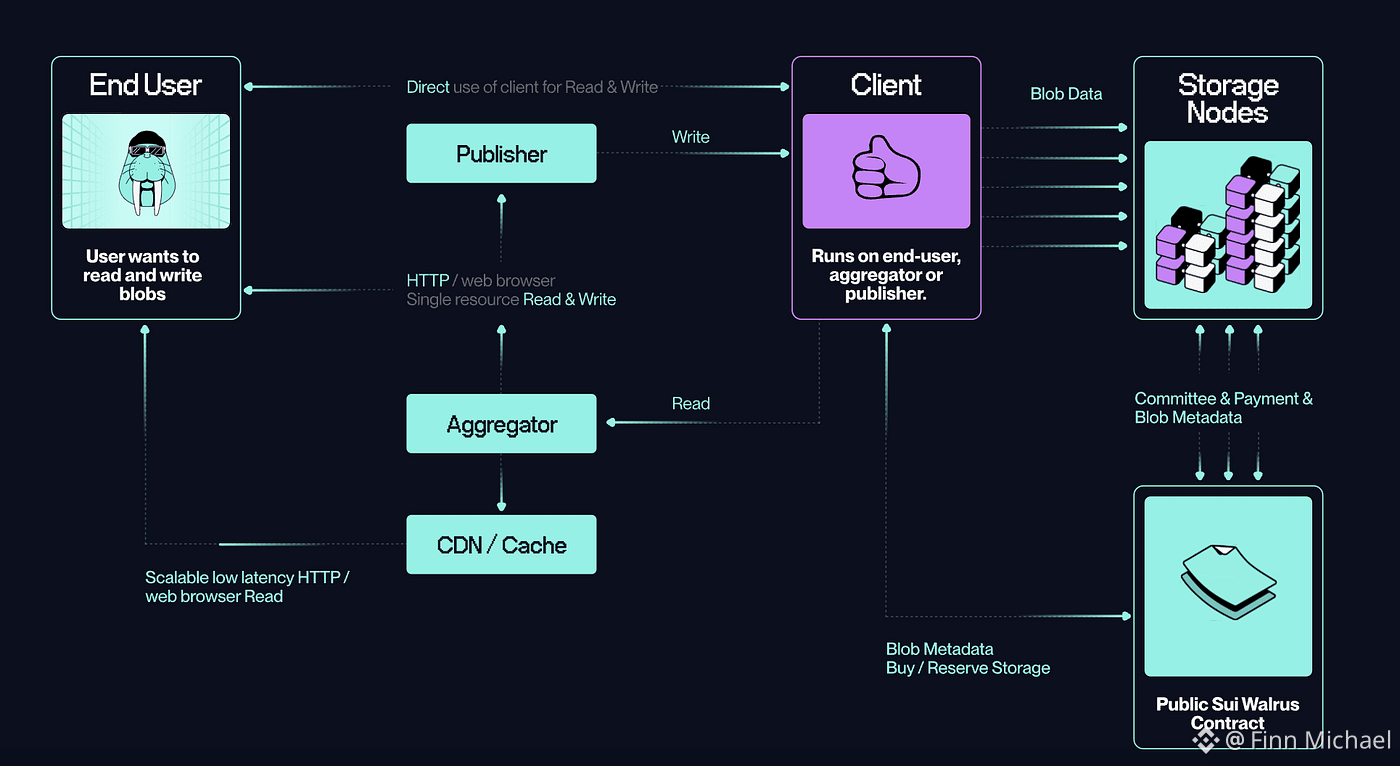
Most people do not realize how unnatural it is to store large data on blockchains. Traditional chains were designed for transactions, not terabytes. Forcing data into them leads to high fees, slow performance, and compromises that hurt users. Walrus does something different. It accepts a simple truth: blockchains should coordinate data, not suffocate it. Using advanced erasure coding, Walrus breaks files into fragments, adds intelligent redundancy, and spreads them across a decentralized network of storage nodes. Even if some nodes disappear, the data lives on. This design mirrors life itself, where resilience comes not from perfection, but from distribution.
Sui becomes the silent conductor of this system. Instead of storing the data itself, Sui tracks ownership, availability, and permissions through on-chain objects. This means applications can trust that data exists, that it can be retrieved, and that its rules are enforced, without ever exposing the content publicly. There is something profoundly human in this balance. Transparency without vulnerability. Verification without surveillance. Control without central authority.
The emotional weight of this matters more than most technical papers admit. In a world where personal data is constantly extracted, analyzed, and monetized, Walrus on Sui offers a quieter promise. Your data is not a product. It is an asset you choose how to store, how long to keep, and how to use. Whether it is a developer storing application state, an artist preserving creative work, or an AI builder managing massive datasets, the feeling is the same. Confidence replaces anxiety.
The WAL token plays a crucial role in aligning this ecosystem. It is not just a payment method. It is the economic signal that keeps the network honest. Users pay for storage, node operators are rewarded for reliability, and stakers help secure the system’s future. Governance powered by WAL gives the community a voice, turning users into participants rather than passive consumers. This shared ownership creates emotional investment, the kind that builds ecosystems that last.
What makes Walrus on Sui especially powerful is how naturally it fits into the future of Web3. AI models need verifiable data availability. Layer 2 solutions need scalable storage without trust assumptions. Decentralized applications need a place where data can grow without fear. Walrus does not compete with blockchains. It completes them. It acts as the missing layer that allows Web3 to feel whole.
There will always be challenges ahead. Scaling responsibly, maintaining decentralization, and educating users takes time. But Walrus was never designed for shortcuts. It was designed with patience, with structure, and with an understanding that infrastructure shapes behavior. When storage is reliable and fair, innovation follows naturally.
In the end, Walrus on Sui is not just solving a technical problem. It is healing a philosophical one. It reminds us that technology should serve human needs, not force humans to adapt to its limitations. By combining a high-performance blockchain with a storage system built for reality, Walrus shows what Web3 can become when speed meets responsibility and decentralization meets empathy. This is not just progress. It is maturity.
@Walrus 🦭/acc #walrus $WAL