

Plasma’s Gasless Transfer API represents a shift from user-paid transaction execution to protocol-managed authorization flows. At the core of this design lies EIP-3009 authorization signatures, which allow token transfers to be executed by a third party without the sender directly submitting an on-chain transaction. This signature-based model ensures cryptographic consent while enabling backend services to sponsor gas, making transactions seamless for end users without compromising security or ownership.
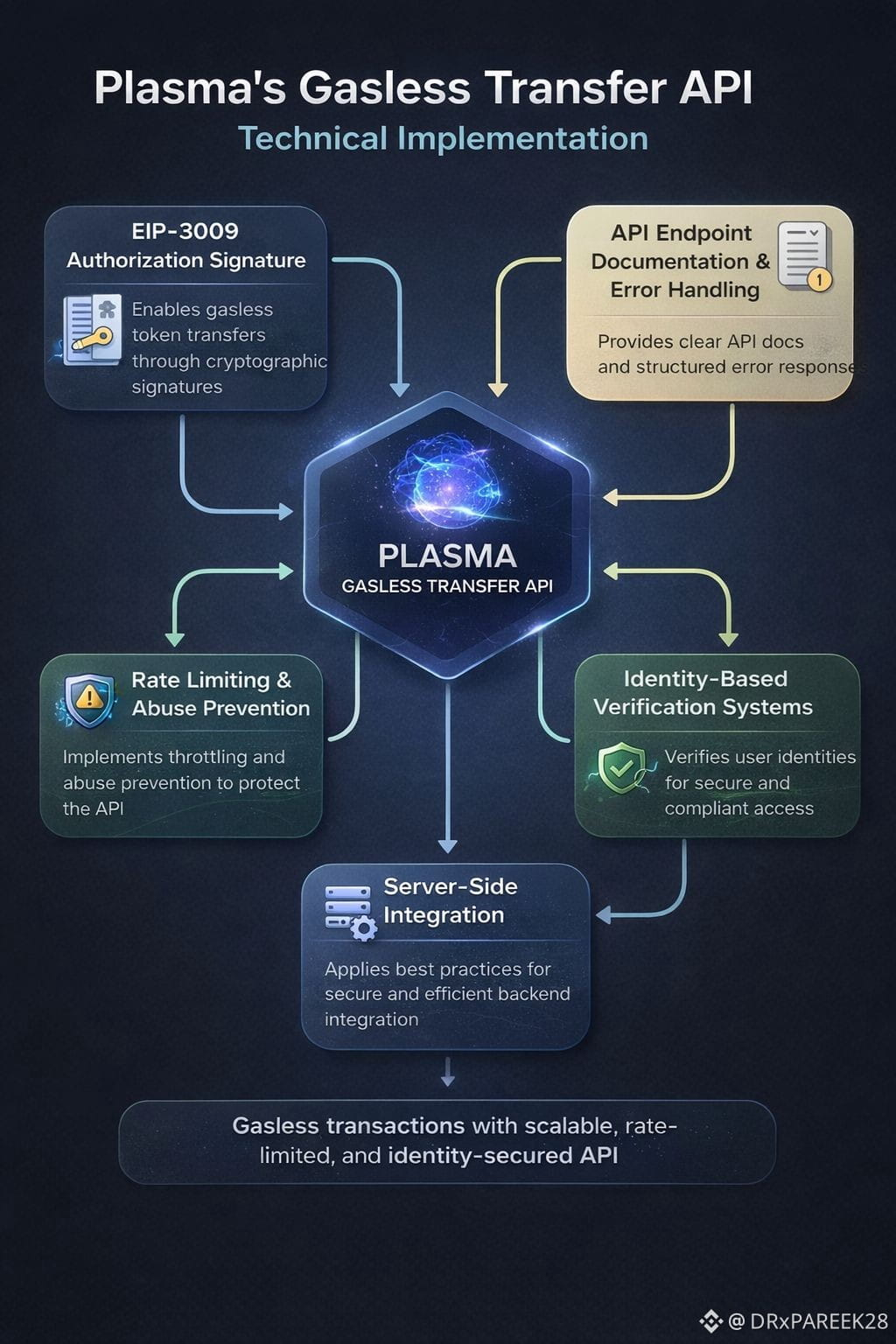
To protect this system from misuse, rate limiting and abuse prevention mechanisms are essential. Plasma enforces request-level throttling, signature expiration windows, and replay protection to ensure that signed authorizations cannot be exploited or spammed. These controls operate both at the API gateway layer and within smart contract validation logic, forming a dual-layer defense against automated abuse and malicious relayers.
On the server-side integration, Plasma emphasizes strict key management, deterministic request construction, and validation-first execution. Backend services must verify authorization payloads, enforce nonce sequencing, and ensure atomic execution to avoid partial failures. This approach reduces operational risk while maintaining predictable transaction outcomes.
Clear API endpoint documentation and structured error handling play a critical role in developer adoption. Plasma’s API design surfaces granular error codes for signature mismatch, expired authorization, rate-limit violations, and identity verification failures. This transparency enables developers to debug integrations efficiently and build resilient applications.
Finally, identity-based verification systems tie authorization flows to verified identities or contextual trust models, enabling selective access and compliance-friendly deployments. Combined with real-world integration patterns—such as custodial wallets, consumer apps, and enterprise backends—Plasma’s gasless API is engineered for production-grade scalability rather than experimental usage.

