
@Vanar came into existence at a time when blockchain technology had already proven its potential but failed to feel usable for normal people. Most networks were built with developers in mind, not everyday users. Transactions were often slow, fees could change without warning, and using a wallet felt more like managing a machine than using a service. For businesses and creators, this unpredictability made blockchain risky rather than reliable.
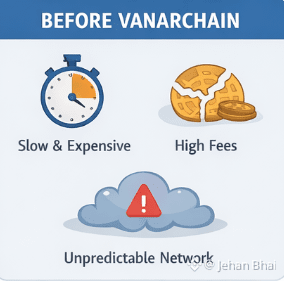
Instead of chasing hype, @Vanar focused on stability and clarity. The idea was simple: a digital system should behave in a predictable way, just like real infrastructure. Users should not need to worry about sudden fee spikes or failed transactions. By designing the network to handle activity smoothly and keep costs consistent, VanarChain removed one of the biggest frustrations people had with blockchain.
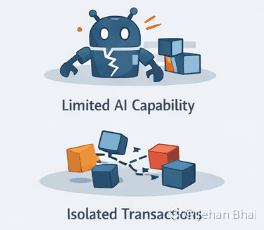
Another major problem with earlier systems was their inability to support intelligent applications. AI systems need continuity, memory, and clear execution rules. Traditional blockchains treat each transaction as an isolated action, which limits how smart applications can become. #VanarChain was designed to support long-term logic and structured data, making it suitable for applications that need more than simple value transfers.
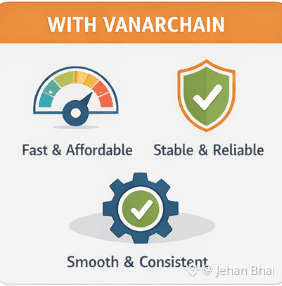
The usefulness of #vanar becomes clear in real-world scenarios. Digital platforms built on it can scale without breaking under pressure. Games, digital ownership systems, and automated services can grow while offering users a smooth experience. People interact with these platforms like normal apps, while the blockchain quietly ensures security and ownership in the background.
Recent progress on #Vanar has shown that this approach works. Projects running on the network have maintained steady performance even during high usage. The reason is not marketing or shortcuts, but careful design choices that prioritize function over noise. A practical example can be seen in digital asset platforms where users buy, sell, or interact without thinking about gas fees or network congestion.

For ordinary people, the benefits are simple and practical. Payments remain affordable. Digital assets truly belong to the user, not the platform. Services powered by automation and AI operate under transparent rules that cannot be changed quietly. Over time, this builds trust and makes advanced technology feel normal rather than intimidating.

@Vanar does not try to impress by being complex. Its strength lies in making powerful systems feel calm, stable, and usable. That is what turns blockchain from an experiment into something people can actually rely on.