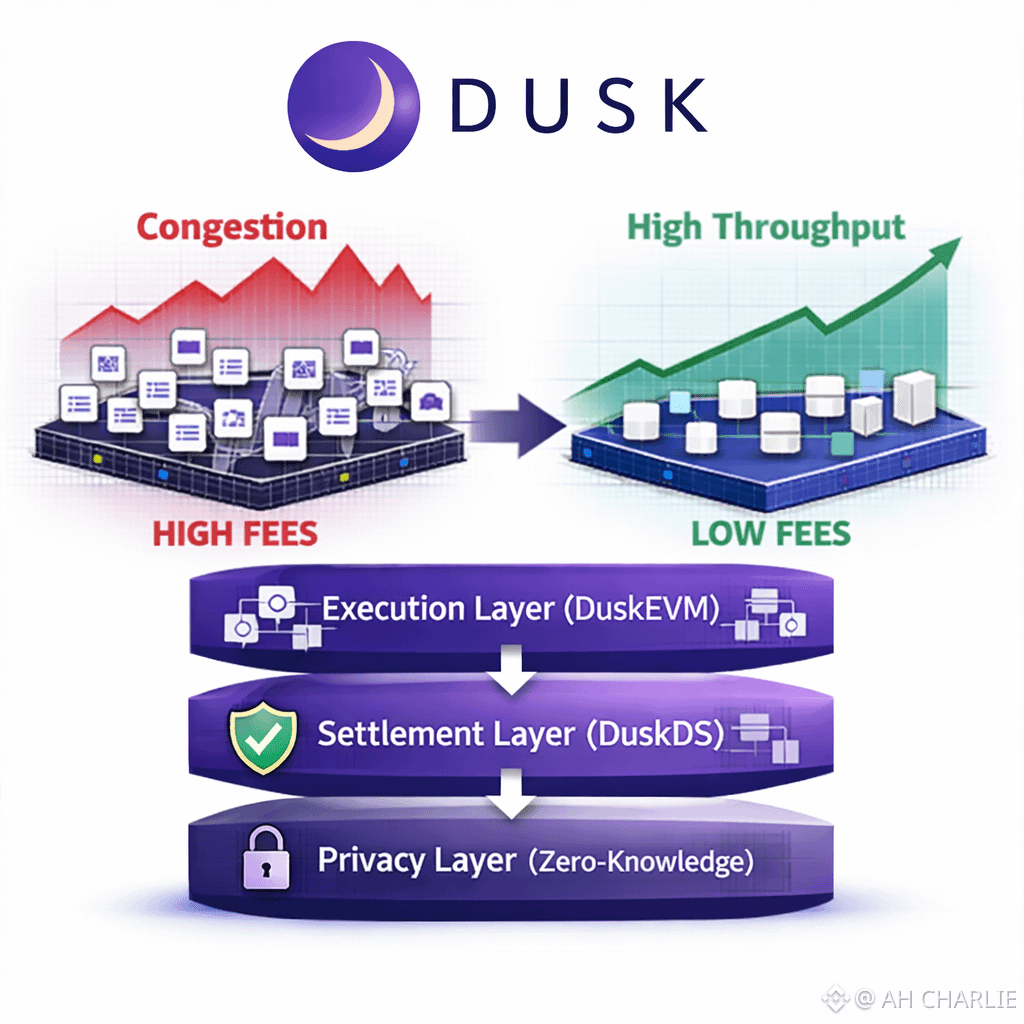
First time you watch a “fast” chain choke, it’s kind of embarrassing. Not for you. For the system. Orders pile up, fees spike, bots start playing bumper cars, and suddenly “finance on-chain” looks like a busy street with no traffic lights. So when people say a network can handle high-frequency flows without turning into a fee auction, I get curious. Then I get suspicious. With Dusk, the interesting part isn’t marketing. It’s the plumbing. Dusk’s base layer, DuskDS, is built around a proof-of-stake consensus called Succinct Attestation. In plain words: a small, randomly picked group does the work of proposing and checking blocks, then the block is ratified with fast finality. The docs describe it as committee-based and designed for fast, deterministic finality that fits financial market needs. That “finality” word matters. Finality is the moment a trade is not “probably done,” but done. In high-speed markets, “probably” is where chaos lives. Now, there’s some history here. Earlier Dusk design material discusses a Segregated Byzantine Agreement (SBA) approach, which is basically a structured way to reach agreement even if some actors misbehave. You don’t need to memorize the acronym. The point is: Dusk has been opinionated about consensus from day one, because regulated finance hates long reorg risk and hates waiting. If settlement takes ages, traders don’t call it “secure.” They call it “unusable.” But consensus alone doesn’t solve congestion. Congestion usually comes from everyone trying to do everything on the same lane. Smart contract calls, token moves, complex app logic, data storage… all fighting for the same block space. Dusk’s answer is to split responsibilities across layers, so the settlement layer doesn’t get dragged into every tiny compute step. Their own architecture explains the move toward a multi-layer setup: DuskDS as the settlement/data layer, with other layers handling different execution and privacy needs, while a single token fuels the stack. Here’s where the “high-frequency” angle gets real. If you want speed, you want predictable throughput and predictable costs. You also want the system to avoid turning every burst of activity into a fee war. Dusk’s approach leans into separation: keep the settlement layer focused on agreement and availability, and push heavy app execution to an execution layer that can batch work. This is where DuskEVM comes in. DuskEVM, per the docs, is an OP-Stack style execution layer. The key detail is cost structure: transactions have an execution fee on the EVM side, and a data availability fee to publish the transaction data back to DuskDS as blobs for batch posting. That’s not just “tech detail.” That’s congestion control. It’s a pressure valve. Think of it like this. If every coffee order in a city had to be approved by the mayor in real time, the whole city would stop. Instead, cafés take orders locally, then the city only cares that taxes and rules are met. In Dusk terms, DuskEVM runs the busy app flow, then posts compressed proof-of-what-happened data to DuskDS. DuskDS doesn’t need to re-execute everything. It needs to agree on the result and keep the data available. That reduces the chance the settlement lane gets clogged by app noise. And yes, the “two-part fee” can sound annoying at first. I had that moment too. Like, why split it? Because you’re paying for two different scarce resources: compute on the execution layer, and space to publish data to the settlement layer. When markets get hot, separating those costs can be healthier than letting everything collapse into one giant, chaotic gas price. Now add privacy and compliance. This is where many chains either go full anon and scare institutions, or go full transparent and break real financial workflows. Dusk’s pitch is that it’s built for regulated markets, using zero-knowledge techniques so you can prove something is valid without showing everything. Zero-knowledge proofs sound fancy, so here’s the simple version: it’s a receipt that proves the rule was followed, without exposing the private details on the receipt. That matters for congestion too, in a weird way. When privacy is bolted on later, systems get heavy. More data, more steps, more overhead. When privacy and compliance are part of the design target, you can build workflows that don’t require dumping sensitive info on-chain, then asking everyone to parse it. Less public baggage, less chain-wide friction. Not “free,” not magic. Just fewer self-inflicted wounds. Some recent Dusk notes also talk about improving the block production pipeline by separating how transactions spread through the network from how final agreement happens, so proposers can access the mempool faster. If that holds up in practice, it’s another latency win. Mempool, by the way, is just the waiting room where transactions sit before they’re included in a block. Faster, cleaner access to that waiting room can reduce the “everyone shouts at once” effect during bursts. So does this mean Dusk can handle endless high-frequency flow with zero congestion? No. Any system with scarce block space can get pressured. The question is whether the system fails like a stampede, or degrades like an adult. Dusk’s design choices fast finality on the settlement layer, modular execution via DuskEVM with batch posting to DuskDS, and a privacy/compliance target baked into the architecture are at least coherent with what high-speed finance actually needs. Dusk is aiming for “boring” performance under stress. Predictable settlement. No drama. No fee circus every time activity spikes. If they can keep that boring vibe during real market surges, that’s when you stop calling it a thesis and start calling it infrastructure.