I want to meet you where real people live, not where whitepapers live. Because when someone says money, privacy, and rules in the same breath, it touches something deeper than technology. It touches safety. It touches dignity. It touches that small fear many of us carry, the fear of being exposed, misunderstood, or controlled. And it also touches another fear, the fear of being cheated, the fear that a system with no checks can hurt ordinary people. If you have ever felt both fears at once, youre exactly the kind of person this project is built for.
Dusk began in 2018 with a very unusual goal for crypto. Instead of chasing the loudest crowd, it aimed at regulated finance, meaning the world of institutions, audits, compliance, and real accountability. That choice sounds boring until you sit with it. Because it is basically saying, were not trying to escape the real world, were trying to bring the real world on chain without forcing everyone to live inside a glass box. Dusk describes itself as a Layer 1 designed for privacy focused financial infrastructure, with privacy and auditability built in by design.
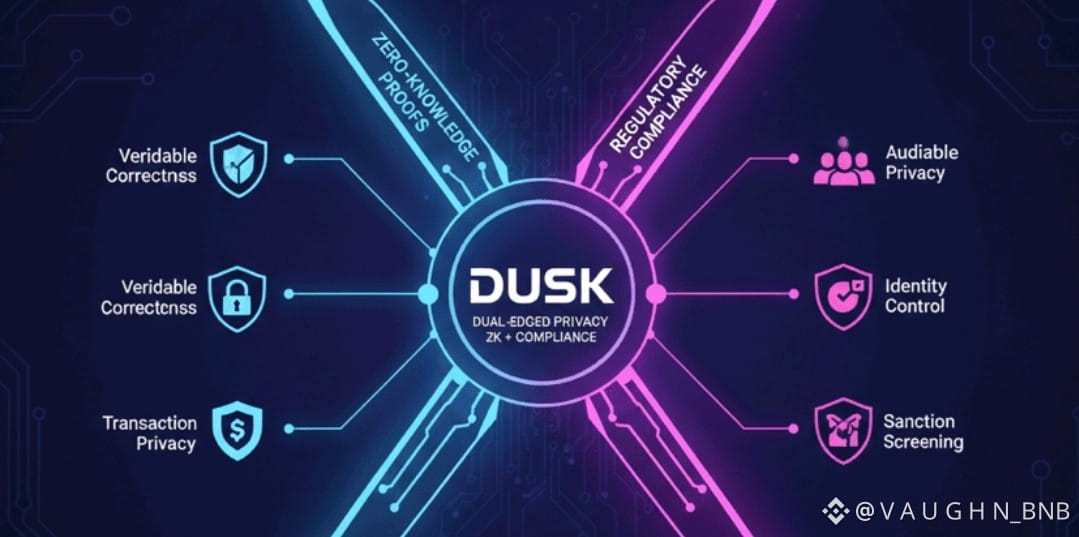
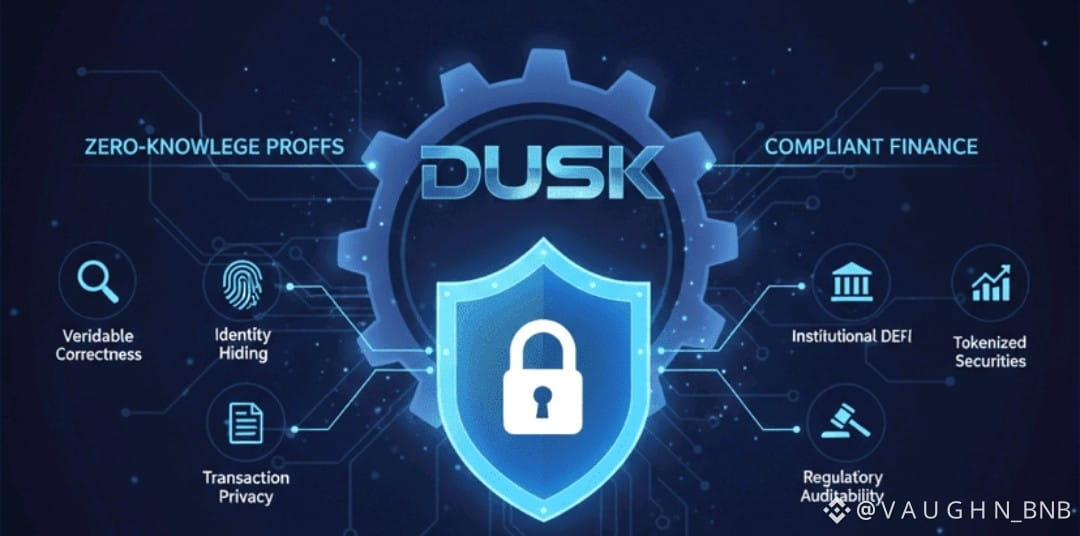
Now let me explain the pain point in very simple words. Many blockchains make every transaction easy to inspect. That can be great for transparency, but it becomes uncomfortable fast when you imagine normal life. A salary pattern. A monthly rent payment. A donation. A business paying suppliers. A family sending help. Once a wallet is linked to a person even one time, the entire history can feel like a trail of footprints that never fade. It becomes easy for strangers to guess who you are, what you earn, what you spend, and when you are vulnerable. That is not just awkward, it can feel unsafe. But here is the twist. Finance cannot run on secrecy alone either. Auditors need evidence. Regulators need visibility at the right moments. Firms need to prove they are following rules. So the real challenge is not privacy versus trust. The real challenge is privacy with proof. Dusk places that exact idea at the center of its protocol design.
This is where the world outside crypto starts to matter. Were seeing governments build clearer rules around crypto assets and crypto services, especially in Europe. The Markets in Crypto Assets Regulation, often called MiCA, entered into force in 2023 and then became applicable in stages, with key rules for certain token categories applying from 30 June 2024 and the wider regime applying from 30 December 2024. The European Securities and Markets Authority explains MiCA as the new regime for crypto asset services and notes the framework includes many implementing measures, showing this is not theory, it is a living system being actively built out. When you place Dusk next to this reality, its focus starts to make emotional sense. Theyre building for a future where privacy has to coexist with compliance, not fight it.
So how does Dusk try to do that without turning your brain into a math problem. The core tool is zero knowledge proofs. Here is the human version: you can prove something is true without showing the private details behind it. You can prove a transfer is valid without revealing the amount and the trail to the whole world. You can prove you meet a rule without handing over your entire identity file. Dusk’s whitepaper describes the protocol as preserving privacy when transacting with the native asset and highlights built in support for proof verification in its compute layer. This matters because it means privacy is not a decoration. It is part of how the chain is meant to function day to day.
The next piece feels like a story about giving privacy an actual body. Dusk has a privacy preserving transaction model called Phoenix. In the whitepaper, Phoenix is described as a UTxO based model built for confidential transfers in a world where smart contract costs might not be known until the end. That sounds technical, but the emotional message is simple: they want privacy that does not break the moment you try to build real applications. And in 2024, Dusk published an update saying the Phoenix model reached full security proofs, treating it as a major milestone toward privacy that can be trusted, not just claimed. When a team talks about proofs, it is a subtle form of respect. Theyre saying, you deserve evidence, not vibes.
But a chain built for finance cannot stop at private transfers. It needs programmable finance, because regulated markets still need logic, settlement rules, and complex workflows. Dusk’s whitepaper proposes a WebAssembly based virtual machine called Rusk and describes native support for verifying zero knowledge proofs inside that environment. If you are not technical, think of it like this. Smart contracts are the engine room of modern crypto systems. If the engine room cannot handle privacy cleanly, then privacy stays a side feature. Dusk is trying to make privacy part of the engine, so builders can create applications where sensitive data stays protected while correctness can still be proven.
Dusk also introduces another model in its whitepaper called Zedger, described as a hybrid privacy preserving transaction model aimed at compliance needs for security tokenization and lifecycle management. This is one of those details that quietly reveals intent. It suggests they are thinking about tokenized instruments and regulated asset flows from the start, not as a last minute add on. If you have ever watched traditional finance up close, you know how much of it is lifecycle management: issuance, ownership rules, transfers, reporting, and controls. Dusk is trying to meet that reality without giving up the human need for privacy.
Then comes the moment every project faces, the moment where it stops being a promise and becomes a responsibility. Mainnet. Dusk published a clear rollout plan in late 2024 with specific milestones, including a mainnet cluster dry run and timed steps for bringing balances into the mainnet genesis. And on 7 January 2025, Dusk announced that mainnet is live. This is not just a date. It is the point where people stop asking only what a project wants to be, and start asking what it does under pressure. It becomes real. It becomes something users can touch.
Now let us talk about the token side, but in a calm and human way. Tokenomics is really about incentives. It is about whether people will show up to secure the network, whether the system can survive long term, and whether participation can stay healthy without creating chaos. Dusk’s official documentation explains the emission schedule as a way to reward network participants, especially early on when transaction fees alone may not be enough to compensate those securing the network. That is a practical truth across many proof of stake systems. The details matter, but the feeling matters too. A network that wants to serve serious finance needs stability, and stability comes from aligning incentives so honest work is rewarded.
There is also a practical adoption question that every new chain must face: can people move between ecosystems without feeling trapped. In May 2025, Dusk announced a two way bridge that allows users to move native DUSK from its mainnet to a BEP20 form on Binance Smart Chain and back. I am mentioning this only because it speaks to a very human emotion: freedom. People want to explore without getting stuck. Builders want access to broader liquidity and tools. A bridge is not just plumbing. It is a signal that the team understands how people actually behave.
One more piece matters if you care about privacy beyond money, which most of us do. Identity. A lot of harm in the digital world comes from the fact that we keep handing pieces of ourselves to systems that do not deserve them. Independent research has explored Dusk in the context of self sovereign identity, describing a design where rights can be privately stored on the Dusk blockchain and later proven without exposing traceable public records. That kind of work matters because it shows the privacy tools are not only for hiding transfers. They can become a foundation for selective disclosure, where you prove what is needed and keep the rest of your life yours.
I also want to be honest with you in a warm way. This road is hard. Privacy engineering is difficult because small mistakes can leak patterns, and patterns are enough to hurt people. Regulated adoption is also slow because institutions move carefully, and regulators demand clarity, process, and evidence. MiCA itself includes many level 2 and level 3 measures that need to be developed and implemented, which is another way of saying the details keep unfolding over time. So if you ever feel impatient reading about a project like this, that feeling is normal. But the tradeoff is that if it works, it can last.
So what does the future look like if Dusk succeeds. It looks less like a loud revolution and more like a quiet relief. It looks like finance on chain that does not force people into public exposure. It looks like markets where sensitive data stays protected, but correctness can still be proven when it matters. It looks like businesses that can use on chain settlement without giving competitors a free window into their operations. It looks like a world where privacy is treated as dignity, not as suspicion. And it looks like a world where compliance becomes something you can satisfy with precise proof instead of constant surveillance.
If you take only one idea from this whole story, take this. Dusk is trying to heal a false choice many of us have accepted for too long. The false choice that says you can have privacy or you can have trust. Theyre building toward a third path where privacy is normal, and accountability is still real.