
I’m going to be honest, Walrus (WAL) doesn’t feel like one of those coins that wins people over with loud marketing, because the core idea is almost too practical for a market that loves drama, and that’s exactly why it can become so dangerous in a good way for traders who know how to sit with a narrative long enough to let it mature. Walrus is built on the Sui ecosystem and it’s designed around one simple pain: blockchains are terrible at storing big data, and modern crypto apps keep pretending they can live without big data even while they’re pushing into AI, gaming media, and rich onchain experiences. Walrus comes in as a storage and data availability layer that tries to make large files behave like first-class citizens, not awkward side quests that get shoved into centralized servers. The interesting part is that the “story” and the “system” are basically the same thing here, because if the system works at scale, the story writes itself, and if the system struggles, the token becomes just another chart you day-trade and forget.
Here’s how it works in a way you can actually feel in your hands, step by step, because the engineering choices are the whole point. When someone wants to store a file, Walrus doesn’t ask every node to copy the whole thing like old-school replication, because that would explode costs and kill performance; instead, it uses a two-dimensional erasure coding approach called Red Stuff that breaks the data into many smaller pieces and spreads them across a network of storage operators, and what makes it emotionally satisfying for anyone who’s ever lost data is that you don’t need every piece back to recover the file. You only need enough of the pieces, and the math is designed so the system stays resilient even if a large fraction of pieces go missing or operators act badly, while still keeping overhead low enough to be economically realistic at scale. They’re not just chasing redundancy, they’re chasing smart redundancy, and the research framing around Red Stuff is explicitly about high resilience, efficient recovery, and security in messy real-world network conditions rather than neat lab assumptions.
Now the part that traders often miss, because it sounds like a detail until you realize it’s the bridge between “storage” and “programmable money.” Walrus wants proof that the network actually accepted your data for storage, not just a promise, so it leans on a concept called Proof of Availability, which is basically an onchain certificate that acts like a receipt for storage acceptance. If you’ve ever watched a market rip because a protocol introduced a clean primitive that other builders can reference, you’ll understand why this matters: a receipt is composable, meaning apps can point to it, auditors can verify it, and automated systems can reason about it without trusting a single company or server. Binance’s own ecosystem write-ups describe PoA in that “receipt” spirit, where the onchain state can reflect that storage was accepted and incentives can circulate around providing that service, which is a neat way of saying the chain can coordinate payments and accountability around data without guessing.
Under the hood, the economics are where WAL stops being a narrative token and becomes a mechanism token. Walrus runs a delegated proof-of-stake style model for selecting and incentivizing storage providers, which means operators are not just random volunteers, they’re economically bonded participants who can be rewarded for good behavior and punished for bad behavior, and token holders can delegate stake rather than running infrastructure themselves. If it becomes a healthy network, that stake becomes a gravity well, because storage services are only trusted when operators have something meaningful to lose, and because committees and epochs can coordinate responsibilities without turning into chaos. Research overviews describe Walrus operating with epochs and an active storage committee, where delegated stake influences which providers participate in core operations, and that governance and incentive model is basically the protocol saying, “I’m not asking you to trust me, I’m asking you to trust the incentives.
So why was it built, emotionally and strategically, and why are we seeing this theme keep returning in crypto? Because centralized storage is convenient until it suddenly isn’t, and blockchains are trust machines until they have to carry real payloads like AI datasets, large media files, and continuously evolving application data. Walrus is trying to sit in the middle, taking the censorship-resistance and verifiability vibe that crypto promises and applying it to data itself, not just to token balances. The reason this matters for a trader is that “data markets for the AI era” is not just a slogan, it’s a direction of travel, because AI systems do not run on small text strings alone, and every serious builder eventually runs into the same question: where does the data live, who can prove it hasn’t been swapped, and who gets paid when it’s used. If Walrus becomes one of the default answers to those questions, demand doesn’t just come from speculation, it comes from usage, and usage demand is the kind that can change the personality of a market over time.
Now let’s bring it back to Binance and make it concrete, because this is where the pro-trader lens wakes up. Binance listed WAL and opened trading against USDT, USDC, BNB, FDUSD, and TRY, with the seed tag applied, which is Binance’s way of telling you this asset is early-stage, higher risk, and likely to move like a living thing rather than a stable commodity. That seed-tag context matters because it shapes liquidity behavior, it shapes how fast whales will punish over-leveraged crowds, and it shapes how market makers price risk around it, especially in periods where the whole market is rotating between “risk-on alt season” and “risk-off survival mode.” When you trade something like this, you’re not just trading a chart, you’re trading a story that’s still being negotiated by the market, and those are the environments where the cleanest money is made by people who respect volatility rather than trying to tame it.
The first numbers you watch are supply reality and valuation pressure, because supply is the silent hand on every rally. CoinMarketCap currently reports a circulating supply around 1.61 billion WAL with a max supply of 5 billion, alongside live price and market cap data that frames how the market is valuing the protocol right now. If you’re thinking like a pro, you don’t stare at price alone, you watch the gap between circulating supply and maximum supply and you ask yourself how the market will digest future emissions, unlocks, and incentive programs, because that’s where a lot of “mysterious” downtrends actually come from. The second number you watch is liquidity and volume behavior, because volume tells you whether a move is being accepted or simply being forced; when a token’s 24-hour volume stays healthy relative to its market cap, you’re seeing a market that can actually process emotion, while thin volume markets create exaggerated wicks that are fun to screenshot but brutal to manage.
Then comes the higher-level metric set that most people ignore because it requires patience, and patience is the rarest asset in crypto. I’m watching signs of real network pull-through: how often Proof of Availability certificates are being created, whether storage renewals and paid usage are expanding, whether operator participation looks robust, and whether the protocol keeps its promise of resilience and recovery without turning into a centralized “few big operators” system in disguise. When storage networks grow, they often grow unevenly, and they’re vulnerable to the temptation of convenience, where a handful of well-funded operators dominate early because they can run infrastructure smoothly; if that happens, the token can still pump, but the long-term narrative weakens, and the market eventually senses that weakness. On the flip side, if We’re seeing a steady spread of reliable providers and real applications building around PoA as a primitive, then the token’s value starts to feel less like pure belief and more like a rent on useful infrastructure, which is the kind of shift that can quietly reset valuation ceilings.
Now let’s talk risks in a way that doesn’t kill the excitement, because excitement without risk awareness is just gambling with better vocabulary. WAL trades in a narrative zone where it can be misunderstood, and misunderstanding creates both opportunity and danger, because people will call it “privacy” or “DeFi” or “data” depending on what angle they need for the moment, and that can whip price around as different crowds rotate in and out. There’s also execution risk, because advanced erasure coding and incentive design sound beautiful until the network is stressed by real adversarial conditions, uneven connectivity, operator churn, and the endless edge cases of real-world data systems, and any serious bug, exploit, or reliability incident can hit the token harder than you’d expect because trust is the product. Competition risk is real too, because decentralized storage is not a winner-take-all market yet; different networks serve different needs, and Walrus has to prove that its particular mix of efficiency, programmability, and verifiability actually becomes a default choice rather than a niche tool loved by engineers and ignored by everyone else.
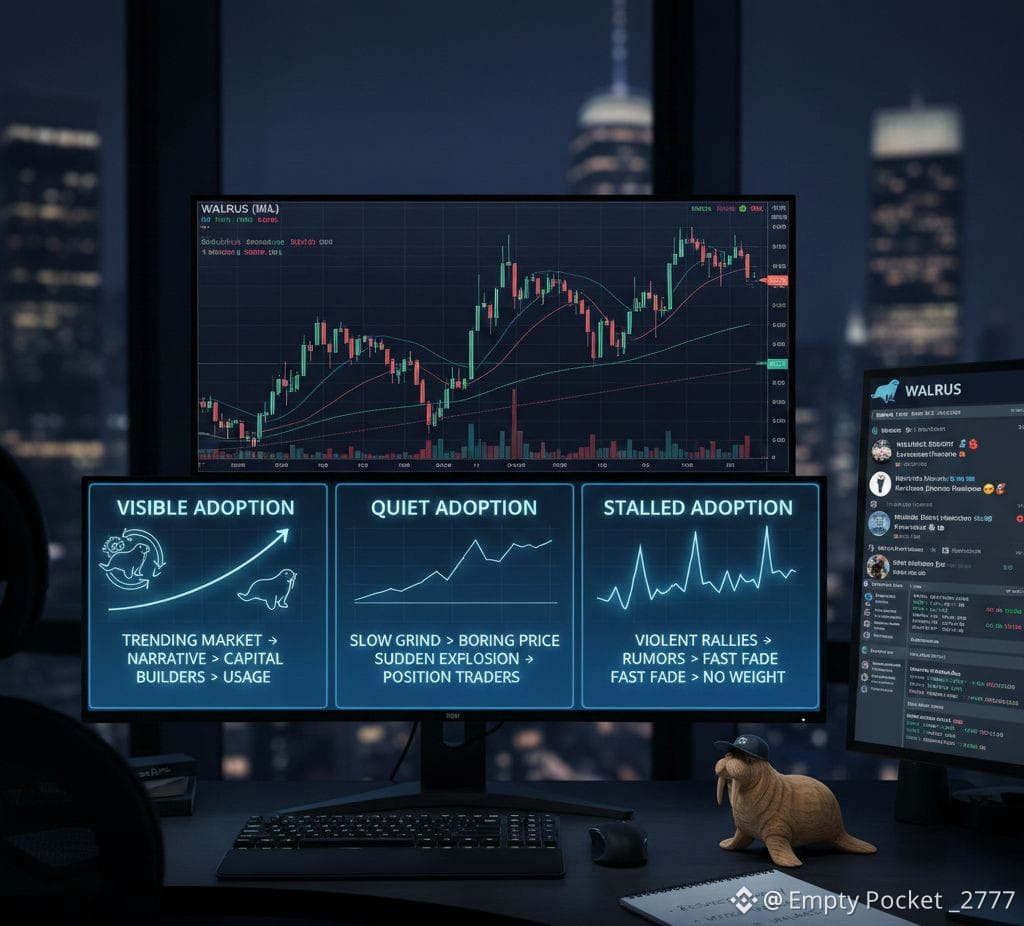
From a trader’s seat, the “future” question is less about prediction and more about what kind of market structure this story tends to produce. If Walrus adoption grows in a visible way, you can get the kind of trending market that feeds on itself, where higher usage strengthens the narrative, the narrative pulls capital, capital funds more builders, and the flywheel becomes self-reinforcing. If adoption grows but quietly, you can get a slower grind where price action looks boring until it suddenly isn’t, and those are the phases where position traders tend to outperform dopamine traders. If adoption stalls, WAL can still have violent rallies because crypto loves second chances and rumor-driven pumps, but those rallies tend to fade faster because there’s no underlying weight to hold the move. In all three scenarios, the pro move is the same: respect the supply story, respect liquidity, watch real usage signals, and keep your ego small enough to admit when the market is in a mood you don’t need to fight.
I’ll end it softly, because coins like this remind me why crypto is still worth watching even after all the noise. Walrus is one of those projects where the real magic isn’t in a slogan, it’s in the way the system tries to turn something fragile, like data availability and trust, into something measurable, tradable, and composable, and that’s a genuinely hard problem that the world keeps running into. They’re building infrastructure that could matter far beyond a single cycle, and I’m not here to tell you to buy or sell, but I am here to say this: when you find a market that’s attached to a real problem, and you learn to trade it with both courage and discipline, you’re not just chasing candles anymore, you’re learning how to ride the edge where technology becomes belief, and belief becomes a new kind of value.