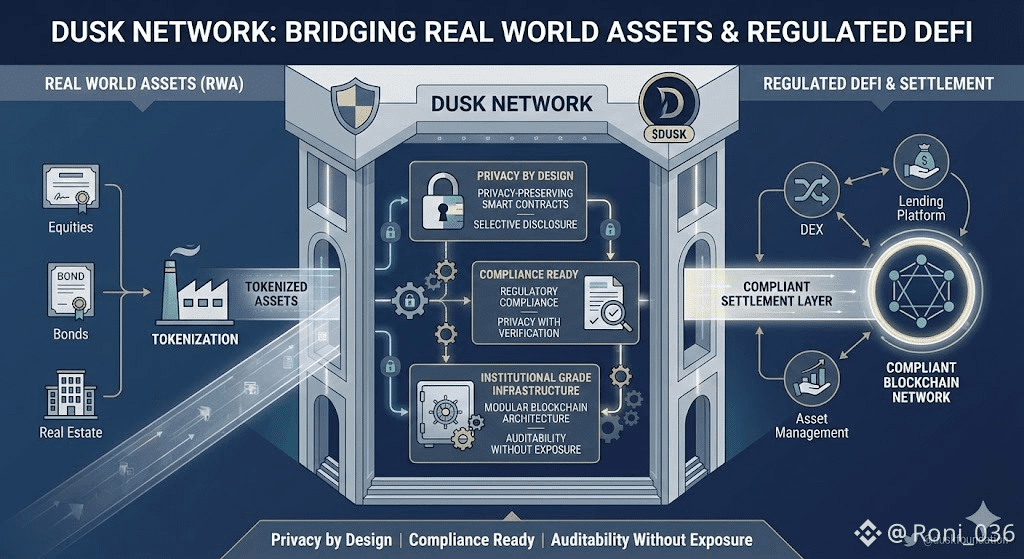
Blockchain technology has grown much more than it was when it was experimental. What started as an alternative financial system among fans has started to more and more overlap with regular finance, regulation and actual economic action. As such a transition occurs, the constraints of the majority of public blockchains are revealed. Institutions should not have transparency with no privacy. Meanwhile, speed, which is not in compliance, cannot be used in regulated markets. And speculation with no real infrastructure is not able to bring long term value. It is in this area that Dusk silently comes out different.
@Dusk _Foundation was founded in 2018 and has worked on a particular and commonly misconceived problem; how to create a public blockchain that supports regulated financial uses cases and maintains privacy, auditability, and legality. Rather than following the fads, Dusk has been created with real financial systems in the real world of real people. This strategy renders the project particularly pertinent since tokenized assets, compliant DeFi, and institutional blockchain adoption transition to reality.
@Dusk is a layer one blockchain that is constructed as regulated and privacy focused financial infrastructure. Considering that general purpose chains are trying to cater to all use cases, Dusk has focused on financial uses that need discretion, accountability, and trust. These are the traits that are necessary in the traditional markets and now interpreted in the decentralized setting.
The main concept of Dusk is that privacy and regulation do not necessarily need to be antitheses. In the majority of blockchains, it is absolutely transparent. All the transactions are transparent, all the balances visible. Although this can be effective in open networks, this does not go well in the financial situation where confidentiality is crucial. Companies are not able to reveal vulnerable deals. Shareholders do not have the ability to conduct their businesses in plain sight. Without privacy controls, institutions have no ability to abide by the regulations.
Dusk solves this issue by considering privacy as an intrinsic part of the protocol. The transactions may be confidential and yet verifiable. This balance enables regulators and auditors to verify that it was correct without revealing the personal information to the whole network. It is rational interpretation of the privacy that is not secrecy to the sake of secrecy, but privacy and accountability.
This philosophy of design is particularly crucial when speaking about tokenized real world assets. The concept of tokenization would see the introduction of equities, bonds, and funds to the blockchain. Nonetheless, the strict legal provisions control these assets. The records of ownership should be correct. No transfers should be against the rules of jurisdiction. The information of the investors should not be compromised.
These requirements are supported by the architecture of Dusk. Dusk offers institutions an opportunity to coexist with decentralization and compliance instead of having to choose one at the expense of the other. Dusk tokenized assets can be programmable compliant, selectively disclosed, and on chain private, by default. This renders the network to be applicable to financial instruments that cannot exist on fully transparent chains.
The other important feature of Dusk is its modular design. Instead of confining developers to a fixed system, Dusk gives components room to develop separately. This elasticity is of importance to the long term infrastructure. Regulations on finances vary. Privacy standards evolve. Institutions require stability and flexibility.
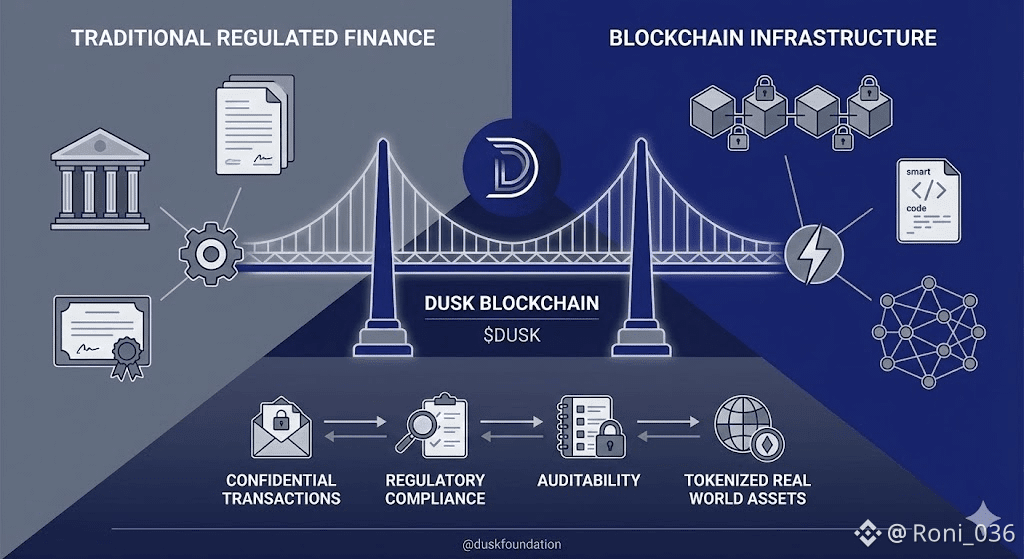
Dusk is modular in its protocol design, which allows upgrades to be provided in the future without interfering with the underlying network. This is an unspoken but vital enterprise and institutional benefit. The infrastructure should be helpful but it must be sustainable.
Compliant decentralized finance is also supported by dusk. The concept of DeFi tends to conflict with regulation since the majority of protocols are designed specifically to permit experiments. Although innovation is important, it cannot just substitute controlled financial markets. Dusk is taking another direction by allowing DeFi apps that may combine identity, compliance regulations, and privacy settings.
This does not imply the loss of decentralization. Rather it entails redefining it to actual financial conditions. On Dusk, regulatory constraints can be implemented with the use of smart contracts without exposing unnecessary information. This enables financial products to run on chain without violating the law.
A basic component of this ecosystem is the $DUSK token. It is not a speculative asset but a utility token, which helps the network to operate. The network is secured by use of DUSK transaction fees and staking. Its operation is in line with the larger objective of sustainability and long term usability as opposed to short term thrill.
The Dusk Foundation helps provide the governance and development direction of the network, and still dwells on partnerships, research, and protocol development. Instead of promoting stories, the foundation focuses on technical advancement and practical application. The method is indicative of the greater identity of the project: infrastructure before attention after.
Another thing that makes Dusk stand out is that it understands that not only is adopting blockchain a technical challenge, but also a human challenge. The financial systems are designed to benefit individuals, companies and even institutions. They should be readable, dependable and credible. The design decisions of Dusk are indicative of an idea of the real world functioning of finance when it is not associated with crypto communities.
To the end users, it implies working with applications that look familiar and have blockchain efficiency. To institutions, it is an opportunity to have a platform that does not compromise on compliance requirements at the expense of innovation. To the developers, it implies a dedicated environment which is more suited to financial logic than to general experimentation.
The topicality of other projects such as Dusk is on the increase as the world of finance examines the digital transformation. The aspect of tokenization, central bank research and institutional blockchain trials, all tend to show that the future will require a more sophisticated standard of a public blockchain. Privacy, compliance, and auditability are not features any longer. They are prerequisites.
Dusk is not promising the replacement of the current financial systems overnight. Rather, it provides a pragmatic point of contact between conventional finance and decentralized infrastructure. It aims at regulated use cases, thus putting itself in a position where blockchain adoption has best chances of occurrence.
Dusk signifies a lower tone vision of the space often filled with sound. It is a wake-up call that the true promise of blockchain is not found in speculation, but in the creation of systems that exist in the context of law, trust, and human needs.
With the development of the compliant DeFi and tokenized assets discussion, the efforts of @Dusk and the place of the $DUSK this space are worth considering. It is not the case due to hype, but because infrastructure created to operate in the real world is likely to be of most influence in the long term.