
DUSK A FRIENDLY STORY ABOUT A BLOCKCHAIN BUILT FOR REAL FINANCE
INTRODUCTION WHY THIS PROJECT FEELS DIFFERENT
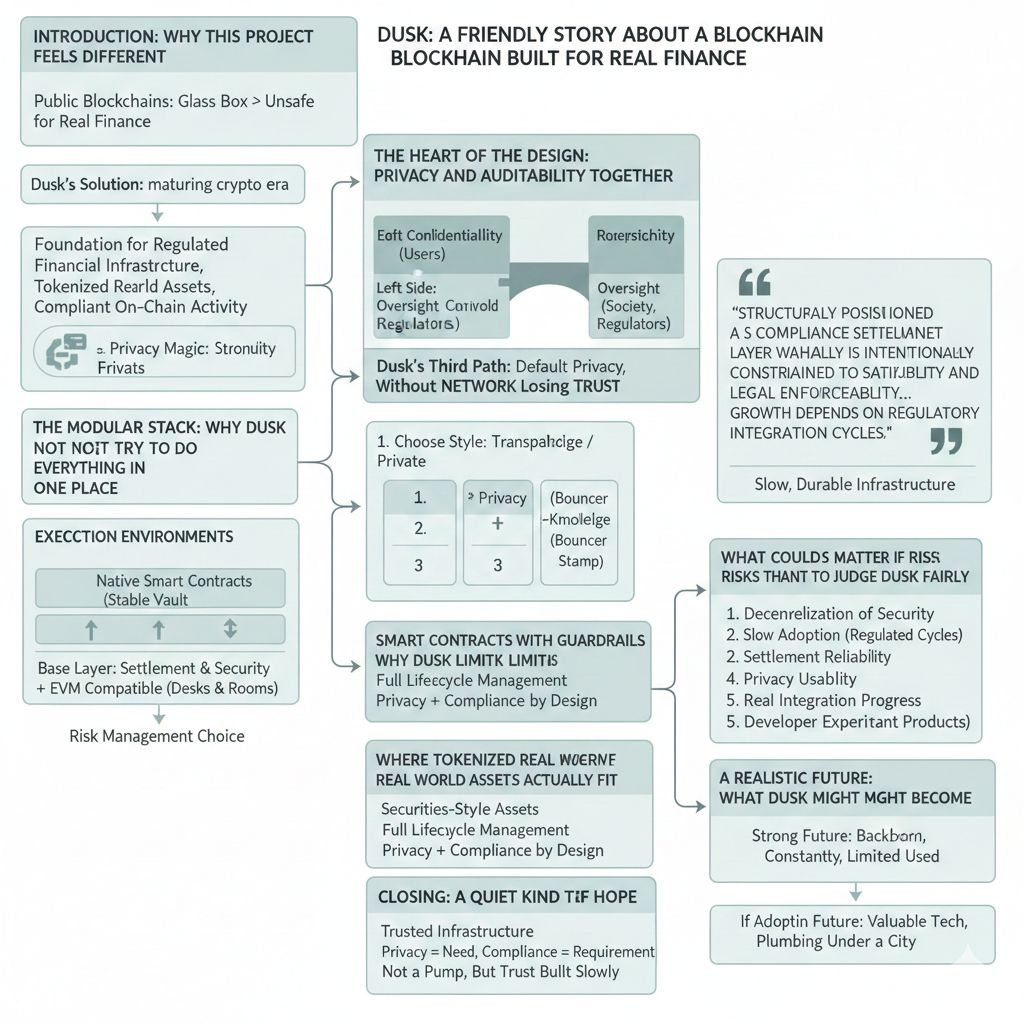
Let me start with a simple feeling most people have when they first look at crypto. Everything is so public. A normal blockchain can make your wallet look like a glass box. Anyone can watch money come in, go out, and sometimes guess why it moved. For casual use, some people shrug and accept it. But the moment you think about real finance, salaries, business payments, trading strategies, customer flows, or tokenized securities, that glass box starts to feel unsafe and unfair.
Dusk exists because it tries to fix that exact discomfort without throwing away the other thing finance needs: accountability. Institutions cannot operate on vibes. They need audits, controls, and a way to prove to regulators that the system is behaving correctly. Dusk is essentially saying we can keep sensitive details private while still keeping the chain honest and verifiable. I’m not asking you to love regulation, but I am asking you to notice something: when finance gets serious, rules show up, and technology either adapts to those rules or it stays on the sidelines.
HOW DUSK GREW FROM AN IDEA INTO A CLEAR MISSION
Dusk started in 2018, and that matters because it was born in a period when crypto was maturing. Back then, the industry was already realizing that huge parts of the world would not adopt blockchains that expose everything and cannot satisfy legal requirements. From the beginning, Dusk positioned itself less as a playground for speculative apps and more as a foundation for regulated financial infrastructure, tokenized real world assets, and compliant on chain activity with privacy built in.
That single sentence is basically the whole worldview. Dusk is not trying to become the loudest chain in the room. It is trying to become the chain that a cautious institution could actually use without risking its license, reputation, or customers.
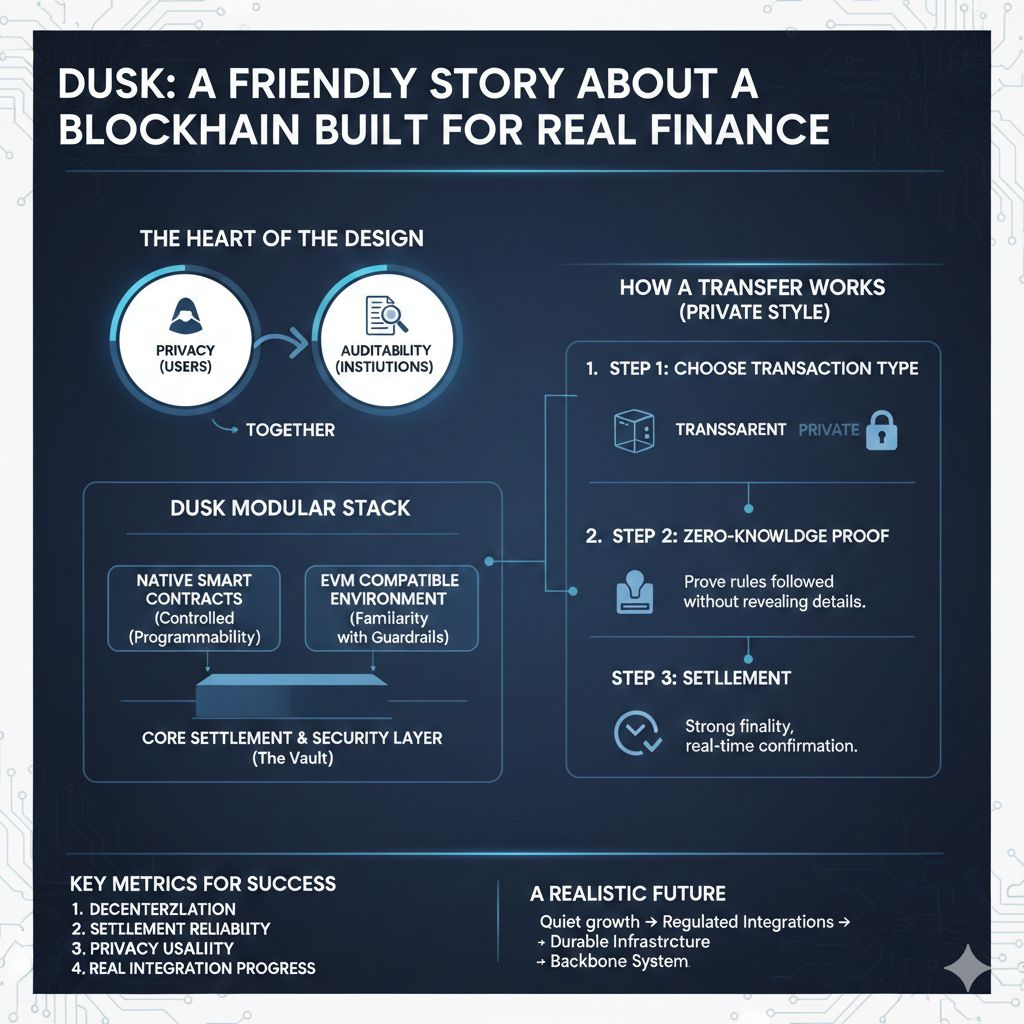
THE HEART OF THE DESIGN PRIVACY AND AUDITABILITY TOGETHER
Here is the emotional core of Dusk in plain language. People deserve confidentiality in finance, but societies also need oversight so markets do not become a free for all. Most systems choose one side. Purely public chains choose visibility and hope nobody gets hurt. Purely private systems choose secrecy and then struggle with trust and compliance. Dusk tries to build a third path: privacy as the default experience for users, with controlled transparency when legitimate oversight is required.
That is why you will hear Dusk talk about regulated finance so often. It is not just a slogan. It explains why the architecture looks the way it does, why some choices feel conservative, and why growth is expected to follow integration cycles rather than hype cycles.
THE MODULAR STACK WHY DUSK DOES NOT TRY TO DO EVERYTHING IN ONE PLACE
One of the smartest things Dusk does is keep the base layer focused on settlement and security, then allow different execution environments on top. Think of it like building a bank vault first, then deciding what kinds of desks and rooms you want inside the building later. The vault should not change every week. It should stay calm.
At the base, Dusk has a core layer that handles consensus and settlement. On top of that, Dusk supports environments where applications can run, including a native smart contract environment and an EVM compatible environment. This separation is not only technical elegance. It is a risk management choice. Institutions like systems where the most critical layer is stable and easy to reason about.
STEP BY STEP HOW A TRANSFER CAN BE PRIVATE WITHOUT THE NETWORK LOSING TRUST
To humanize how Dusk works, imagine you are sending value and you want two things at once. You want the network to confirm that you are not creating money out of thin air, and you want the rest of the world to mind its own business.
Step one is choosing what kind of transaction you are making. Dusk supports a transparent style and a private style. The transparent style is useful for flows that truly need open visibility. The private style is for confidential transfers where balances and amounts are not meant to be public.
Step two is where the magic becomes practical. When you use the private style, Dusk uses zero knowledge methods so you can prove your transfer follows the rules without revealing the sensitive details. If you are new to this, picture it like showing a bouncer a stamp on your hand instead of handing over your entire life story. The bouncer only needs to know you are allowed in. They do not need your bank statements, your address, and your whole history.
Step three is settlement. Whether your transfer is private or transparent, the chain still needs to finalize it and make it real. Dusk aims for strong finality because financial systems cannot live comfortably with constant uncertainty. In normal life, you can tolerate a package arriving a day late. In settlement, uncertainty can become risk, and risk becomes cost.
SMART CONTRACTS WITH GUARDRAILS WHY DUSK LIMITS FREEDOM ON PURPOSE
Many chains celebrate unlimited programmability. Anyone can deploy anything, and the chain becomes a chaotic bazaar of experiments. That can create innovation, but it can also create disasters, and regulated institutions have a low tolerance for chaos.
Dusk still supports smart contracts, but it approaches programmability with a more careful mindset. The goal is to keep systems auditable and behavior understandable. This is a big reason Dusk is often described as being built for institutional grade finance. They’re not optimizing for the fastest meme cycle. They’re optimizing for something that can survive audits, formal reviews, and legal accountability.
WHERE TOKENIZED REAL WORLD ASSETS ACTUALLY FIT
Tokenized assets are easy to talk about and harder to deliver in reality. A security is not just a token with a logo. It comes with real rules: who can hold it, when it can move, what disclosures are required, what happens during corporate actions, and how records must be reconstructed if there is a dispute.
Dusk has built standards and transaction models aimed at securities style assets and full lifecycle management, with privacy and compliance considered at the design level. This is where Dusk’s personality becomes clear. It wants to be a settlement layer for regulated instruments, not just a chain that hosts random applications.
WHY YOUR STATEMENT ABOUT DUSK FEELS ACCURATE
You said Dusk is structurally positioned not as a DeFi chain competing for liquidity, but as a compliance settlement layer where programmability is intentionally constrained to satisfy auditability and legal enforceability, meaning its growth depends on regulatory integration cycles rather than crypto market cycles.
That reads like the most grounded way to understand Dusk. In the real world, regulated integrations happen in stages: partner selection, legal review, technical pilots, approvals, audits, and then slow rollout. That rhythm is not exciting in the short term, but it can produce durable infrastructure if it is executed well.
WHAT METRICS MATTER IF YOU WANT TO JUDGE DUSK FAIRLY
If you judge Dusk like a typical DeFi chain, you might look only for loud signals like short term liquidity surges. But Dusk is aiming for a different kind of success, so the health indicators look different too.
One important metric is decentralization of security. You want to see a healthy validator set and staking participation that is not overly concentrated.
Another metric is settlement reliability. The chain should behave predictably, produce blocks consistently, and maintain stable finality characteristics over time, especially when the market is stressed.
Another metric is privacy usability. Private transactions must be usable by real people and real applications without becoming painfully slow or expensive. If privacy is too difficult to use, people will avoid it, and the chain loses one of its main reasons to exist.
A major metric for Dusk is real integration progress. This includes regulated pilots, issuance workflows, and partnerships that move beyond announcements into actual production behavior.
Finally, developer experience matters, but in a more mature way. The question is not how many experiments exist. The question is whether builders can create reliable, compliant products that institutions can run without fear.
WHAT COULD GO WRONG THE RISKS THAT DESERVE HONEST ATTENTION
The biggest risk is slow adoption because regulated cycles are slow. That is not a technical failure, it is a market reality. If you expect constant fireworks, you will misread quiet progress as no progress.
Complexity is another risk. Privacy tech, compliance standards, and hybrid transaction models increase the surface area for mistakes. This is why audits, testing, and conservative releases matter so much here.
There is also competitive risk. Institutions might choose private permissioned systems or consortium ledgers instead of public infrastructure, even if public infrastructure is better technically, simply because internal legal departments prefer what feels familiar.
Regulatory perception is a fragile thing. Privacy tools can be misunderstood. The project must continuously show that privacy is about protecting legitimate users and businesses, not about avoiding lawful oversight. If the narrative around privacy gets unfairly politicized, adoption could slow.
And there is a community risk too. A chain with guardrails can feel less thrilling to the part of crypto that loves maximum freedom. Dusk has to balance seriousness with enough openness that builders still feel inspired.
A REALISTIC FUTURE WHAT DUSK MIGHT BECOME
In a realistic future, Dusk grows in steps. It looks quiet for months, then a regulated integration goes live and suddenly the chain matters in a new way. That kind of growth can feel slow, but it can also be deeply durable.
In a stronger future, tokenized securities and compliant stable assets become normal, and institutions begin to prefer settlement layers where confidentiality and auditability were designed together rather than forced together later. If that happens, Dusk can become a backbone system that is not trendy but is constantly used.
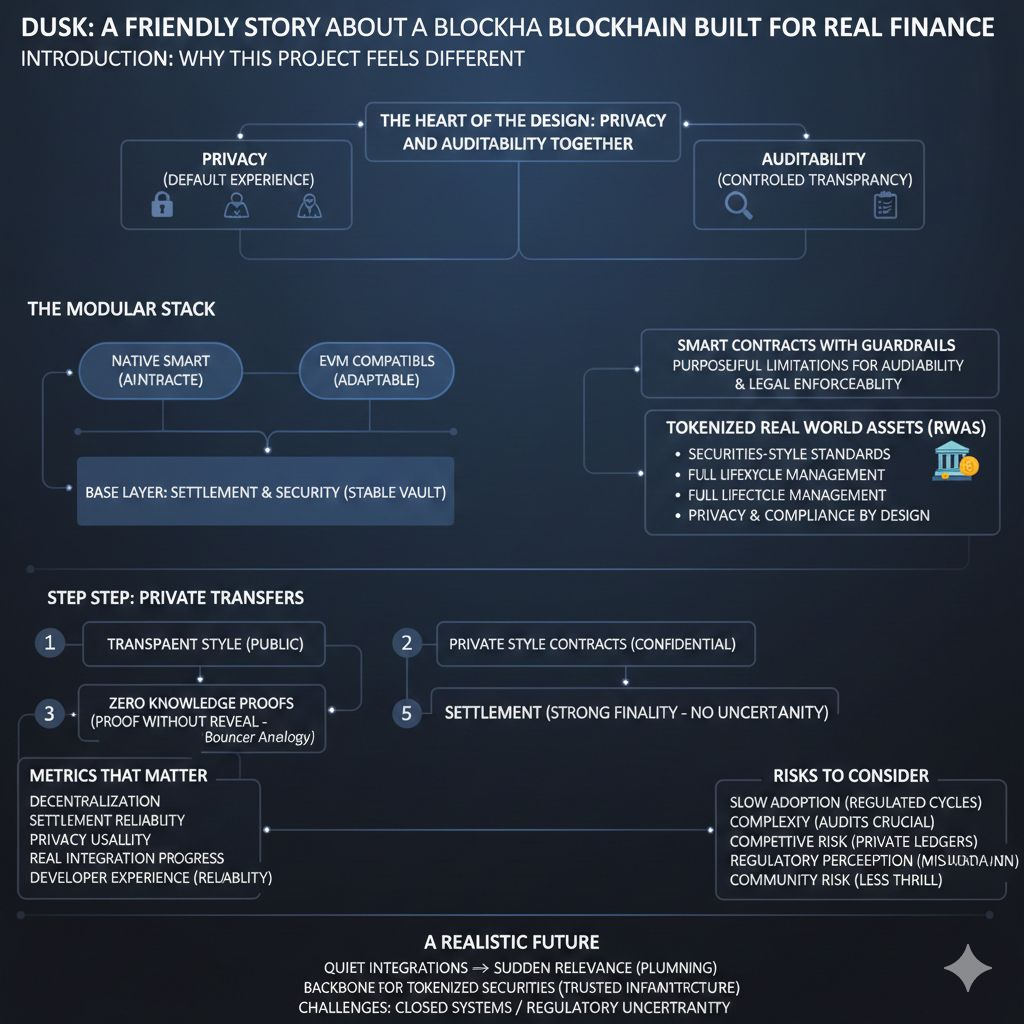
In a weaker future, the world chooses closed systems, or regulatory uncertainty stays high, or developers choose other ecosystems because they want faster retail traction. Dusk could still remain valuable technology while not reaching the scale it aims for.
If adoption takes off, it will probably not look like a DeFi summer. It becomes more like plumbing getting installed under a growing city. We’re seeing the early shape of that world across finance in general, where digital assets are expected to behave like real instruments, not like toys.
A QUICK NOTE ABOUT EXCHANGES WITHOUT DISTRACTION
If you ever need a simple reference point for trading access, keep it clean and stick to Binance. The real story here is not where it trades. The real story is whether it becomes trusted infrastructure.
CLOSING A QUIET KIND OF HOPE
I want to end this calmly, because Dusk is not a project that makes the most sense when you are hyped. It makes sense when you imagine a world where blockchain is not just a playground, but a place where real assets and real obligations can move safely.
If Dusk succeeds, it will be because it treated privacy as a basic human need and compliance as a practical requirement, not as an enemy. It will be because it built the kind of chain that can be explained to a regulator without embarrassment and used by a normal person without fear.
And if you are watching from the outside, the most motivating way to think about it is this: progress in finance does not always look like a pump. Sometimes it looks like trust being built slowly, one careful integration at a time, until the new system feels normal. If that happens, Dusk will not need to compete for attention. It will simply be there, quietly doing its job, and that is exactly what good financial infrastructure is supposed to feel like.
