
Vanar Chain and the quiet art of making Web3 feel normal
Introduction: the feeling Vanar is chasing
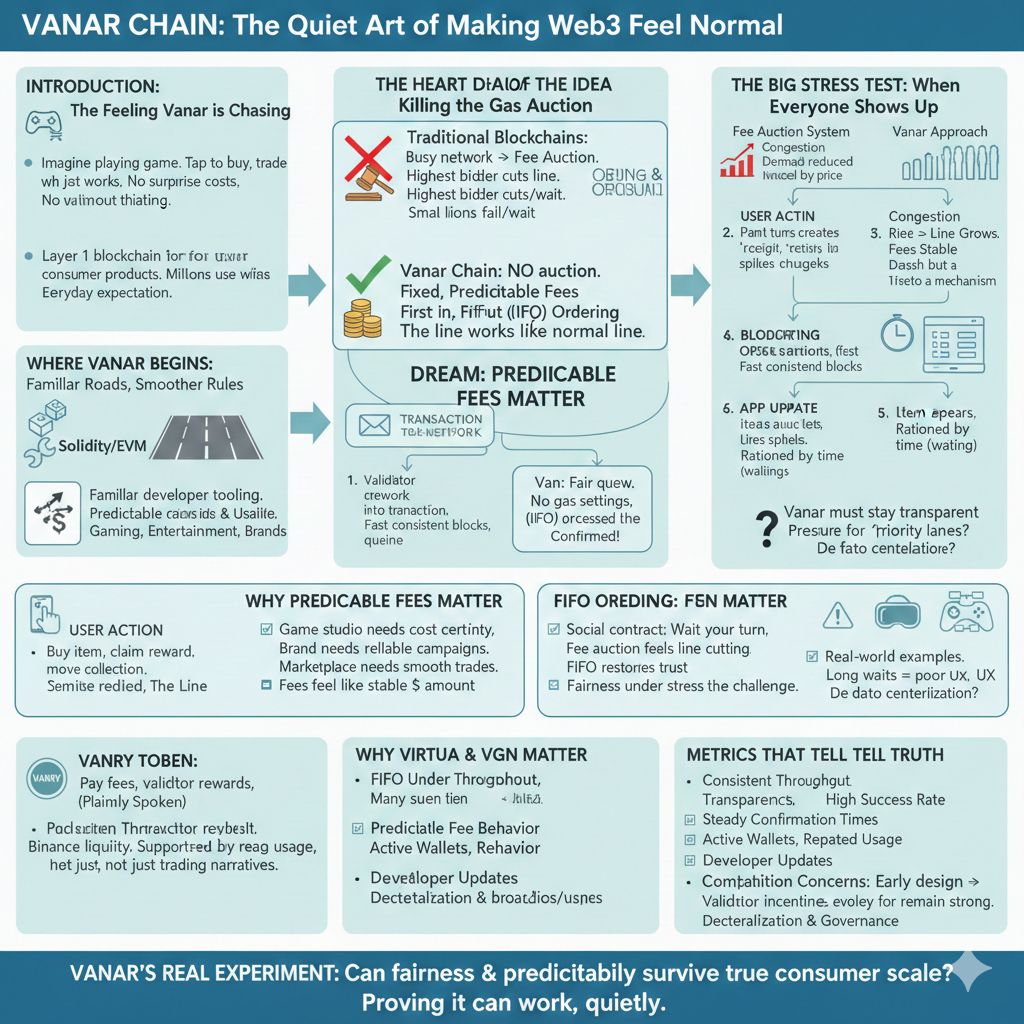
Let me start with a simple picture. Imagine you are playing a game you genuinely love. You tap to buy a small item, or you trade a collectible with a friend, and you expect it to just work. No strange warnings. No surprise costs. No waiting so long that the moment loses its spark. Vanar Chain is built around that everyday expectation. It is a Layer 1 blockchain that wants to serve real consumer products, the kind that millions of people use without thinking about the technology underneath.
I’m going to explain Vanar like I would to a friend who is curious but not technical. The important thing to remember is that Vanar is not trying to win by sounding the most complex. It is trying to win by being predictable and usable, especially for things like gaming, entertainment, and brand experiences. Those are areas where people do lots of tiny actions, and tiny actions cannot survive in a world where costs and speed suddenly swing up and down.
The simple question Vanar is asking is almost emotional. Can we make blockchain feel calm and reliable enough that it stops being the main character and becomes the background?
Where Vanar begins: familiar roads, smoother rules
Some blockchain projects build everything from scratch. Vanar takes a different approach. It leans into familiar developer tooling and patterns so builders can arrive without feeling lost. That matters because the fastest way to grow a real ecosystem is to reduce friction for the people building products. When developers can reuse what they already know, they ship faster, and users get real things to try.
But Vanar also looks at what is normal in many chains and says, this part is not friendly for mainstream adoption. It focuses on the specific pain that hurts consumers the most, which is the fee experience and what happens when a network gets crowded.
Think of it like a city. You can keep the same basic map and the same kind of cars, but if traffic rules are chaotic, nobody enjoys driving. Vanar is trying to redesign the traffic rules so the ride feels smooth even when the streets are busy.
The heart of the idea: killing the gas auction
Here is the part that makes Vanar feel bold.
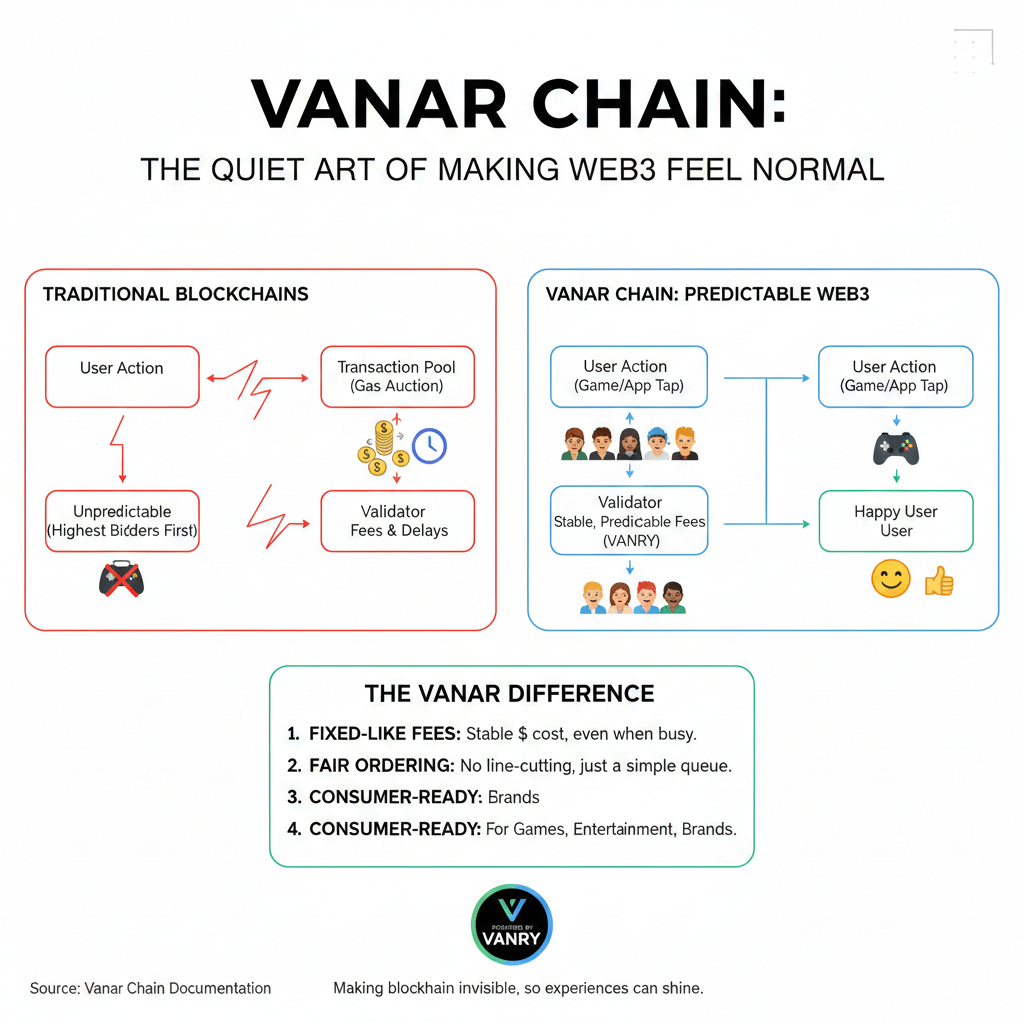
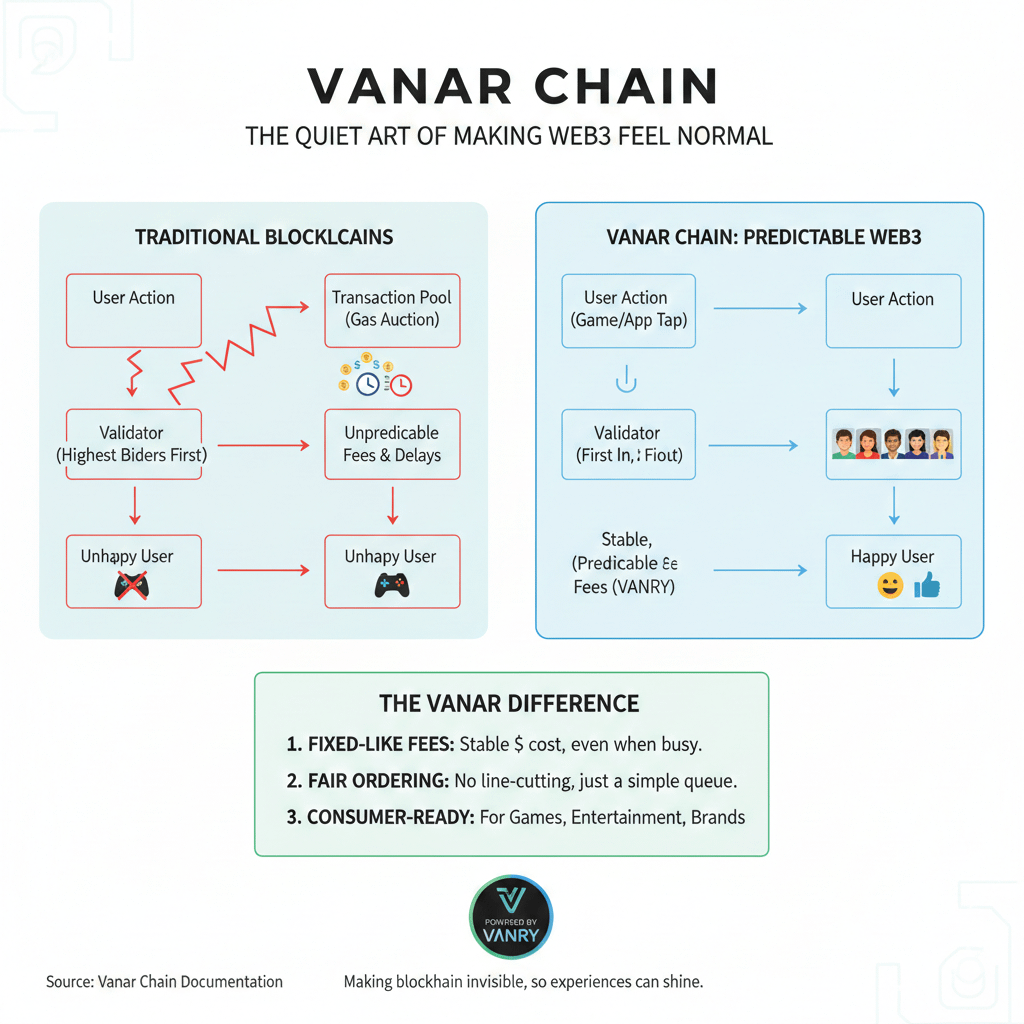
On many blockchains, when the network gets busy, an auction quietly begins. People compete to get their transaction included, and the way they compete is by paying more. If you pay more, you cut the line. If you pay less, you wait, or you fail, or you keep retrying until you get lucky. That might be acceptable for traders moving large value, but it is a nightmare for consumer apps where a single user might do dozens of small actions in one session.
Vanar is trying to kill that auction. It wants fees to feel fixed and predictable in real world terms, and it wants transactions to be processed in a simple first in first out order. In human terms, Vanar wants the line to work like a normal line. If you arrived earlier, you should go earlier. You should not have to pay extra just to be treated fairly.
This is exactly what you pointed to. Vanar’s real experiment is not just being cheap. It is trying to make microtransactions predictable under peak congestion without sliding into a quiet system where someone behind the scenes decides who gets served first.
If you understand this tension, you understand Vanar.
How a Vanar transaction works: the story of one tap
Let’s walk through what happens when you do something on a Vanar powered app, like a game connected to the VGN games network or a metaverse style experience like Virtua.
First, you do something simple. You buy a small item. You claim a reward. You move a collectible. The app turns your action into a transaction. You do not need to understand the transaction. You only need it to behave.
Next, that transaction is sent to the network and placed in a waiting area where pending transactions gather. Picture a line forming at a counter. Every person in line is a transaction.
Then a validator produces a new block. A block is like a new batch of receipts stamped at once. When blocks are produced quickly and consistently, apps feel responsive.
Now comes the part that defines the experience. The network decides which transactions get included and in what order. In a fee auction chain, the ordering tends to reward the highest bidders. In Vanar’s approach, the goal is to keep a fair queue where earlier arrivals are processed earlier.
Finally, your transaction gets confirmed, and the app updates. The item appears. The trade completes. The ownership changes. You move on with your day.
That is the dream. A clean flow where you never have to stop and think about gas settings, fee spikes, failed transactions, or weird delays.
Why predictable fees matter more than people realize
When you are deep in crypto culture, it is easy to accept unpredictable fees as normal. But consumer markets do not forgive unpredictability. A game studio wants to know the cost of supporting a million players. A brand wants to run a campaign where every participant can claim something without the experience breaking. A marketplace wants to process many small trades without making users feel punished for being active.
That is why Vanar’s fee framing is such a big deal. The goal is that the fee feels like a stable dollar amount rather than a number that can suddenly explode because the network is busy. In practice, the fee is still paid in the network token, VANRY, but the intention is that the fee behaves like a predictable real world price.
This is the kind of design choice that sounds boring until you imagine a teenager trying to buy a tiny in game item and seeing a fee that is bigger than the item. That is not adoption. That is a door slamming shut.
FIFO ordering: fairness that people intuitively trust
FIFO ordering is one of those ideas that feels almost too simple, which is why it is emotionally compelling.
Most people understand lines. A line is a social contract. You wait your turn, and you trust that others are waiting too. When a system allows line cutting, people get frustrated even if the system is technically working. The fee auction model can feel like line cutting at scale, and it can make everyday users feel like the system is for someone else.
FIFO aims to restore that simple trust. Your place in line should be earned by when you arrived, not by how much extra you offered.
But here is the honest truth. Fairness in calm times is easy. Fairness under stress is hard. The moment the network gets congested, the line grows, and the line becomes the user experience. That is where Vanar will either prove its philosophy or feel pressure to compromise.
The big stress test: what happens when everyone shows up at once
This is the part where your question becomes the center of the story.
In a fee auction system, congestion is rationed by price. When demand rises, fees rise. Some people stop using the network because it becomes too expensive, and that reduces demand. It is harsh, but it is a mechanism.
In Vanar’s approach, congestion is rationed mostly by time. Fees stay stable, but the line can grow. Instead of paying more, you wait longer.
Waiting can be fine for some things. If you are moving a collectible and it confirms in a few extra seconds, you might not mind. But if you are in a game loop where actions need to feel immediate, long delays can break the experience. If you are a brand running a timed drop, long queues can turn a fun moment into chaos.
And that is where the subtle danger appears. When time rationing becomes painful, powerful actors start asking for exceptions. They want guaranteed throughput. They want priority lanes. They want special treatment during peak moments.
This is how de facto centralized rationing can sneak in. Not with a loud announcement, but with quiet arrangements that certain partners are processed first, or certain traffic is treated differently, or certain patterns are filtered.
The real test for Vanar is whether it can handle peak demand with rules that stay transparent and fair. If It becomes a chain that keeps the line fair even in the storm, it will earn a kind of trust most networks struggle to win. If it cannot, the pressure to create exceptions could slowly reshape the chain into something that feels fair only as long as you are on the inside.
I want to say this gently, because it is not about accusing anyone of bad intent. It is about incentives. Consumer products create pressure. At scale, pressure finds weak points.
What VANRY does, in plain language
VANRY is the fuel that makes the network run.
When you do an action, you pay a fee, and that fee is paid in VANRY even if the system tries to keep the cost stable in dollar terms. Validators also need incentives to secure the network, and tokens often play a role in rewards and participation.
If you ever check market activity, you will see VANRY on Binance, which is where many people look for liquidity and price discovery. But the deeper meaning of VANRY is not the chart. The deeper meaning is whether it is powering real usage that comes from people doing things, not just trading narratives.
When a chain is truly healthy, its token is supported by the simple fact that users and apps actually need the network.
Why Virtua and VGN matter for the story
Vanar often points to products like Virtua Metaverse and the VGN games network because they represent the kind of world Vanar is designed for.
These are environments where users might perform many small actions. Claim, trade, mint, buy, upgrade, move. The network must behave like a reliable service. The user cannot be asked to become a fee strategist. They cannot be asked to wait unpredictably. They cannot be asked to troubleshoot failed transactions as if they are doing technical work.
In consumer markets, the technology only survives if it disappears into the experience. They’re not coming for the chain. They are coming for the fun, the identity, the social layer, the sense of ownership, the sense that digital things can have meaning.
So when people talk about Vanar’s ecosystem, the most important question is not how many partnerships are announced. The important question is whether real people are using these experiences and returning, because that is where the chain either becomes real or stays theoretical.
The metrics that actually tell the truth
When you want to judge whether Vanar is genuinely healthy, you need to look at signals that reflect its mission.
You want to see consistent transaction throughput and a high success rate, especially during busy periods. A consumer chain must not collapse when attention arrives.
You want to see confirmation times that feel steady, because consumer experiences are rhythms. If the rhythm breaks, retention breaks.
You want to see fee behavior that remains predictable in practice. This is Vanar’s signature promise. If fees drift during volatility, the story weakens.
You want to see active wallets and repeated usage rather than one time spikes. Adoption is not a spike. Adoption is a habit.
You want to see developers shipping updates and users responding. Real products have movement. If things feel frozen, it is a warning sign.
You also want to watch decentralization and governance signals. When key parameters depend on a central actor or a tight group, it can work early on, but it carries long term trust risk. A healthy trajectory is one where the rules become more auditable, participation becomes wider, and power becomes harder to capture.
Risks and weaknesses, spoken plainly and without drama
Vanar’s strengths are also its risks, because it is trying to change the part of blockchain economics that most chains rely on.
The predictable fee approach creates a dependency on how that predictability is maintained. If the system relies on external inputs or a coordinator to keep the fee stable in dollar terms, that must be done with transparency and strong safeguards.
FIFO ordering is fair in theory, but it creates real challenges under congestion. If the network gets busy and the line grows, the user experience becomes waiting, and consumer apps do not tolerate long waits.
Early network design choices that prioritize stability can also raise centralization concerns. This is not a moral judgment. It is simply the trade off. Curated validators can produce consistent performance, but it means the chain must prove it can evolve toward broader participation without losing reliability.
There is also the reality that ultra low fees are not free. They change how the network funds security and how validators are incentivized. Long term sustainability requires that incentives remain strong even when fees are tiny.
And then there is the hardest risk, which is simply competition and attention. Consumer ecosystems are ruthless. Many chains want to be the home of games and entertainment. The winners will be the ones that make it genuinely easy for studios to ship and for users to stay.
A realistic future: what success could look like without fantasy
A realistic success story for Vanar is not that it becomes the only chain people use. A realistic success story is that it becomes the chain that consumer builders trust when they need predictable microtransactions, fast confirmations, and an onboarding experience that does not scare away new users.
In that future, Vanar becomes a quiet backbone for experiences people actually enjoy. A game economy that feels smooth. A marketplace where small trades do not feel punished. A metaverse style world where interactions are stable. Brand activations that do not collapse under hype.
We’re seeing the broader industry slowly learn that user experience is not a side quest. It is the main quest. And user experience is built on predictability. That is what Vanar is trying to supply.
But the real proof will come from stress. Peak congestion moments. Viral campaigns. Sudden influxes of users. In those moments, Vanar must show that its fixed fee and FIFO ideals do not collapse into quiet exceptions. It must show that fairness is not a slogan. It is a property.
Closing: calm hope and steady motivation
Vanar’s vision is almost simple enough to underestimate. It wants blockchain to stop feeling like a gamble and start feeling like infrastructure. It wants tiny actions to stay tiny, even when the network is busy. It wants the line to feel fair, not like a marketplace where the richest voice always goes first.
I’m not asking you to believe in it blindly. I’m saying this is a real experiment, and experiments are valuable because they teach us what the future can and cannot be. If Vanar proves that predictable fees and FIFO ordering can survive real consumer scale without drifting into behind the curtain rationing, it will carve out a meaningful place in Web3. Not by shouting, but by quietly working.
And that kind of progress is worth caring about. Because the future that actually reaches billions is not the one that demands everyone become technical. It is the one that meets people where they are, gives them a smooth experience, and lets them discover ownership and digital value without stress. If It becomes that kind of bridge, it can leave people not hyped and anxious, but calm, motivated, and ready to build something real.
