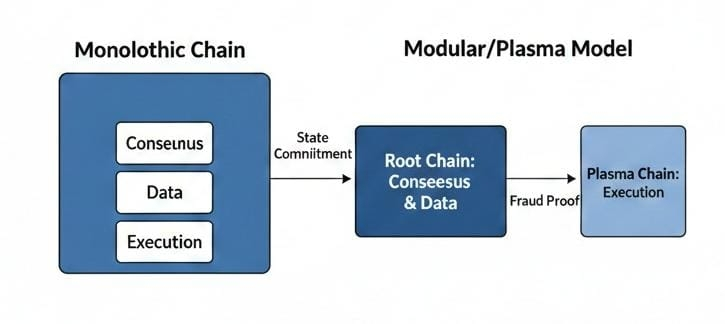
Most blockchain architectures are built on a flawed, all encompassing premise: that a single, general purpose layer must provide consensus, data availability, security, and execution for every possible use case. This monolithic model forces a brutal triage. To prioritize decentralized security and consensus as Bitcoin and Ethereum do the network must inherently constrain throughput and increase cost at the execution layer.
Conversely, chains that prioritize high throughput and low fees often achieve this by consolidating validator control or weakening decentralization guarantees.
This creates a fundamental impedance mismatch with real-world user behavior. For activities like frequent, low-value payments, enterprise settlement, or microtransactions, users demand finality and low cost without needing to deeply contemplate the geopolitical distribution of validators.
The monolithic chain, striving to be everything to everyone, becomes optimal for nothing in particular. It is a settlement layer trying to double as a payment processor, a role for which it is architecturally and economically unsuited.
Specialization Over Singularity
Plasma, conceived by Vitalik Buterin and Joseph Poon in 2017, represents an early and philosophically pure answer to this problem. Its the radical specialization that not every transaction requires global consensus. Instead, Plasma proposes a hierarchy of commitments.
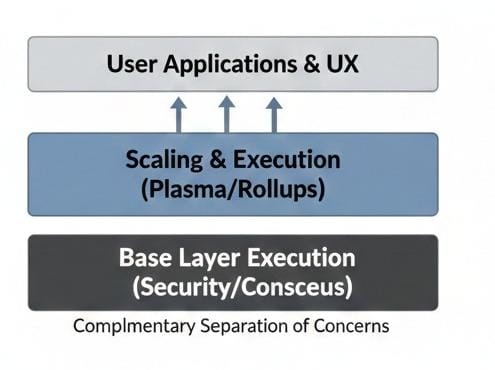
Its design philosophy is one of complementary scaling. It asks: what if we could create dedicated execution environments child chains or sidechains that handle vast volumes of transactions internally, while periodically anchoring their final state to a supremely secure parent chain (initially Ethereum)? The parent provides unchallengeable settlement and dispute resolution; the child provides scalable, cheap execution. This is not a marketing feature but a fundamental architectural choice that separates the roles of trust (provided by the base layer) and scale (provided by the attached layer).
Commitments and Exits
At its technical heart, Plasma is a framework for building scalable applications using fraud proofs anchored to a root blockchain. A Plasma chain operates with its own block producer, processing transactions at high speed. Critically, it does not ask the root chain to validate every transaction. Instead, it periodically publishes a cryptographic commitment—a Merkle root—of its current state to the root chain.
Users derive their security from a single, powerful guarantee: the ability to unilaterally exit back to the root chain. If a Plasma operator acts maliciously (e.g., by attempting to steal funds), users can submit a fraud proof to the root chain during a challenge period, using the published commitments as evidence. The system’s security is thus enforced not by validating all activity, but by providing a credible threat of punishment via mass exit. This makes it an EVM-compatible scaling solution that defers ultimately to Ethereum’s security model.
Predictable Finality
From a non-speculative user perspective a merchant accepting payments, a payroll system executing disbursements Plasma’s appeal is predictability. Transactions are fast and costs are negligible within the Plasma environment. My activity here is secured by Ethereum, even if I only interact with Ethereum during deposit and withdrawal." This creates a UX analogous to using a high-performance payment rail (like a Visa network) that is ultimately backed by the central bank's settlement system. The trust is derived from the root, but the experience is defined by the application layer.
The Credible Anchor
Plasma’s trust narrative is its strongest feature. It does not attempt to bootstrap a new consensus security model or token-powered validator set. Instead, it piggybacks directly on the security of its parent chain, typically Ethereum. This neutrality and credibly neutrality is paramount. For institutions or builders looking for scalable execution, the choice is not between "secure but slow Ethereum" and "fast but experimental new chain." It is a choice to build on a layer that inherits Ethereum’s battle-tested security while operating under a separate performance profile. This emphasizes provable security over speculative speed hype.
Plasma in the Modern Modular Stack
The narrative that "Plasma was superseded by rollups" is an oversimplification. Rather, Plasma’s ideas have been absorbed and refined within the broader modular blockchain thesis. The core innovation off chain execution anchored by on-chain settlements and fraud proofs is the direct intellectual predecessor to Optimistic Rollups. The primary architectural evolution was solving Plasma’s key limitation: data availability. Rollups guarantee data availability on-chain, simplifying the exit process and security model.
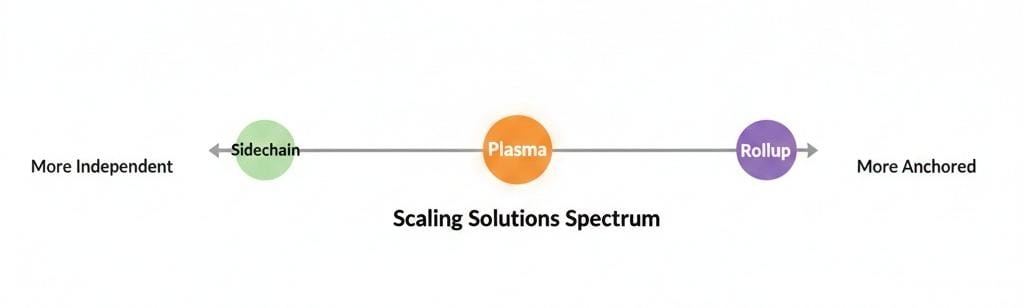
Plasma’s model retains distinct advantages for specific, closed-state applications where data availability can be managed explicitly. It represents a point on the design spectrum between sovereign sidechains and fully data-available rollups. Its role today is as a highly specialized, complementary network for use cases like payments or private enterprise chains where its assumptions hold. It is not a universal rollup competitor, but a specific tool in a larger toolkit.
Real Adoption and Complementary Scaling
The practical validation of this complementary model is seen in implementations like the OMG Network (formerly OmiseGO), which has processed hundreds of millions of dollars in value transfer for payments-oriented use cases. Its relevance is not in competing with Ethereum for smart contract dominance, but in providing a dedicated, efficient rail for value exchange that settles on Ethereum. This matters more than retail hype because it demonstrates functional integration into real economic workflows payments, remittances, treasury management where cost and speed are critical, and security is non-negotiable.
This underscores the broader thesis: the ecosystem scales not through a single chain capturing all value, but through a stack of specialized, interconnected protocols. The base layer provides ultimate trust. Rollups provide general-purpose scalable computation. Plasma-like constructions and state channels provide ultra-efficient, application-specific scaling. They are complementary, not competitive. Each layer does what it does best, and the user experience is seamlessly abstracted across them.
The Legacy of a Modular Blueprint
Plasma’s long term relevance is not contingent on it becoming the dominant scaling paradigm. Its significance lies in its foundational contribution to a more nuanced and effective architectural philosophy. It moved the conversation beyond the simplistic "one chain to rule them all" model and provided a clear, security-first blueprint for building complementary execution layers.
In the end, robust infrastructure is not built through monolithic conquest, but through intelligent specialization and secure interoperability. Plasma, as an early and rigorous articulation of this principle, remains a critical chapter in the ongoing story of how blockchain technology evolves from a novel experiment into a stable, scalable, and useful foundation for global economic activity. Its legacy is the modular stack itself a testament to the power of complementary design over solitary competition.