I've been in this space long enough to know that most Layer 1s chase the same shiny narrative faster blocks, cheaper gas, DeFi summer 2.0, or whatever meme coin pump is trending this week. Dusk Network doesn't play that game. It never has. Founded back in 2018 when most people still thought privacy meant Monero forks and compliance was a dirty word whispered only in TradFi boardrooms, Dusk quietly built something entirely different: a blockchain where privacy isn't an afterthought or a rebellion against regulators it's the compliant foundation for moving real institutional money on-chain.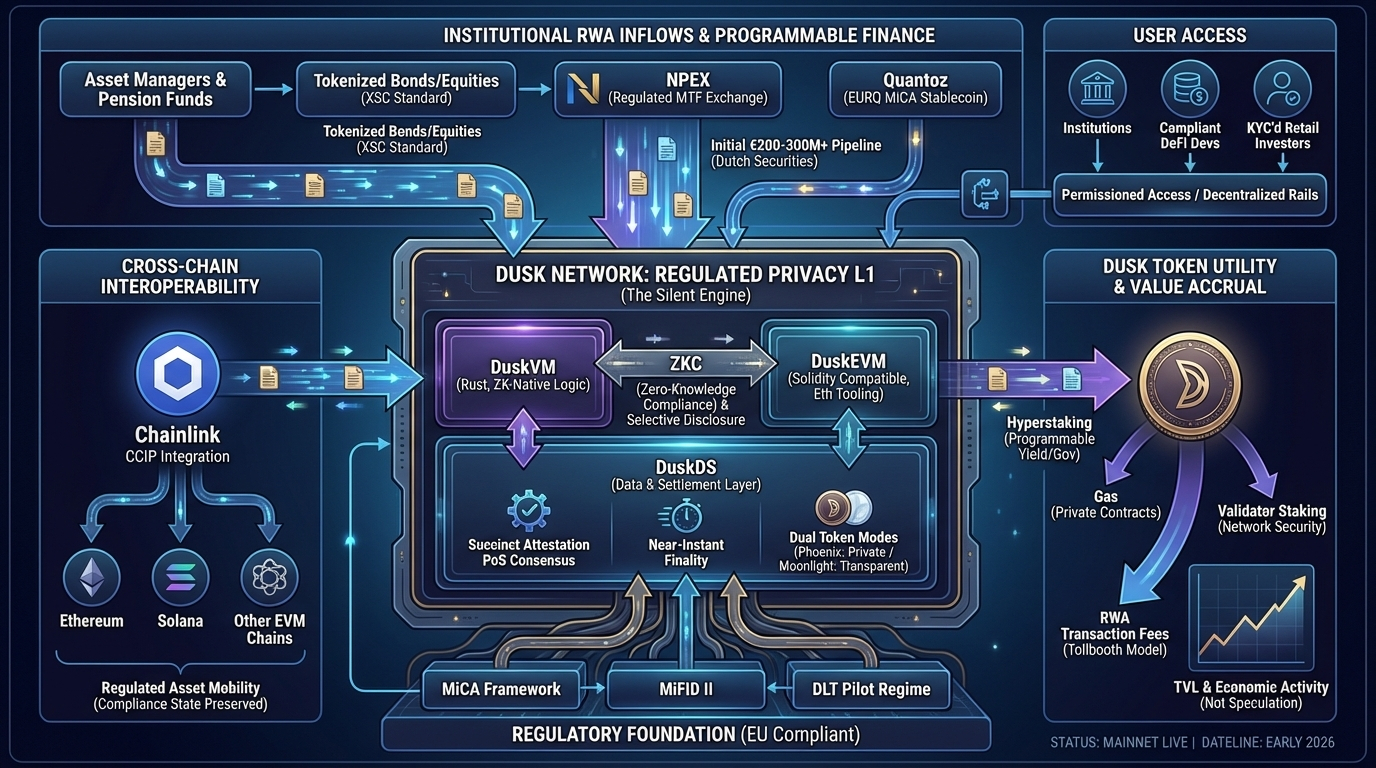
As I sit here in early February 2026, watching DUSK hover around $0.10–$0.11 after a wild January ride that saw it spike over 120% on Chainlink news before settling, I keep coming back to one hard truth. The crypto market is finally maturing into something that looks a lot like traditional finance, but with better rails. And the projects that survive this phase aren't the ones screaming loudest about decentralization theater. They're the ones solving the actual friction: how do you tokenize a bond, settle it privately, prove compliance to a regulator without exposing trade secrets, and still let anyone with a wallet participate if the rules allow? Dusk isn't promising utopia. It's delivering infrastructure that makes regulated finance programmable without breaking the law or leaking alpha.
Let me walk you through why I think Dusk is quietly positioning itself as one of the most structurally sound bets in the 2026 market—not because of hype cycles, but because of how its architecture aligns incentives across institutions, developers, and everyday users in ways most chains still ignore.
The core thesis of Dusk has always been brutally simple yet fiendishly difficult to execute: privacy and auditability are not opposites; they're two sides of the same coin when you design the system right. In traditional finance, deals happen behind closed doors order books are dark pools, OTC desks hide size, counterparties don't broadcast every term. On public blockchains like Ethereum, everything is glass: transparent to the point of fragility. You can't run a serious securities desk if every trade reveals your book to competitors or front-runners. Dusk flips that script by making privacy the default while embedding selective disclosure at the protocol level. Zero-knowledge proofs handle the heavy lifting so transaction details (amounts, identities, contract logic) stay confidential by default, but authorized parties regulators, auditors, or KYC'd participants can verify compliance without seeing the full picture.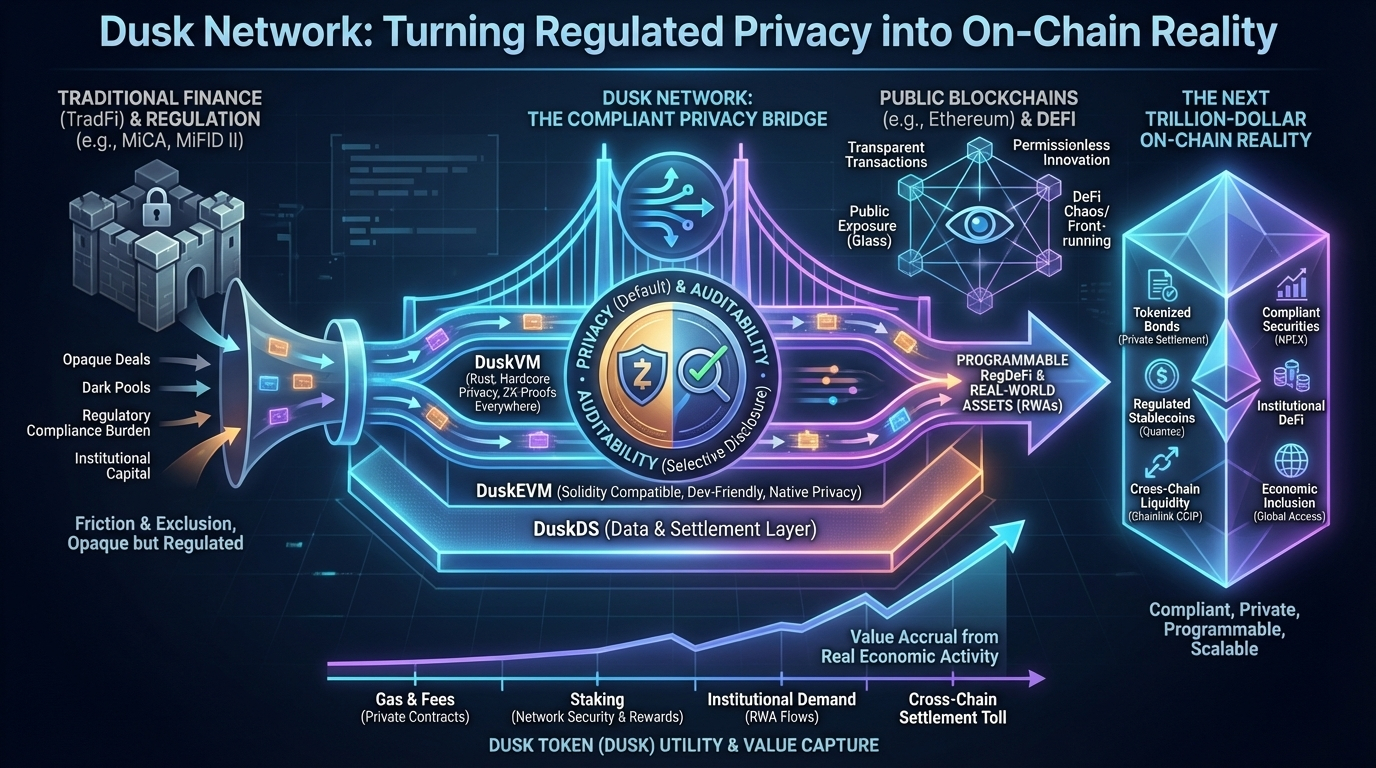
This isn't retrofitted privacy like some Layer 2s bolt on with mixers or shielded pools. It's baked into the settlement layer itself. That means when an institution issues a tokenized bond on Dusk, the coupon payments, maturity logic, and ownership transfers happen privately, yet the entire flow satisfies MiCA, MiFID II, and the EU's DLT Pilot Regime. No need for trusted intermediaries to "wrap" privacy or custodians to hold keys. The chain enforces the rules natively. That's the kind of thing that makes pension funds and asset managers sit up instead of scrolling past another yield farm.
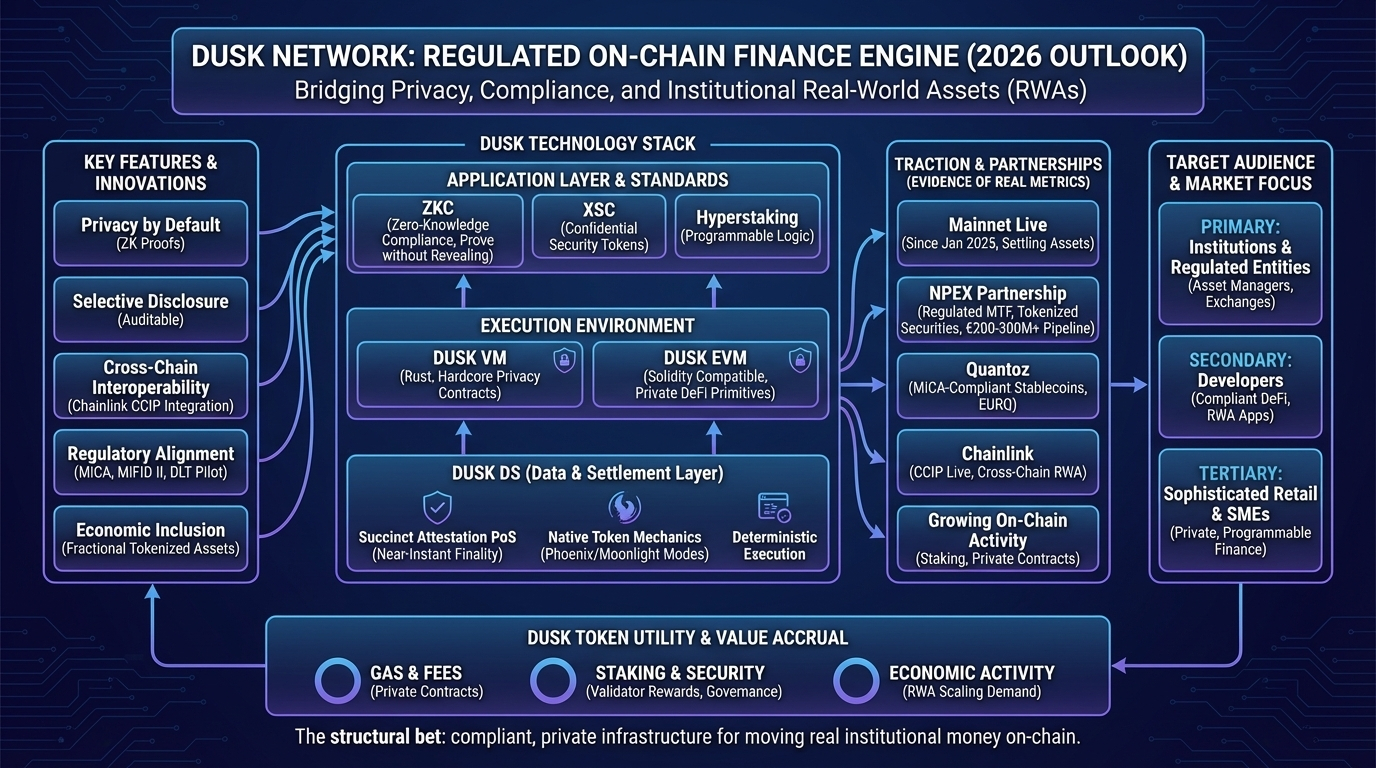
The primary product right now is the live mainnet itself, operational since January 2025 after six long years of building. But 2026 is when it starts feeling real. The modular stack separates concerns cleanly. At the base is DuskDS the data and settlement layer running Succinct Attestation, a PoS consensus that delivers near-instant finality without sacrificing security. Finality matters enormously in finance; you can't have a bond settlement that might reorg two hours later. DuskDS handles staking, native token mechanics (with dual modes: Phoenix for full privacy, Moonlight for more transparent flows when compliance demands it), and deterministic execution so everyone knows exactly when a trade clears.
On top sits the execution environment. DuskVM handles the hardcore privacy smart contracts in Rust, ideal for sensitive logic where you need ZK proofs everywhere. But the real game-changer in 2026 has been DuskEVM, which rolled out fully in January. It gives full Solidity compatibility, meaning any Ethereum dev can port dApps with minimal changes while inheriting native privacy and compliance guarantees. Gas is paid in DUSK, settlement happens on DuskDS, and confidential execution is automatic. Suddenly, you're not rebuilding DeFi primitives from scratch you're just making them private and regulator-friendly.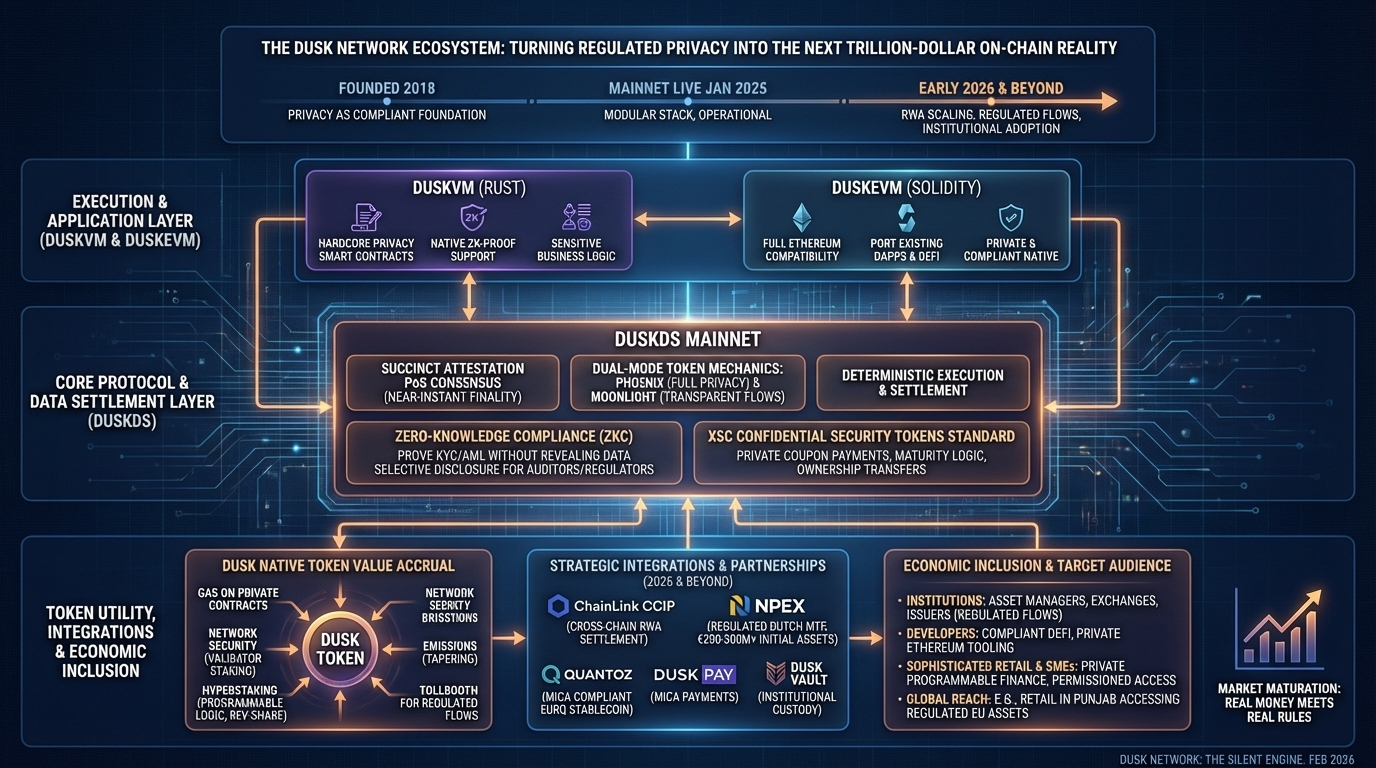
Key features flow from this design. Zero-knowledge compliance (what they call ZKC) lets you prove KYC/AML adherence without revealing personal data. Selective disclosure means a regulator sees only what the law requires. XSC standards define confidential security tokens. The native token model supports programmable staking (Hyperstaking lets you attach logic to stakes, like revenue-sharing or governance). And integrations like Chainlink's CCIP, announced late last year and live now, let tokenized assets move cross-chain Dusk-issued securities can settle on Ethereum or Solana without losing compliance properties. That's huge for liquidity in fragmented RWA markets.
DUSK, the native token, isn't just gas and staking rewards. It captures value from every layer. Stakers secure the network and earn from transaction fees plus emissions (still ongoing but tapering). Institutions need DUSK for gas on private contracts, validators require it to run nodes, and as RWAs scale, demand grows with real economic activity not speculation. Right now trading volume spikes on news like NPEX dApp launches or Chainlink flows, but the long-term thesis is utility accrual from regulated flows. If €200–300 million in Dutch securities start settling on-chain via NPEX (and that's the initial pipeline), DUSK becomes the tollbooth.
The secondary mission beyond the headline RegDeFi focus is genuine economic inclusion. The tagline on their site hits hard: "bringing institution-level assets to anyone's wallet." Most RWA projects talk about tokenizing real estate or bonds for the masses, but they stop at issuance. Dusk pushes further by making secondary markets possible under compliance rules. A retail investor in Punjab or anywhere else could, in theory, hold fractional tokenized equities from a regulated exchange, trade them privately, and settle instantly provided they pass KYC where required. It's not permissionless anarchy; it's permissioned access with decentralized rails. That bridges the gap between TradFi exclusion and DeFi chaos.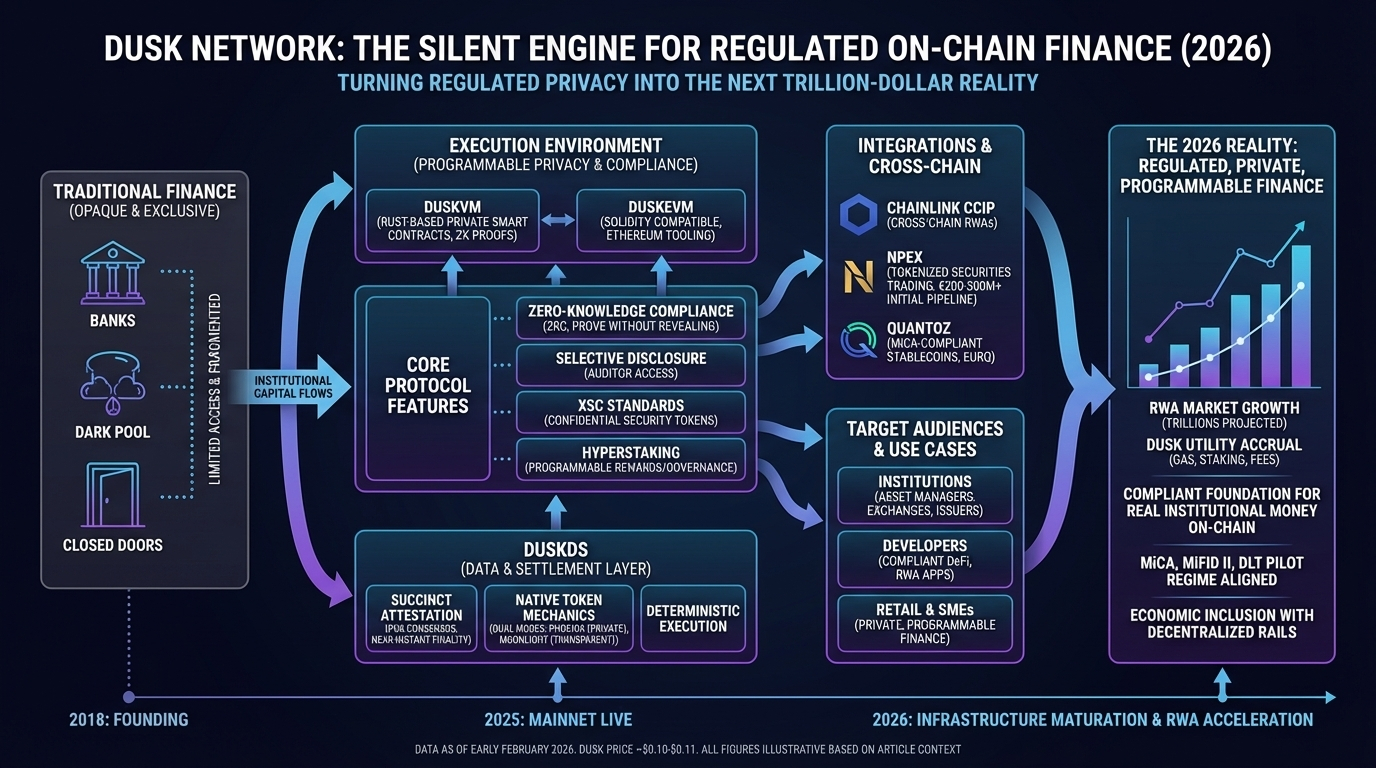
The target audience splits cleanly. Primary: institutions and regulated entities asset managers, exchanges like NPEX (a real Dutch MTF), issuers of securities, stablecoin providers like Quantoz with their MiCA-compliant EURQ. These players need infrastructure that doesn't get them fined or blacklisted. Secondary: developers building compliant DeFi or RWA apps who want Ethereum tooling without Ethereum's transparency downsides. Tertiary: sophisticated retail users and businesses seeking private, programmable finance SMEs automating financing, private companies issuing tokens without public exposure.
Strategic focus in 2026 is laser-sharp on Europe and regulatory moats. MiCA gave the EU a framework; Dusk aligned early. Partnerships prove it: NPEX for tokenized securities trading (dApp rolling out Q1 with initial €200–300M+ in assets), Chainlink for cross-chain standards (CCIP enabling compliant transfers to other EVM chains), Quantoz for regulated stablecoins. Mainnet upgrades emphasize stability, speed, and developer onboarding. Dusk Pay (MiCA-compliant payments) and Dusk Vault (institutional custody) are in flight. The bet is that as RWAs explode projected trillions in tokenized assets by decade's end the compliant, private Layer 1 wins the institutional allocation.
Evidence of traction isn't in tweet storms or TVL pumps (though TVL is climbing quietly). It's in real metrics. Mainnet has been settling tokenized assets since 2025. NPEX partnership advanced to live tokenized securities under existing licenses no pilots, actual regulated flow. Chainlink integration went live, breaking cross-chain barriers. Listings on Binance US, KuCoin, and others brought accessibility. On-chain activity shows growing staking participation and private contract deployments. Price action in January surging on partnership news, correcting but holding higher lows mirrors capital flowing to utility narratives. Whales accumulated during dips while retail chased memes elsewhere.
What excites me most isn't the short-term pump potential (though $0.30–$0.50 feels realistic if RWA flows accelerate). It's the structural edge. In a world where regulators are no longer ignorable, privacy coins that fight compliance get sanctioned or delisted. Transparent chains can't handle institutional alpha. Dusk threads the needle: private enough for business, auditable enough for law. If Europe leads regulated tokenization (and with MiCA, it might), Dusk becomes the default stack.
I've seen too many projects overpromise and fade. Dusk underpromised for years, shipped quietly, and now the market is catching up. It's not sexy. It's necessary. And in crypto's next phase where real money meets real rules that's what wins