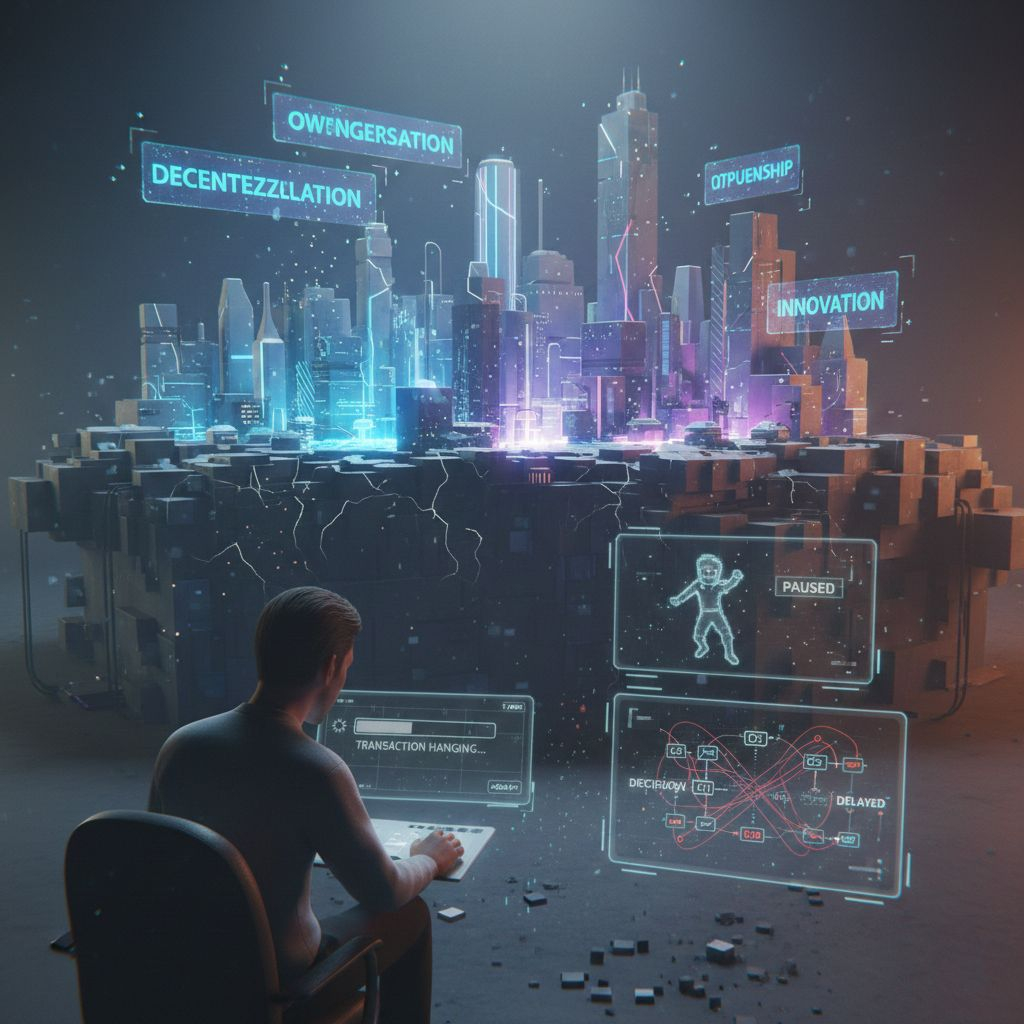
There’s a problem in Web3 that doesn’t get enough attention because it’s not dramatic.
No hacks. No scandals. No sudden collapses.
Things just… don’t work sometimes.
Transactions hang.
Apps slow down.
Games pause.
DAOs delay decisions because execution suddenly feels risky.
And then everyone moves on, pretending this is normal.
We keep talking about decentralization, ownership, innovation.
Big words. Familiar words. Comforting words.
But none of them guarantee the one thing users actually feel every day: reliability.
That’s the part we keep missing.
Web3 is very good at telling stories about the future.
It’s less good at running the present without friction.
Most execution layers were not designed for sustained, boring usage.
They were designed to prove ideas.
To ship quickly.
To show that something was possible.
Over time, those experiments became infrastructure.
And the cracks never really went away.
Instead of fixing them, we learned how to work around them.
We added layers to hide congestion.
We shifted load elsewhere and called it scaling.
We accepted that some things would just break occasionally.
From the outside, it still looks impressive.
From the inside, it feels fragile.
The industry rarely talks about this honestly.
When something fails, it’s framed as an edge case.
When performance drops, it’s “temporary.”
When users complain, they’re told it’s early.
But this space is no longer early in the ways that matter.
Real people use it. Real money moves through it. Real businesses depend on it.
Quiet failure is more dangerous than loud failure.
Because it slowly teaches people not to rely on you.
And that’s exactly what’s been happening.
Projects don’t always die. They fade.
Users don’t rage quit. They stop checking back.
Builders don’t make announcements. They just choose other foundations.
Most existing “solutions” don’t truly solve this.
They redistribute risk instead of removing it.
Some optimize for speed while quietly concentrating control.
Some rely on off-chain coordination that users are asked not to think about.
Some assume everyone will behave because it’s inconvenient not to.
That’s not trustless.
That’s hopeful.
And hope is not a substitute for accountability.
If Web3 wants to grow beyond speculation and experimentation, it has to care about unglamorous things.
Who is responsible when execution fails.
What incentives exist when conditions are bad, not perfect.
What consequences actually occur when systems misbehave.
These questions don’t trend.
But they determine whether systems last.
This is where Plasma fits into the conversation.
Not as a bold promise.
Not as a new narrative.
But as a focused response to a specific problem: stable value moving through unreliable execution layers.
Plasma is a Layer 1 blockchain built specifically for stablecoin settlement.
That choice matters.
Stablecoins are already one of the most widely used parts of Web3.
Payments. Transfers. Remittances. Treasury movements. Everyday activity.
Yet they often run on infrastructure that wasn’t designed around their needs.
Plasma starts from the assumption that moving stable value should be predictable.
Finality should be quick and consistent.
Fees should not feel like a penalty for normal use.
Gas is handled in stablecoins, and in some cases removed entirely from the user experience.
Not to be clever.
But because payment systems shouldn’t surprise people.
Plasma remains compatible with existing Ethereum tooling, which lowers friction for builders and avoids unnecessary reinvention.
That’s a practical choice, not an ideological one.
Security is anchored to Bitcoin, not as a slogan, but as a way to lean on a network that has earned neutrality over time.
When systems handle everyday value, censorship resistance stops being abstract.
Plasma doesn’t claim this eliminates trust.
It reduces it.
It makes assumptions visible.
That restraint is what makes it interesting.
This approach matters beyond payments.
For NFTs, reliable settlement means marketplaces that don’t stall when attention shows up.
Creators don’t need new mechanics. They need consistency.
For DAOs, it means governance and treasury actions that execute when decided, without timing games or unpredictable conditions.
For games, it means economies that don’t break immersion because the underlying chain can’t keep up with activity.
For long-term Web3 use, it means fewer workarounds and fewer apologies.
Plasma and $XPL are not positioned as exciting.
They don’t need to be.
Their value lies in treating execution as a responsibility, not a side effect.
In focusing on incentives and consequences instead of narratives.
That’s why it feels quietly important.
Web3 doesn’t need more ambition.
It needs more discipline.
It needs systems that assume things will go wrong and design for that reality.
It needs infrastructure that behaves predictably when no one is watching.
Growing up, for this space, probably looks less inspiring than people expected.
Less talk about changing the world.
More focus on not breaking it.
Less fascination with novelty.
More respect for reliability.
When Web3 finally feels boring to use, steady in behavior, and unremarkable in execution, that’s when it will have earned real trust.
Until then, the work isn’t about dreaming bigger.
It’s about making sure what we’ve already built can actually hold.