
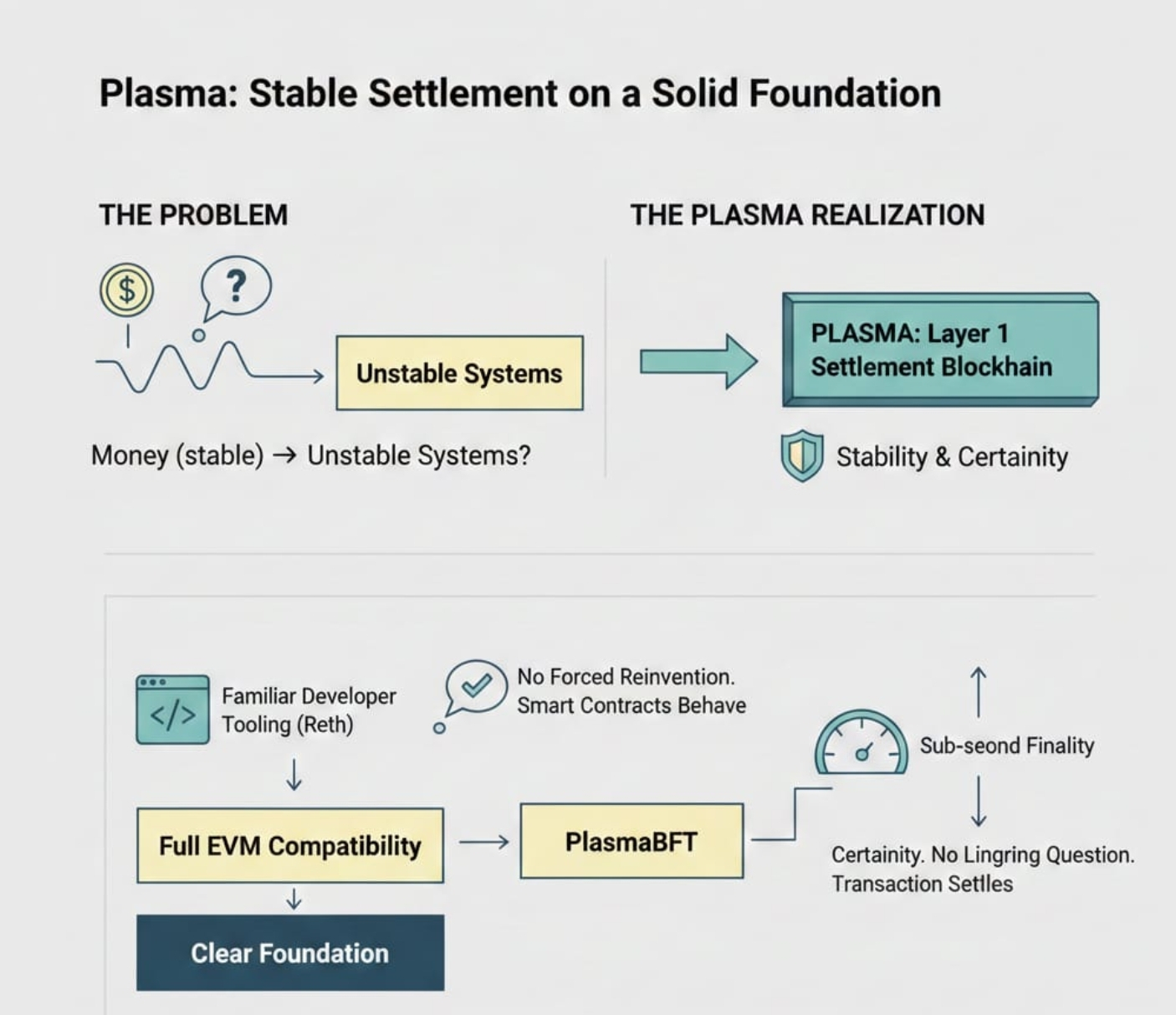
@Plasma feels less like a product launch and more like a quiet realization. The realization that money which is meant to stay stable should not have to travel through unstable systems. At its core Plasma is a Layer 1 blockchain built for settlement above all else. Not for constant experimentation and not for spectacle. It starts from a clear foundation. Full EVM compatibility through Reth ensures that what developers already know continues to work. There is no forced reinvention. Smart contracts behave as expected. Tooling feels familiar. That choice alone removes a layer of fear. PlasmaBFT delivers sub second finality and that speed is not about racing other chains. It is about certainty. The moment a transaction is sent there is no lingering question. It settles and the mind moves on.
The most defining choice is the decision to be stablecoin first. Gasless USDT transfers and stablecoin first gas reflect a deep understanding of real human behavior. Most people are not trying to speculate every time they move money. They are paying salaries settling invoices supporting families or moving savings. I’m seeing a system that removes emotional friction. Instead of forcing users to hold volatile assets just to interact Plasma lets stable value carry itself. If it becomes clear why this matters it is because financial tools should reduce stress not create it.
When Plasma operates in the real world its design becomes even more meaningful. Retail users in high adoption markets experience something rare in blockchain simplicity. There is no need to understand complex fee dynamics or token price swings just to participate. Institutions in payments and finance encounter predictability. Settlement happens quickly and reliably. Accounting becomes cleaner. Risk models become simpler. I’m noticing how much calm exists in that experience. You send value. It arrives. There is no performance around it.
Security is treated with similar restraint and respect. By anchoring neutrality and censorship resistance to Bitcoin Plasma borrows credibility from time itself. It does not try to replace Bitcoin or compete with its role. It acknowledges what history has already proven. We’re seeing a system that understands trust is inherited carefully not claimed loudly. This anchoring is less about marketing and more about long term posture. It signals an intention to remain neutral even when pressure appears.
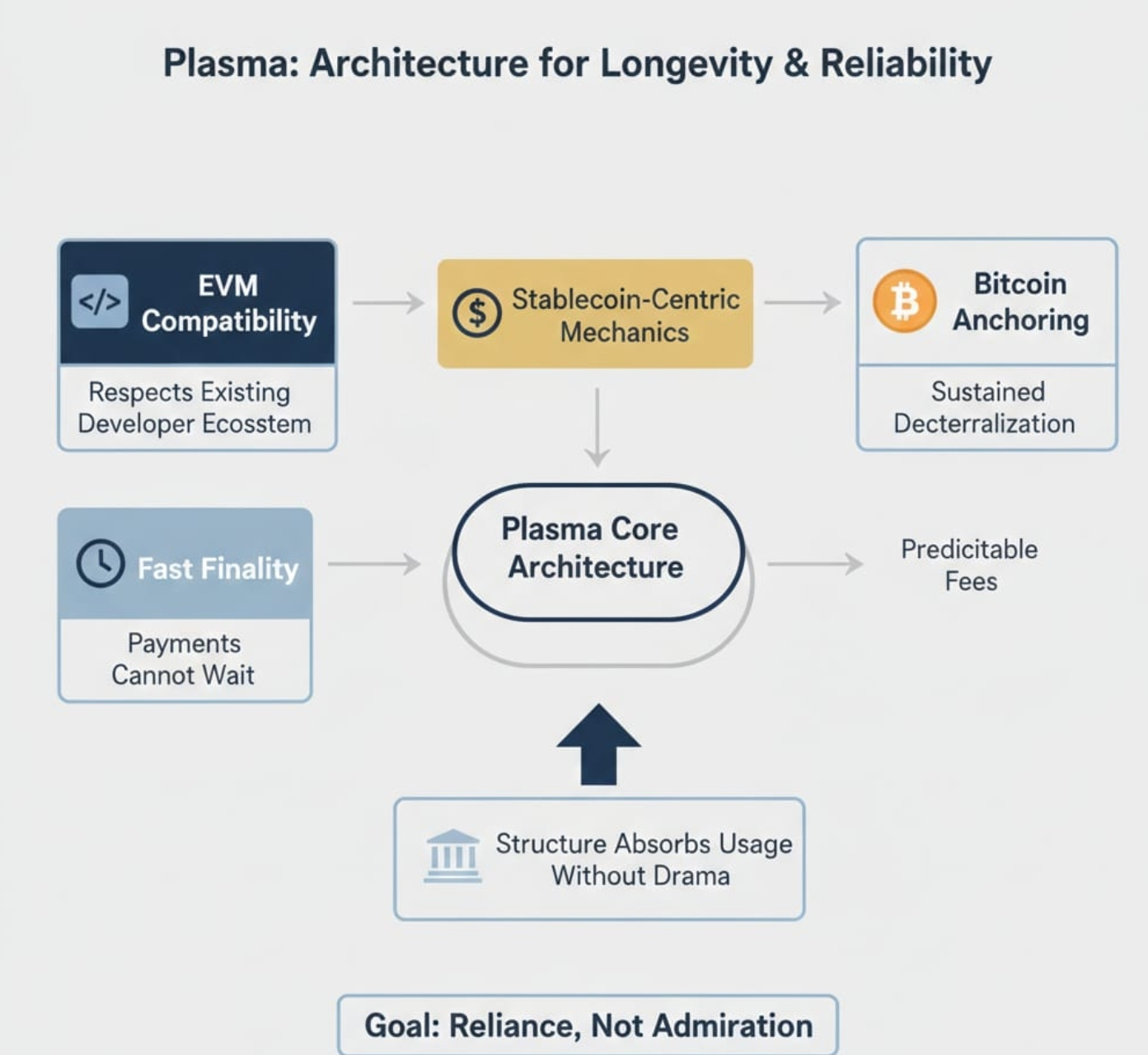
The architecture reflects a mindset that values longevity. EVM compatibility respects the existing developer ecosystem. Fast finality exists because payments cannot wait without consequence. Stablecoin centric mechanics exist because fees should not surprise people after the fact. Bitcoin anchoring exists because decentralization is not something you declare once and forget. They’re building a structure that can absorb usage without drama. If it becomes widely adopted it will be because people rely on it rather than admire it.
Progress on Plasma is not measured through noise. It shows up quietly in behavior. Settlement times that remain consistent even under load. Fees that stay understandable over time. A growing share of transactions that are stablecoin based rather than speculative. Developers who deploy and keep improving instead of hopping between ecosystems. Institutions that expand usage beyond pilots and proofs. I’m watching patterns rather than announcements. We’re seeing success when users stop asking which chain they are using because it no longer matters.
No system meant to last avoids risk and Plasma does not pretend otherwise. Stablecoin reliance means regulation will shape the landscape. Speed requires resilience during moments of stress. Anchoring to Bitcoin introduces external dependencies that must be respected. Naming these realities early is not weakness. It is discipline. If it becomes durable it will be because these risks were understood and managed not ignored.
The long term vision for Plasma feels patient rather than aggressive. As users grow more confident and institutions deepen settlement volume the network evolves alongside them. Tooling improves. Integrations deepen. The chain becomes less visible because it is doing its job. I’m imagining a future where Plasma fades into the background of everyday finance quietly supporting movement of value without demanding attention. We’re seeing the shape of infrastructure that grows with its users instead of forcing them to adapt.
In the end Plasma does not feel like a promise of revolution. It feels like a promise of reliability. Built for stablecoin settlement with speed familiarity and neutrality at its core it honors the simple human need for certainty. I’m left with a calm optimism. If it becomes widely trusted it will not be because it was loud. It will be because it was there when people needed it and it worked every time.