At some quiet hour of the night, when most networks are humming on autopilot, a file begins to fall apart on purpose. It is not corruption, not failure, but a deliberate undoing a large piece of data surrendering its wholeness so it can live in many places at once. This is where Walrus feels less like software and more like a philosophy encoded in math: the belief that nothing important should depend on a single house, a single company, or a single country. Somewhere beneath that belief sits WAL, a token that is less a speculative chip and more a heartbeat that keeps the whole arrangement breathing.
To understand why this matters, you have to remember how fragile our digital world actually is. We talk about “the cloud” as if it were weather vast, natural, untouchable but it is really a collection of gigantic buildings filled with humming machines, owned by a handful of corporations. One subpoena, one policy shift, one outage, and whole archives can vanish or become unreachable. Walrus begins as a quiet rebellion against that reality. It does not promise utopia; it proposes a different geometry of trust.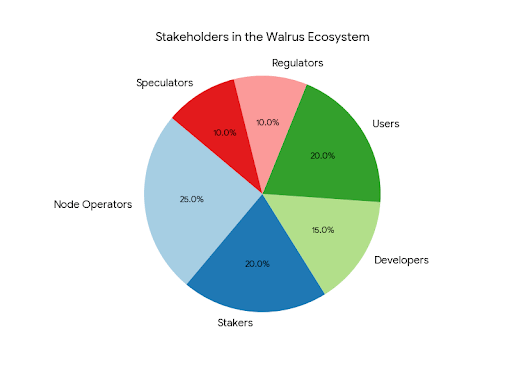
The protocol lives on Sui, but that phrase hides more than it reveals. Sui is not a warehouse here; it is a nervous system. It tracks who paid for what, which fragments belong together, and how long they are meant to exist. The heavy lifting the actual data is scattered across a decentralized constellation of storage nodes. When someone uploads a file, Walrus does something almost poetic: it refuses to let it stay whole. Using a technique called erasure coding, the system breaks the file into pieces, then creates extra, mathematically related fragments. Some of these can disappear and the file will still be recoverable, like a story that survives even when pages are torn out.
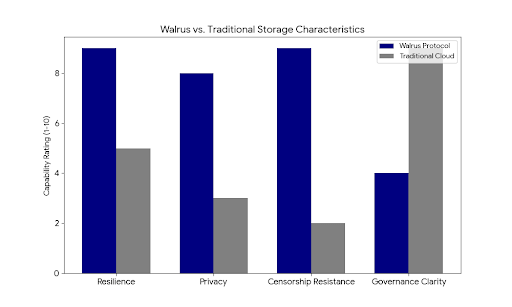
This is where the technology becomes human. In traditional storage, redundancy means copying everything again and again, a kind of anxious hoarding. Walrus chooses a different temperament: careful fragmentation, intelligent spread, and calculated resilience. No single operator ever holds the full truth of your data, which means no single authority can easily seize, censor, or delete it. Privacy is not achieved through secrecy alone, but through distribution — the political act of making power inconvenient to centralize.
WAL enters this picture as the quiet fuel of the system. When you store something, you pay in WAL for a defined period of time, not forever. That is a subtle but profound choice. Most decentralized storage projects preach permanence; Walrus respects time. Data can live, age, and eventually fade if its owner stops paying. Payments flow gradually to the nodes that actually hold your fragments, aligning reward with real work rather than empty promises. Stakers, who secure the network, are tied into this rhythm, betting their tokens that they will behave honestly over long stretches of time.
Yet beneath this elegance lies tension. Markets are impatient creatures, and WAL will inevitably attract traders who care little for storage and much for price charts. The protocol asks for steadiness in a world that rewards volatility. Node operators must commit resources for months or years, while speculators may flip tokens in minutes. This friction will test whether Walrus is an infrastructure project or slowly becomes just another financial playground.
There are deeper questions too. Decentralized storage sounds liberating, but liberation is complicated. If harmful or illegal content is distributed across hundreds of nodes in dozens of countries, who is responsible? Who can be compelled? Walrus makes censorship harder, but it also makes governance harder. Power dissolves into a cloud of operators, stakers, and developers, none of whom fully control the whole. Freedom grows; clarity shrinks.
Technically, the design is ambitious. Coordinating erasure-coded fragments across a living, changing network is brutally hard. Nodes appear and disappear. Connections fail. Disks crash. Recovery must be fast enough to be practical and cheap enough to matter. Walrus bets that clever mathematics, combined with economic incentives, can keep this fragile choreography stable. It is a gamble written in code.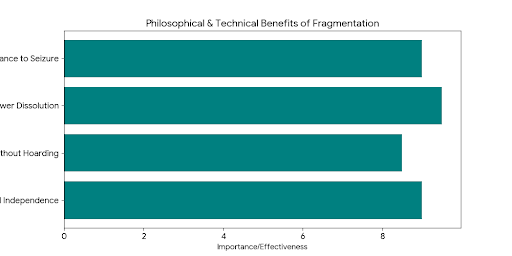
What makes the project fascinating is not just its mechanics, but its implication for the future of data. Imagine AI systems that do not hoard training datasets in secret corporate vaults, but lease them temporarily from decentralized archives. Imagine journalists storing sensitive material in a way no single government can erase. Imagine artists minting massive digital works that outlive any one platform. Walrus gestures toward a world where data is neither locked in silos nor floating in a lawless void, but living in a distributed middle ground.
Still, success is not guaranteed. Infrastructure projects rarely fail because the math is wrong; they fail because the social fabric around them frays. If too much storage power concentrates in a few large operators, the dream of decentralization weakens. If regulation becomes hostile, gateways and interfaces could be squeezed even if the underlying network survives. If costs swing wildly, developers may abandon the ecosystem.
Walking through this landscape, Walrus feels like a bet on patience a slow, methodical attempt to rewrite how the internet remembers. It does not shout. It does not sell visions of instant wealth. It builds a memory system that fractures on purpose so it can endure.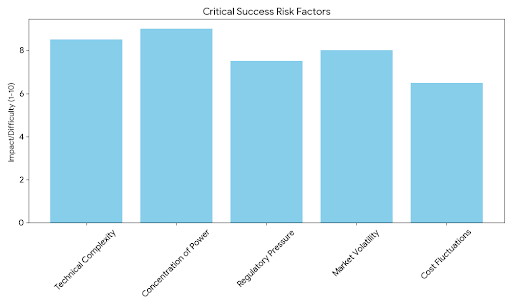
In the end, Walrus is less about files and more about power. Who gets to decide what stays online? Who controls the archives of our age? By scattering data into shards and tying them together with cryptography and economics, the protocol proposes a quieter, more plural answer: no single hand should hold that authority.
Whether that answer holds will depend not just on code, but on people the operators who keep nodes running, the developers who build on top, the regulators who respond, and the users who decide to trust a fragmented future. The mathematics can survive in theory; the community must survive in practice.
Somewhere, in a server rack you will never see, a file is breaking apart again not in panic, but in design splitting into luminous fragments that slip across borders and jurisdictions. In that scattering is both risk and hope, a reminder that the internet’s memory can be fragile, political, and strangely beautiful all at once.