

Most people first hear about @Walrus 🦭/acc described as “storage on Sui,” and mentally file it away as just another chain-specific infra project. That’s actually the least interesting way to think about it. What makes Walrus powerful and different is how it splits responsibilities across layers so cleanly that apps on Solana, Ethereum, or anywhere else can use it without dragging their whole stack onto Sui.
This isn’t about moving your app. It’s about moving your data burden.
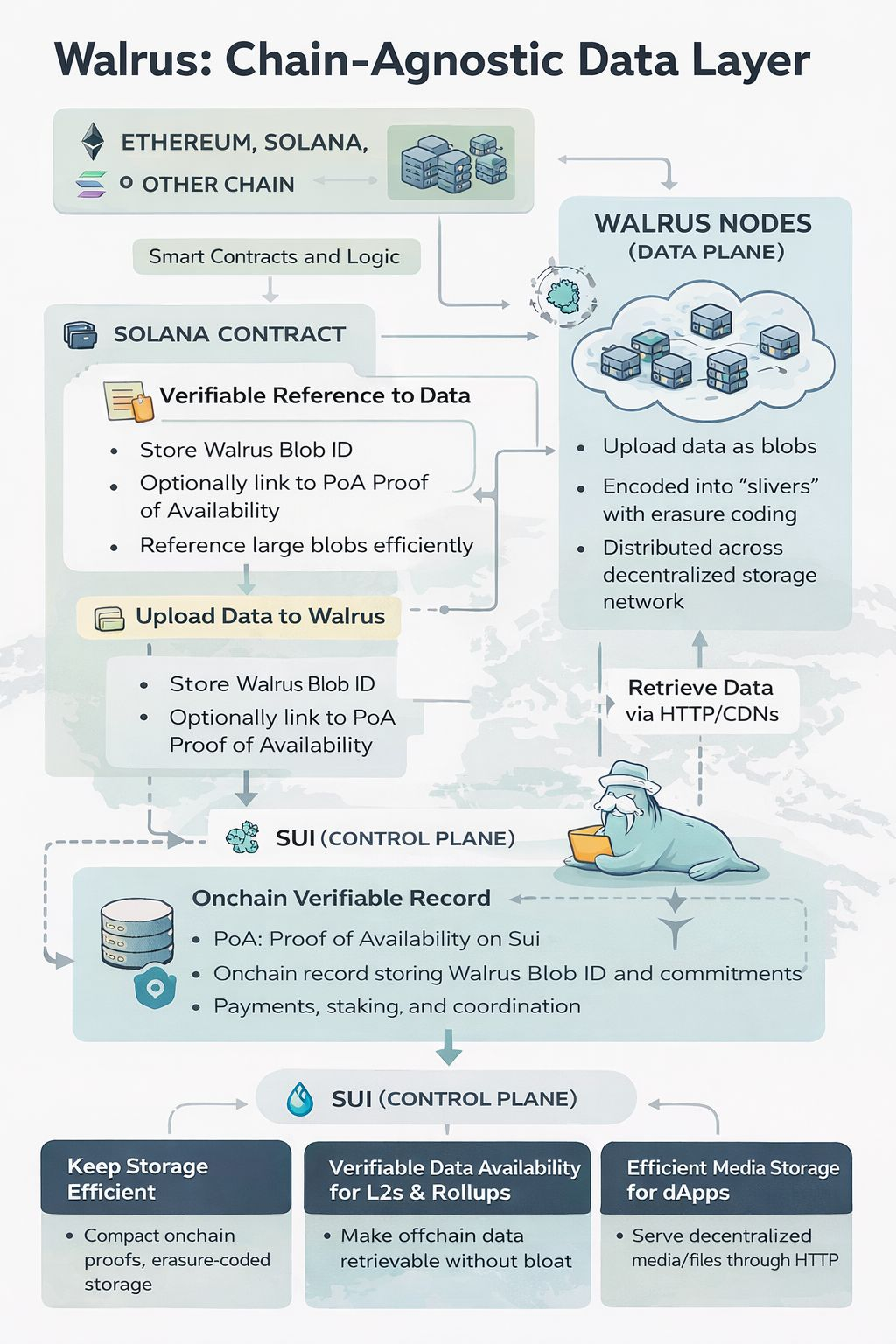
A data layer that doesn’t ask you to migrate
Blockchains are great at consensus and terrible at storing large amounts of raw data. Every byte has to be replicated, verified, and paid for. That design is intentional it keeps chains secure but it makes them a bad place for things like AI datasets, game assets, media files, or rollup data blobs.
#walrus steps in as a specialized data layer that lives alongside blockchains instead of competing with them. Your smart contracts, tokens, and users stay on the chain you chose. Walrus becomes the place where the heavy data actually lives.
From the outside, it behaves like a high-performance, verifiable object store. But under the hood, it’s doing something more subtle: separating the data plane from the control plane.
The split that makes everything work
Think of Walrus as having two personalities:
1. The data plane (Walrus nodes)
This is where your bytes physically exist. When you upload a file or dataset, Walrus doesn’t just replicate it like a basic storage network. It encodes the data into smaller pieces often called slivers using advanced erasure coding. Those slivers are distributed across many storage nodes.
The result is resilience without massive duplication. Even if a large portion of nodes go offline, the original data can still be reconstructed. You get durability and availability without paying the cost of full replication everywhere.
2. The control plane (on Sui)
While the data lives across Walrus nodes, the proofs and bookkeeping live on Sui. Each stored blob has an associated onchain record that includes:
A deterministic commitment to the data
Storage duration and metadata
A Proof-of-Availability showing that a sufficient portion of the network has accepted responsibility for storing it
This onchain object is the cryptographic anchor. It’s what lets anyone verify that the data should exist and that the network committed to keeping it available.
Here’s the key insight: your application doesn’t have to run on Sui to benefit from that. Sui acts like a coordination and verification layer, not your execution environment.
How another chain actually uses Walrus
From the perspective of a developer building on Ethereum or Solana, Walrus feels surprisingly simple.
First, you upload your data using a client, SDK, or HTTP interface. Walrus handles encoding and distribution behind the scenes. Once the network has accepted the data, a proof-backed handle is created effectively a verifiable reference to that blob.
Then, inside your own smart contract on your home chain, you store only small pieces of information: the blob’s ID and, if you want deeper verification, a reference to the availability proof. That’s it. No massive files onchain. No bloated state.
When your frontend, indexer, or offchain service needs the actual data, it fetches it from Walrus through HTTP-compatible gateways and caches. Because Walrus is designed to play nicely with traditional web infrastructure, you can layer in CDNs and caching just like in Web2 but with cryptographic assurances about what you’re serving.
So the pattern becomes:
Store big data on Walrus. Keep logic and assets on your chain. Connect them with small, verifiable references.
Why this matters for rollups and L2s
Data availability is one of the hardest problems for rollups. They need somewhere to publish transaction batches, proofs, or state data in a way that users don’t have to trust a single centralized server.
Walrus is built with exactly this use case in mind. Instead of posting huge blobs directly to a base chain, a rollup can store them in Walrus and post compact references plus proofs onchain. Observers can independently check that the data is still available through Walrus nodes and the associated proofs.
That reduces onchain load while keeping the system verifiable a balance that’s very hard to achieve with traditional storage solutions.
Better UX without giving up decentralization
A lot of NFT platforms, games, and social apps quietly rely on centralized storage for images, videos, and metadata because fully onchain storage is too expensive. That creates a weak point: if the server disappears, so does the content.
Walrus offers a middle path. Media can be stored in a decentralized, erasure-coded network while still being served efficiently over HTTP. Builders don’t have to choose between “fast but centralized” and “decentralized but unusable.” They can have decentralized storage that behaves like modern web infrastructure.
The mental model that clicks
The cleanest way to think about Walrus is this:
Your chain is where your app logic, tokens, and user interactions live.
Walrus nodes are where your large data actually lives.
Sui is where the system records proofs, payments, and commitments about that data.
You’re not relocating your app. You’re outsourcing the hardest part of infrastructure reliable, verifiable large-scale data storage to a network designed specifically for that job.
That’s what makes Walrus more than just “storage on another chain.” It’s a shared data backbone any blockchain can plug into, turning heavy data from a scaling headache into a modular service.

