$XRP blockchain upgrades don’t usually make headlines, but they often reshape the future quietly. While traders focus on charts and short-term volatility, the XRP Ledger continues to evolve at the protocol level.
A newly activated upgrade tackles one of the biggest obstacles to institutional adoption: meeting strict compliance requirements without compromising decentralization.
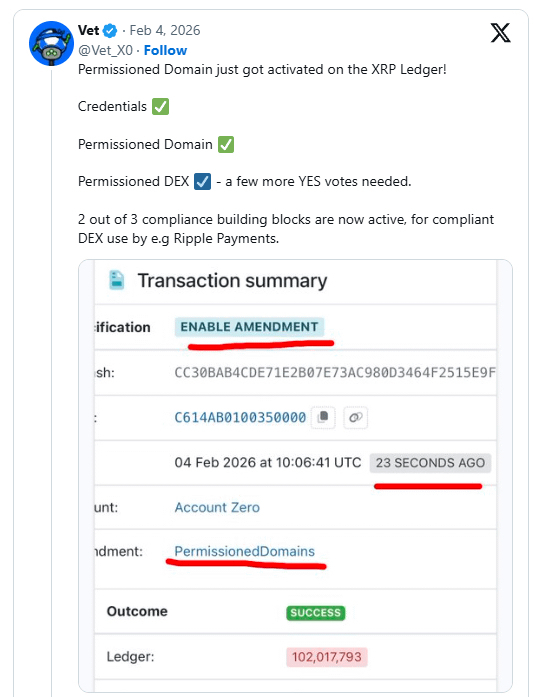
In a recent post on X, XRPL developer and community contributor Vet confirmed that the Permissioned Domain amendment is now active. This marks a major milestone in XRPL’s roadmap toward regulated, enterprise-grade DeFi.
🔍 What Is the Permissioned Domain Upgrade?
Permissioned Domains allow developers to create controlled on-ledger environments where access is based on verified credentials. Participation can be limited to approved entities, while still operating on a public, decentralized blockchain.
The base XRP Ledger remains open and permissionless — but specific applications can enforce rules aligned with regulatory standards.
This design gives institutions flexibility: compliance is handled at the application level, not forced onto the core protocol.🏗 Building a Compliant DEX EcosystemAccording to Vet, Permissioned Domains are the second of three key compliance components now live on $XRPL:
Credentials — on-ledger identity or compliance attestations
Permissioned Domains — define where and how those credentials apply
Permissioned DEX — still awaiting final validator approvals
Once the Permissioned DEX amendment activates, XRPL will support fully compliant decentralized exchanges, suitable for regulated liquidity, enterprise payments, and Ripple Payments–style flows.
⚙️ How XRPL Amendment Activation Works
Vet also clarified how amendments officially go live:
After reaching the required validator support and completing the activation timer, amendments don’t activate immediately. The network waits for the next “flag ledger”, which occurs every 256 ledgers.
If validator votes remain in favor, the network issues an EnableAmendment pseudo-transaction, formally activating the feature on-ledger. This explains why amendments often go live shortly after the timer expires.
🌍 Why This Matters for XRP and Institutions
Permissioned Domains reinforce XRPL’s long-term strategy: real-world financial integration over hype.
Institutions need:
Atomic settlement
Reduced counterparty risk
Programmable compliance
XRPL now delivers all three — without sacrificing decentralization.
While price action may remain volatile, infrastructure progress tells a different story. As regulated capital moves on-chain, upgrades like Permissioned Domains position the XRP Ledger as a serious global settlement layer for compliant finance.