
Most L1s are still fighting over the same shrinking pool of crypto-native liquidity, but Vanar is quietly optimizing for something traders often ignore until it’s too late: non-financial attention flows. Games, entertainment, brands these aren’t just “verticals,” they’re capital sinks with radically different user behavior. The key insight is that Vanar’s architecture and product choices suggest it understands that speculative capital is cyclical, but consumer attention compounds. That framing alone puts it in a different competitive set than most L1s that still measure success in TPS and TVL.
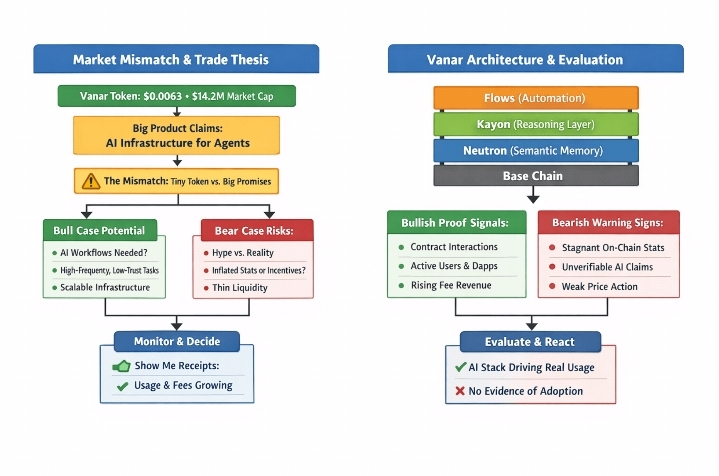
What stands out when you track on-chain behavior around Vanar-linked products is that transaction patterns skew toward repeat, low-value interactions rather than episodic capital movements. That’s not exciting if you’re farming yield, but it’s exactly what you want if you’re stress-testing an L1 for real consumer throughput. Chains that survive long-term don’t just handle spikes they normalize constant, boring usage. Vanar’s design choices make more sense when you realize it’s optimizing for retention curves, not liquidity mercenaries.
The market usually underprices this kind of usage because it doesn’t show up as explosive TVL. But TVL is a weak signal for consumer platforms anyway. If you look at wallet churn instead how many addresses come back week after week Vanar’s ecosystem behaves more like a Web2 platform with crypto rails than a DeFi playground. That matters because capital rotation in this cycle is increasingly hostile to protocols that rely on emissions to fake activity.
Virtua Metaverse is a good example of this dynamic. Most metaverse projects collapsed under the weight of unsustainable token incentives and empty worlds. Virtua survived not because it promised yield, but because it anchored itself to licensed IP and user-driven engagement loops. That shifts the economic center of gravity from token emissions to content velocity. On-chain, that shows up as steadier transaction frequency even during broader market drawdowns a rare trait in this market.
From a trader’s perspective, the VANRY token isn’t positioned as a pure speculative reflex to network usage. Its role is closer to a coordination asset across multiple consumer-facing surfaces. That’s riskier in the short term because it delays reflexive demand, but structurally healthier if adoption materializes. Tokens that front-run usage tend to decay when incentives taper. Tokens that lag usage often look “dead” right before they matter.
One under-discussed aspect is how Vanar’s multi-vertical strategy reduces correlation risk. Most L1s bet everything on one killer app category DeFi, AI, or gaming. Vanar spreads across sectors with different market cycles. When DeFi liquidity dries up, games still onboard users. When NFT volumes cool, brand integrations still move. This doesn’t guarantee success, but it dampens the boom-bust amplitude that kills most ecosystems.
Technically, Vanar’s decisions favor predictable execution over bleeding-edge experimentation. That’s not sexy, but it’s pragmatic. Consumer applications punish instability far more than financial apps do. A failed transaction in DeFi is annoying; a failed transaction in a game is a churn event. Chains that don’t internalize that difference tend to overestimate their readiness for mass adoption.
There’s also a subtle but important distinction in how Vanar approaches AI narratives. Instead of tokenizing “AI” as an abstract compute story, it positions AI as a layer that enhances user-facing products moderation, personalization, asset generation. That reduces narrative upside but increases real integration probability. Traders chasing AI beta often miss that the best AI crypto plays won’t look like AI plays on a chart.
From a market-structure perspective, $VANRY ’s behavior suggests it’s not a pure liquidity magnet and that’s actually the point. Assets that don’t immediately attract leverage are less likely to be structurally broken in drawdowns. If you overlay price structure with volume trends, you’d likely see more organic participation than leveraged spikes. That usually bores momentum traders but attracts long-horizon builders.
The real question isn’t whether Vanar can outperform other L1s on metrics. It’s whether it can survive long enough for consumer adoption curves to matter. Most chains die before that phase because they optimize for traders, not users. Vanar seems willing to accept near-term underperformance in exchange for long-term optionality a trade most teams claim to make but rarely follow through on.
