@Vanar only really clicks when you stop imagining a crypto user altogether. Picture someone launching a game, unlocking an item, redeeming a perk, or moving something between apps without ever realizing there’s a blockchain involved. No wallet pop-ups. No fee calculations. No moment where the experience stutters and reminds them they’re standing on technical scaffolding. Everything just works. That, to me, feels like the real finish line—not raw throughput claims, but whether the system can fade into the background and feel completely normal.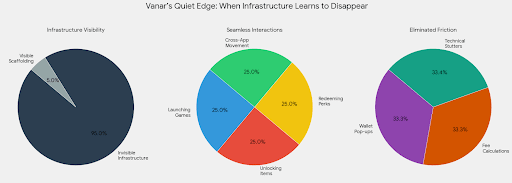
Most blockchains still feel like they expect participation in ritual. You connect, sign, approve, switch networks, wait, retry, and learn to tolerate the friction as part of the culture. Vanar seems to be designing for people who never agreed to that contract. The message isn’t “welcome to Web3, here’s how things work.” It’s “you don’t need to know this exists.” That alone says more about its target audience than any roadmap slide ever could.
The fixed-fee approach is where this philosophy stops being abstract. Consumer products rarely fail because something is too expensive once. They fail because costs become unpredictable. Studios and brands can work within tight margins, but they can’t build around fees that spike the moment usage grows. When Vanar emphasizes stable, low-cost transactions for everyday actions, it doesn’t feel like token engineering. It feels like an attempt to make blockchain behave like infrastructure. Infrastructure isn’t supposed to be exciting. It’s supposed to be dependable. Boring, even. And boring is what businesses trust.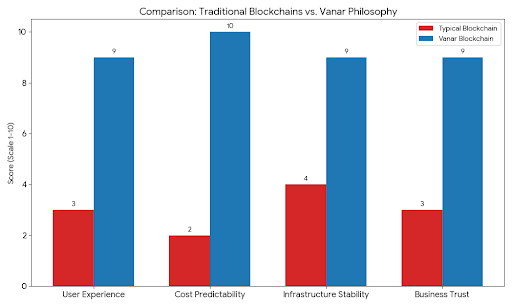
That idea—boring as a feature—rarely gets enough respect in crypto conversations. If you’re talking to entertainment companies or consumer platforms, the questions they ask aren’t ideological. They’re operational. What does this cost per user? What happens during peak demand? Will the experience tomorrow feel the same as today? In that world, predictability isn’t a technical footnote. It is the product.
Seen through that lens, Vanar’s on-chain activity starts to tell a different story. Instead of sporadic bursts of high-stakes movement, you see lots of small, routine actions spread over time. Claims. Upgrades. Transfers. Confirmations that feel closer to taps than trades. It doesn’t resemble a financial arena. It looks like plumbing quietly doing its job behind applications people actually want to use.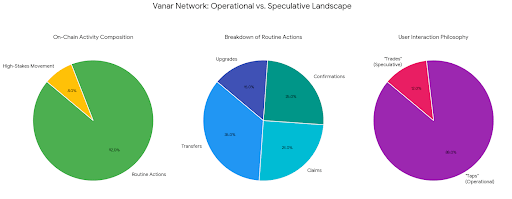
The account growth is where optimism and caution intersect. Broad distribution can mean genuine engagement from users who don’t think of themselves as crypto participants. But in consumer systems, it can also mean wallets are being spun up invisibly during onboarding. That’s powerful, but fragile. The moment a user encounters recovery confusion, unclear ownership, or an unexpected signing prompt, the spell breaks. Something that felt ordinary suddenly feels technical, and trust disappears fast.
That’s why the surrounding ecosystem matters more than positioning statements. “Metaverse” as a label means very little. What matters is whether there are feedback loops that bring people back without forcing them. Marketplaces that feel like features instead of destinations. Games that generate steady, repeat interaction rather than one-time novelty. Digital items that have utility instead of just metadata. If Virtua and adjacent projects are producing real repeat behavior, that signal is far louder than any partnership headline.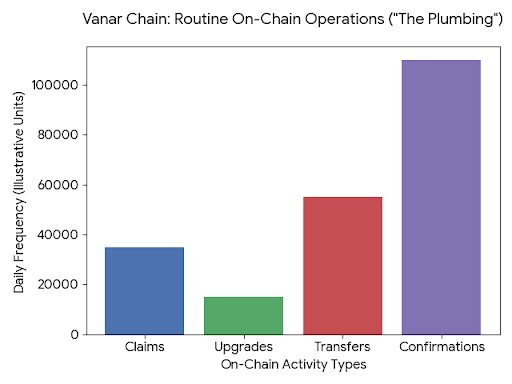
The AI layer is another area where skepticism is usually warranted. “AI plus blockchain” often amounts to branding. But Vanar’s framing feels more practical than ornamental. Neutron and Kayon don’t read like chatbots bolted onto a chain. They read like attempts to make on-chain data easier to structure, query, and actually use. Most blockchains are excellent at proving data exists. They’re far less good at making that data convenient. If Vanar reduces the amount of custom tooling teams have to rebuild every time, that’s not flashy—but it’s meaningful.
If it works, developers won’t evangelize it on social media. They’ll just quietly choose it again because it removed friction. That’s the real test. Big architectural promises are easy to describe. A smooth developer experience only reveals itself after real products ship and nobody regrets the choice.
The governance and validator design follows the same pragmatic logic. Leaning on reputation or authority early on isn’t about winning decentralization debates. It’s about feeling safe to organizations that don’t want to stake their product on unknown operators from day one. Some will reject that trade-off entirely. Others will see it as a temporary constraint in service of adoption. Either way, it shapes who feels comfortable building now and how decentralization can realistically evolve later.
VANRY itself fits neatly into this quieter model. It pays for gas, supports security through staking, and functions as shared utility across the ecosystem. But with predictable, low dollar-denominated fees, the usual reflexive token narrative changes. Increased usage doesn’t automatically mean congestion-driven fee wars. That’s intentional. Long-term value has to come from participation, security, and sustained product loops—not from moments of panic. It’s a subtler model, and arguably a more honest one for everyday users.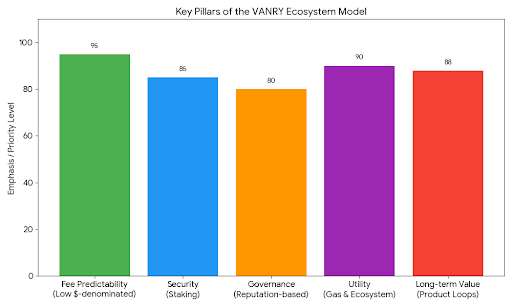
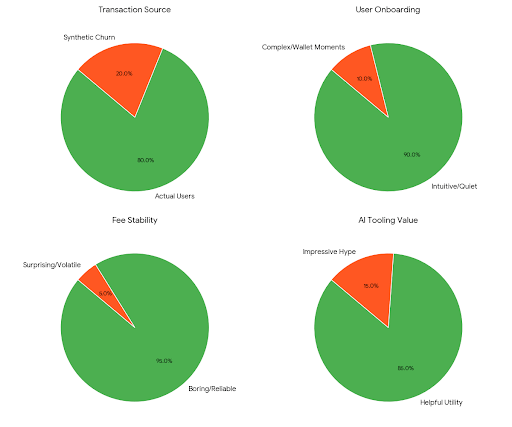
So the things worth watching aren’t hype metrics. They’re unglamorous questions with real consequences. Are these transactions coming from actual users inside real products, or are they synthetic churn? Do fees stay boring under load? Does onboarding remain intuitive when users move from casual access to true ownership? And does the AI tooling get used because it helps, not because it sounds impressive?
If @Vanar succeeds, it won’t announce itself loudly. It will recede. People will tap buttons, move items, verify permissions, and never once be surprised by a fee or a wallet moment. The chain won’t feel like the protagonist. It will feel like the stage crew—unseen, reliable, making sure the lights stay on. And if onboarding billions of users is ever going to be more than a slogan, that kind of quiet competence is exactly what crypto has been missing.