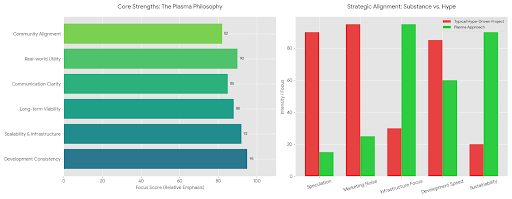
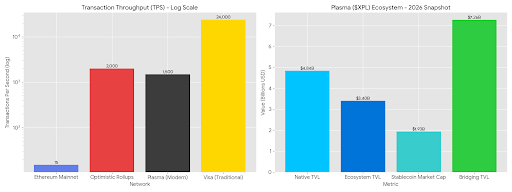
 Plasma is one of those projects that doesn’t immediately try to grab your attention, and that’s exactly what makes it interesting. In a space where most narratives are driven by short-term hype, aggressive marketing, and constant noise, Plasma feels deliberately different. It’s building quietly, methodically, and with a clear sense of direction. That approach doesn’t always trend on social media, but over time, it’s often the kind that matters most.
What stands out first about Plasma is its focus on fundamentals. Instead of promising everything at once, the project seems centered on solving real infrastructure problems in a practical way. There’s a strong emphasis on scalability, efficiency, and usability—things that don’t always sound exciting in a tweet, but become crucial as ecosystems mature. Many crypto projects fail not because they lack ideas, but because their foundations can’t support real usage. Plasma appears to be designed with that lesson in mind.
Another notable aspect is how Plasma positions itself within the broader ecosystem. It doesn’t try to reinvent everything or compete loudly with every existing solution. Instead, it feels like it’s carving out its own space, identifying where current systems struggle, and working toward incremental but meaningful improvements. This kind of positioning suggests long-term thinking rather than short-term speculation. It’s less about dominating a cycle and more about staying relevant across multiple ones.
The team’s approach to development also deserves attention. Progress doesn’t seem rushed, yet it’s consistent. Updates feel purposeful rather than performative. That consistency builds quiet confidence over time, especially for those who have been in the space long enough to recognize the difference between real building and surface-level activity. In crypto, speed is often celebrated, but sustainability usually wins. Plasma seems to lean toward the latter.
There’s also something to be said about how Plasma communicates. The messaging isn’t overloaded with buzzwords or exaggerated claims. Instead, it tends to be straightforward and grounded. That tone resonates with a growing segment of users and builders who are tired of empty promises and want clarity. As the market matures, projects that communicate honestly often earn deeper trust, even if it takes longer.
From a broader perspective, Plasma fits into a shift that’s happening across the industry. After years of experimentation, the focus is slowly moving back to infrastructure and real utility. Speculation still exists, but it’s no longer enough on its own. Users, developers, and even institutions are starting to look for systems that can actually handle scale, security, and real-world use cases. Plasma’s direction aligns well with that shift.
What makes this especially compelling is that Plasma doesn’t seem to rely on external validation to define its value. It’s not constantly chasing partnerships just for headlines or pushing narratives to stay relevant. Instead, it appears to be building something it believes will stand on its own merits. That kind of confidence is subtle, but powerful. Over time, it often attracts people who are genuinely interested in contributing rather than just extracting value.
There’s also a sense that Plasma understands timing. Not every innovation needs to be loud at launch. Sometimes, being early means being ignored, and that’s okay. By focusing on getting things right rather than getting attention, Plasma positions itself to benefit when the market eventually shifts its focus back to substance. History has shown that many of the most impactful projects were overlooked in their early stages.
Another important factor is adaptability. While Plasma has a clear vision, it doesn’t feel rigid. The crypto landscape evolves quickly, and projects that survive are usually the ones that can adjust without losing their core purpose. Plasma’s emphasis on infrastructure and scalability suggests a flexible foundation—one that can support new use cases as they emerge rather than being locked into a single narrative.
For builders and developers, Plasma can be particularly appealing. A strong underlying system reduces friction and opens room for creativity. When infrastructure works as intended, developers can focus on building applications instead of constantly working around limitations. If Plasma continues to prioritize this experience, it could naturally attract a community of builders who value reliability over hype.
From a user perspective, the benefits may not be immediately visible, but they compound over time. Better infrastructure often translates into smoother interactions, lower costs, and fewer failures. These improvements don’t always make headlines, but they significantly shape long-term adoption. Plasma’s approach suggests an understanding that real users care more about how things work than how they’re marketed.
It’s also worth noting that Plasma’s quieter presence can act as a filter. It naturally attracts people who are willing to look beyond surface-level narratives. This can lead to a more aligned and patient community, which is often a key ingredient for long-term success. Communities built purely on hype tend to fragment quickly, while those formed around shared values and understanding tend to endure.
Of course, no project is without risk, and Plasma is no exception. Execution always matters more than intention, and the space is highly competitive. But what sets Plasma apart is not a guarantee of success—it’s the mindset behind its development. The focus on doing things properly, even when it’s not fashionable, increases the probability of lasting relevance.
As the market cycles continue, attention will likely shift back and forth between speculation and substance. During those moments, projects like Plasma often stand out not because they suddenly change, but because the market finally catches up to what they’ve been building all along. When infrastructure becomes the priority again, the groundwork Plasma has laid could become far more visible.
In the end, Plasma feels like a project that’s comfortable playing the long game. It’s not trying to convince everyone overnight. It’s building, refining, and letting progress speak for itself. For those paying attention, that quiet consistency can be more compelling than any viral moment. Whether you’re a builder, a user, or simply someone observing the space, Plasma is the kind of project that’s worth watching not because it’s loud, but because it’s steady.