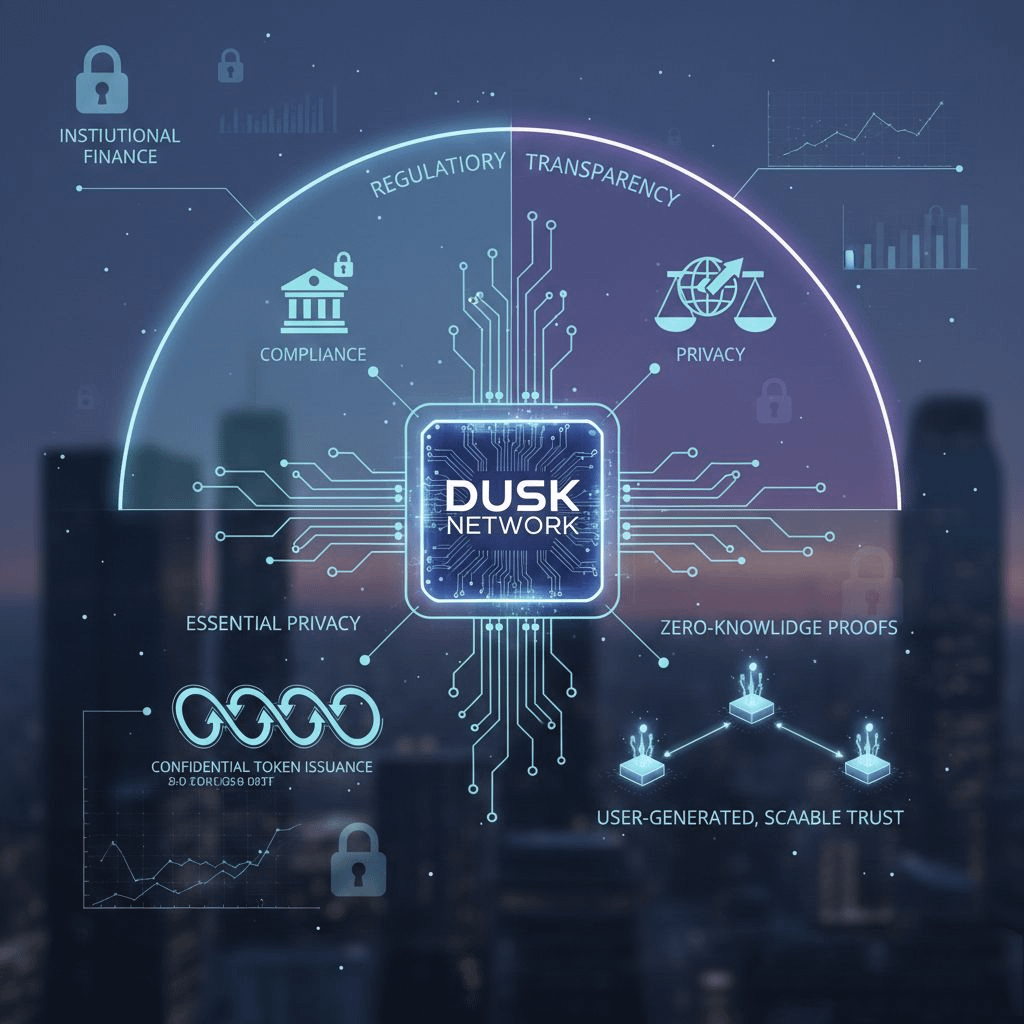
@Dusk exists to solve a problem most blockchains were never designed to address: how to bring regulated finance on-chain without destroying privacy. As the blockchain industry matures, the conversation has moved beyond what is theoretically possible toward what is operationally viable. Dusk is built for that reality. It is not an experimental system or a speculative narrative—it is infrastructure designed for real financial activity operating under real legal constraints.
From the outset, Dusk was designed with a clear understanding of how financial markets function in practice. Confidentiality is not optional in traditional finance. Transactions are private, positions are protected, and sensitive information is disclosed only to authorized parties. At the same time, these systems remain auditable, enforceable, and compliant. Dusk does not attempt to overturn this balance. Instead, it recreates it on-chain, replacing trust-based intermediaries with cryptographic guarantees.
Most blockchains treat transparency as an absolute good. Every transaction is public, every balance visible, every interaction permanently traceable. While this model works for open experimentation, it collapses when applied to regulated financial products. Institutions cannot expose client data. Issuers cannot publish ownership structures. Funds cannot operate if strategies are visible in real time. These are not philosophical objections to transparency—they are structural realities of regulated markets.
Dusk addresses this problem at the protocol level by making privacy foundational rather than optional. Using zero-knowledge cryptography, Dusk enables transactions and asset transfers to be validated without revealing sensitive information to the public. Rules can be enforced, correctness can be proven, and compliance can be demonstrated without broadcasting confidential data across the network.
This design fundamentally changes how on-chain finance can operate. Instead of forcing all participants into full transparency, Dusk enables selective disclosure. Information is shared only with those who are entitled to see it. Regulators can access detailed data when required. Counterparties can verify legitimacy and compliance. The network as a whole can confirm that rules are followed without learning private inputs. This mirrors real-world financial workflows, but with stronger security and fewer points of failure.
The importance of this approach becomes even clearer when considering real-world assets. Tokenization is often presented as inevitable, but infrastructure matters more than the concept itself. Regulated assets—such as equities, bonds, funds, and real estate—carry legal obligations that cannot be ignored. Ownership records must remain protected. Investor privacy must be preserved. Reporting must adhere to jurisdictional requirements.
On fully transparent blockchains, these obligations conflict with the underlying design. Sensitive data becomes public by default. Compliance is implemented through external workarounds rather than natively. As a result, institutional adoption remains limited.
Dusk approaches tokenization from the opposite direction. It assumes regulated assets are the primary use case and builds the system around them. Assets can be issued, traded, and settled on-chain while maintaining confidentiality. Compliance logic can be embedded directly into transactions. Audits become cryptographic proofs rather than manual, trust-heavy processes.
This makes Dusk particularly attractive to financial institutions seeking blockchain efficiency without introducing unnecessary risk. Settlement can be faster. Operational costs can be reduced. Transparency is provided where it is required—rather than everywhere by default.
Compliance is not treated as an external constraint within the Dusk ecosystem. It is integrated directly into the protocol. Permissions can be verified without publicly exposing identities. Rules can be enforced automatically. This reduces operational complexity while increasing confidence for all participants.
As global privacy regulations continue to tighten, this design becomes increasingly relevant. Data protection frameworks assume that sensitive information is handled deliberately and disclosed selectively. Dusk aligns naturally with this reality, allowing institutions to benefit from blockchain infrastructure without compromising legal or ethical responsibilities.
The DUSK token reflects this long-term, infrastructure-first philosophy. It secures the network, supports consensus, and enables governance. Validators are incentivized to act honestly and maintain reliability. Governance mechanisms allow the protocol to evolve alongside regulatory and technological change, creating a stable foundation institutions can rely on over time.
Dusk is not designed for short-term speculation. It is designed for durability. Financial infrastructure must function in both calm and stressed markets. It must handle scale, complexity, and scrutiny. Dusk’s architecture reflects these priorities.
This focus is particularly relevant as global finance undergoes structural transformation. Settlement systems face increasing pressure to modernize. Cross-border transactions remain inefficient. Tokenization is moving from experimentation to production. At the same time, regulators are becoming more engaged, seeking systems that provide verifiability without undermining privacy.
Most blockchains struggle to meet these requirements simultaneously. Dusk was built specifically to do so.
Rather than relying on hype or exaggerated narratives, Dusk’s value proposition is pragmatic. It is about enabling finance to move on-chain in a way that institutions, regulators, and market participants can realistically accept.
In doing so, Dusk represents a shift in how blockchain technology is applied. Instead of asking finance to adapt to crypto’s limitations, it adapts cryptographic systems to the realities of finance. This does not weaken the technology—it strengthens it by aligning it with real-world needs.
As on-chain finance continues to mature, demand for privacy-preserving, compliant infrastructure will only grow. Systems that ignore these requirements may thrive in niche environments, but they will struggle to support serious capital. Dusk is positioned for the latter.
The future of finance will be verifiable, compliant, and selectively private. It will rely on cryptography rather than blind trust. It will operate globally while respecting local rules. Dusk is built for that future—providing a foundation where regulated financial activity can move on-chain without sacrificing the principles that make finance work.