
Most Layer-1s are still competing on abstract performance metrics because they don’t understand where crypto demand actually crystallizes. Plasma is different because it starts from a sharper premise: stablecoins are no longer an application category, they’re the base layer of crypto usage. When you look at on-chain data across cycles, volatility assets come and go, but stablecoin flows compound. Plasma isn’t trying to win the “general L1” race; it’s trying to monopolize the settlement layer for dollar-denominated crypto activity. That’s a fundamentally different game with different winners.
The first non-obvious signal is that Plasma’s architecture optimizes for behavioral certainty, not maximum expressiveness. Sub-second finality via PlasmaBFT isn’t about UX polish it’s about reducing balance sheet risk for entities moving size. Institutions and payment processors don’t care about composability density; they care about how long capital sits exposed between intent and settlement. When finality collapses toward human reaction time, the need for hedging layers disappears, which lowers total transaction cost in a way TPS charts never capture.
Gasless USDT transfers aren’t a “feature”; they’re a deliberate inversion of who bears network cost. On most chains, users subsidize validators through gas, which creates friction exactly where stablecoin velocity should be highest. Plasma flips that by making stablecoins the gas primitive. The result is subtle but powerful: wallet behavior shifts from batching and delay to continuous flow. Over time, that increases transaction frequency per address while reducing average transfer size a pattern you typically only see on centralized rails. That’s not theoretical; it’s observable in chains where gas abstraction has already been stress-tested.
EVM compatibility via Reth looks conservative on the surface, but economically it’s a liquidity capture strategy. Plasma doesn’t need developers experimenting with novel VMs; it needs existing stablecoin-heavy contracts to redeploy without rewriting risk logic. In capital terms, this reduces migration friction for protocols that already manage nine or ten figures in TVL but can’t afford execution surprises. The real edge isn’t dev adoption it’s risk committee approval. Reth is a signal to conservative capital that nothing weird is happening under the hood.
Bitcoin-anchored security is where Plasma quietly diverges from most L1s. This isn’t about borrowing Bitcoin’s brand; it’s about anchoring finality to an asset whose political neutrality is already priced in by the market. When you analyze censorship events across chains, the pattern is clear: chains tied to discretionary governance eventually get leaned on. For stablecoin settlement, even the perception of that risk is enough to reroute flows elsewhere. Plasma is explicitly pricing that concern into its security model before it shows up in the data.
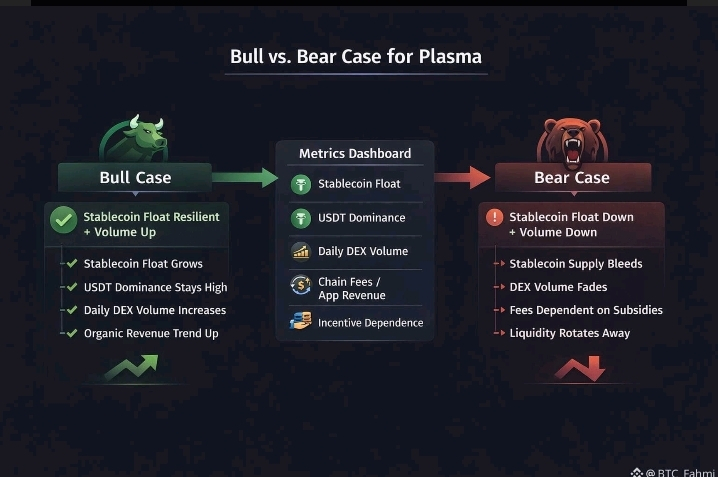
What really matters is how this behaves under declining incentives. Most L1s rely on token emissions to bootstrap activity, then bleed volume when yields compress. Plasma’s bet is that stablecoin users are yield-agnostic past a threshold they prioritize reliability and cost predictability. If that’s correct, Plasma’s volume curve should flatten rather than spike, with lower variance across market regimes. That’s not exciting for speculators, but it’s exactly what payment rails look like once they’ve won.
Capital rotation right now favors infrastructure that reduces cognitive overhead. Traders are exhausted by chains that require constant monitoring of incentives, bridges, and governance drama. A settlement-focused L1 that minimizes decision surface area has an edge in this environment. Plasma doesn’t ask users to believe in upside narratives; it asks them to route dollars efficiently. In a risk-off tape, that’s a stronger pitch than most realize.

