

When I first stepped into the blockchain world, I was promised a financial revolution. Instead, I found a series of "world computers" that were slow expensive and required me to hold three different tokens just to send a simple payment. For years crypto felt like an experiment that never quite left the lab a niche hobby for the technically inclined rather than a tool for the masses.
Then I started using Plasma (XPL).
It didn’t feel like another science project. It felt like a finished product. Instead of trying to be a digital playground for everything from monkey NFTs to experimental gaming Plasma has a singular laser-focused mission: becoming the high-speed rail for the global stablecoin economy. Here is why I believe Plasma is finally closing the gap between "crypto tech" and "real world money."
1. THE DEATH OF THE GAS FEE
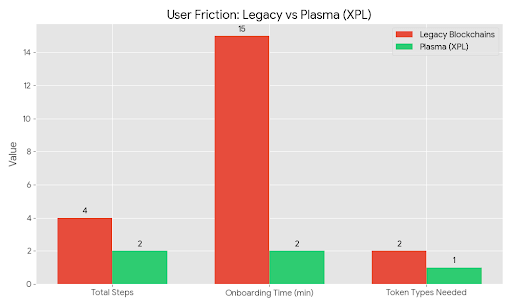
The biggest hurdle to mass adoption has always been what I call the "double-token friction." On almost every other chain, if you want to send $50 in USDT, you are forced to own a separate native coin (like ETH or SOL) just to pay for the "gas."
For a newcomer, this is a nightmare. It involves going to an exchange, passing KYC, buying a token they don't want, and bridging it to a wallet just to move the money they do want. It’s a terrible user experience that confuses everyone outside the crypto bubble.
Plasma solves this with a native Paymaster mechanism. This was my true "aha!" moment. It allows for gasless transactions, where the network or a third-party sponsor covers the fee behind the scenes. In many cases, you can simply pay the transaction fee using the stablecoin you’re already sending. By removing the need to hold XPL just to move your own dollars, Plasma makes the blockchain invisible. And in technology, invisible is the ultimate goal.
2. TECHNICAL DNA: SPEED WITHOUT COMPROMISE
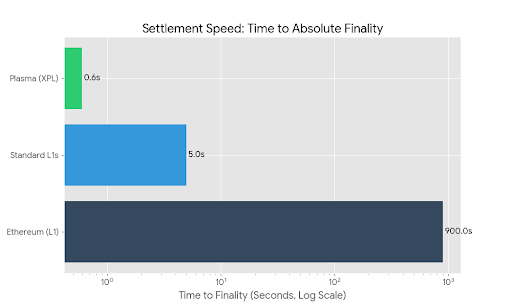
In my experience, "speed" in the blockchain world is often a marketing gimmick. Many chains claim thousands of transactions per second, but when you actually use them, you’re still left staring at a spinning wheel waiting for "finality"—the moment the transaction is truly irreversible.
Plasma's performance comes from a sophisticated marriage of two technologies: PlasmaBFT and the Reth engine.
By utilizing Reth (a high-performance Ethereum execution client written in Rust), Plasma maintains full compatibility with the apps we already know but runs them on a much faster engine. The result is sub-second finality. When I hit "send" on Plasma, the transaction is settled before I can even look up from my phone. This isn't just a technical flex; it’s a requirement for actual retail—the kind of speed you need at a grocery store checkout or a high-volume online merchant.
3. THE BITCOIN SECURITY ANCHOR
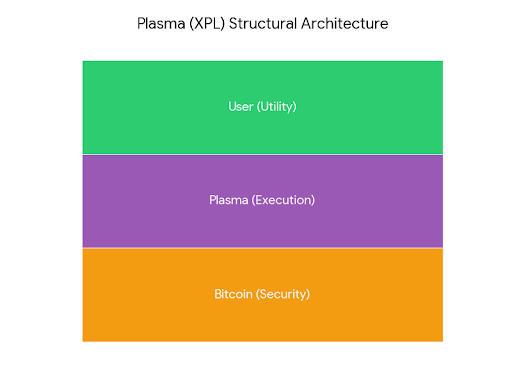
I’m often asked: "If it’s this fast and easy, is it actually secure?" This is where Plasma’s architecture gets brilliant. It doesn't try to exist in a vacuum or rely solely on a small group of validators. Instead, it acts as a Bitcoin sidechain.
While it handles transactions at lightning speed on its own layer, it periodically "anchors" its state to the Bitcoin blockchain. Think of it like a high-speed high-frequency trading floor that locks its daily books into a giant, indestructible vault every few minutes.
This gives me the best of both worlds: the speed and smart contract flexibility of a modern EVM environment, backed by the immutable, trillion-dollar security of the Bitcoin network. It’s a hybrid model that provides institutional-grade peace of mind without the sluggishness of 20th-century technology.
4. WHY SPECIALIZATION WINS
For years, the industry has been obsessed with "General Purpose" blockchains—networks that try to do everything for everyone. But the history of technology shows us that specialization is what leads to scale. We have specialized chips for AI, specialized servers for video streaming, and specialized protocols for email.
Plasma (XPL) is the specialized protocol for value.
By stripping away the complexity of gas fees, optimizing for sub-second settlement, and anchoring to the most secure network in existence, Plasma has built a specialized highway for the $200 billion stablecoin market. It doesn't care about being a world computer; it wants to be the world's ledger.
THE VERDICT
For the first time, I can see a future where my parents use a blockchain-based wallet and never even realize they’re on a blockchain. They’ll just know that the money moved instantly and it didn't cost them a "gas fee" to do it.
That is the "Plasma difference." It’s moving us out of the era of "crypto-native" complexity and into the era of global financial utility. In 2026, that isn't just progress it's the only way forward.