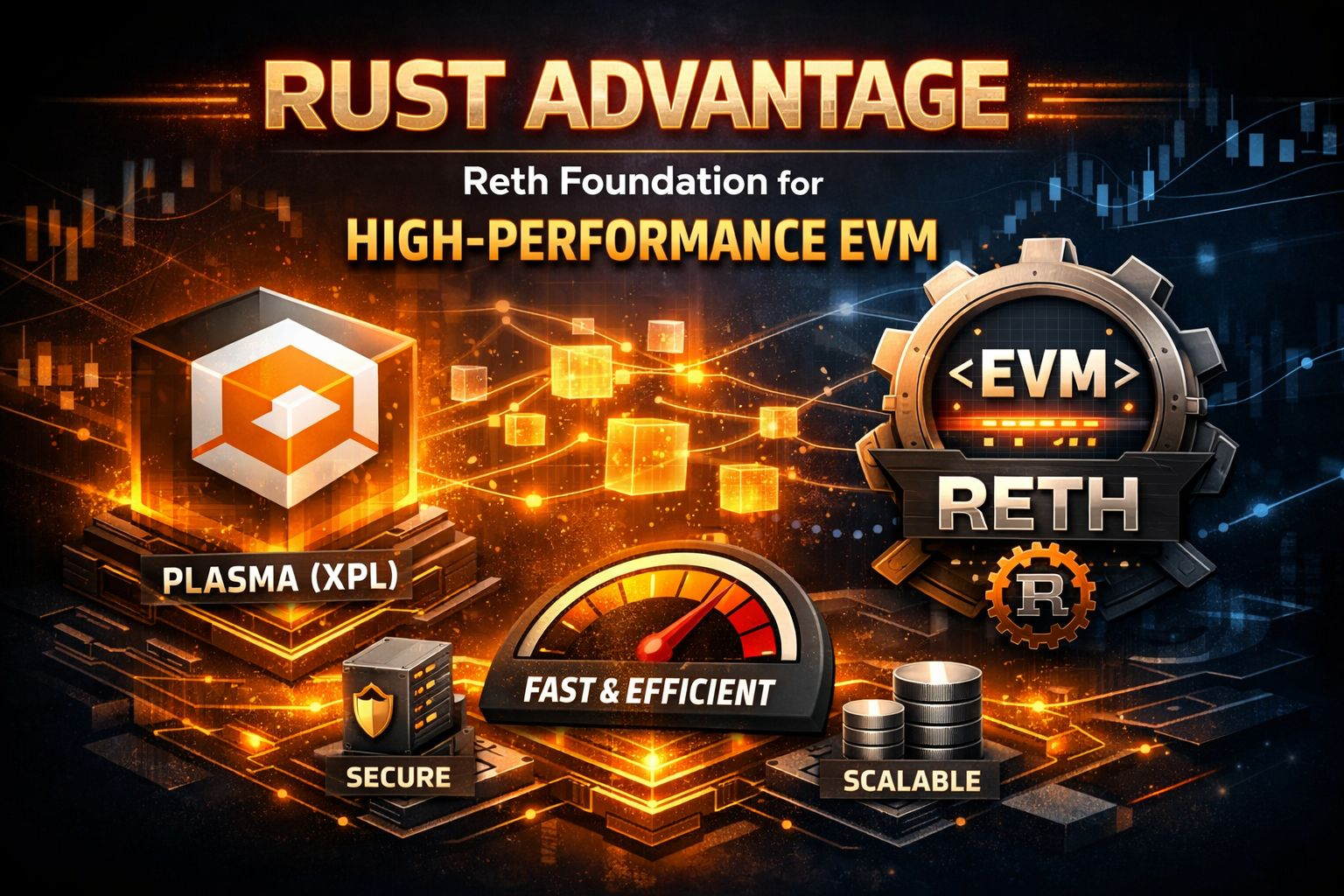
I used to think “EVM performance” was mostly about faster blocks and bigger gas limits. Then I watched a payments-heavy chain hit a weird wall. Not a crash. Not a hack. Just… lag. Nodes falling behind. RPCs timing out. Reorg fear creeping in. And everyone blaming “network load” like it’s weather. But the problem was lower. It was the engine. That’s where Rust and specifically Reth starts to matter. Not in a hype way. In a “your system either keeps up or it doesn’t” way. Plasma (XPL) is a clean case study here because it’s built for high-volume stablecoin flows. That means lots of small transfers, lots of state reads, lots of boring work that still must be correct. Plasma’s public docs describe a split brain by design: PlasmaBFT handles sequencing and finality, while Reth runs the EVM and applies state changes. So when people ask “why Rust?” the honest answer is: because execution is where chains quietly die. Here’s the simple mental model. A blockchain node has two jobs. First, agree on the order of transactions. Second, actually run them and update the ledger. Most debates focus on job one. Finality and Validators. Leader schedules. But job two is where the CPU sweats. It’s where disk access hurts. It’s where memory layouts matter. And it’s where a stablecoin chain can choke, even if consensus is fast. Reth is an Ethereum execution client written in Rust, built to be modular and fast. “Execution client” sounds fancy, so let’s make it plain: it’s the part that takes transactions, runs smart contract code, and updates account balances and contract storage. If that layer is slow, you can have sub-second blocks on paper and still feel stuck in mud. Rust’s advantage isn’t magic speed. It’s control. Rust lets you write code that runs close to the metal, like C or C++, but with guardrails that catch a lot of memory bugs before they ship. Think of it like building a race car with a seatbelt that actually locks. Less time spent chasing weird crashes. More time pushing performance without gambling on safety. That safety angle isn’t “nice to have” in crypto infra. A node client is the foundation. If it has bugs, every app above it pays. And stablecoin payment rails don’t get to shrug and say “beta.” Plasma’s goal is to feel like payments, not like a science fair. So you want an execution layer that is strict, predictable, and hard to break under stress. That’s the Rust vibe. Now the performance part. High-performance EVM isn’t one thing. It’s a pile of small wins that compound. One win is modular design. Reth was built with clean parts so teams can swap components, tune them, and test changes without ripping the whole client apart. That matters for a chain like Plasma because “EVM compatible” is not enough. You need “EVM compatible at scale.” Plasma’s docs put it plainly: it’s fully EVM-compatible and built on Reth, so devs can deploy Solidity with normal tools. Cool. But the deeper point is operational. If you keep the Ethereum execution model intact, you inherit the best tooling in crypto. Wallets, debuggers, indexers, infra habits. The trade is you must execute like Ethereum does… only faster. Another win is efficiency under load. Stablecoin traffic is repetitive. Tons of balance changes. Tons of reads. Same contracts called over and over. A fast client needs to handle that without turning into a disk-thrashing machine. This is where client engineering becomes the product. Better caching. Better database layout. Better parallel work where safe. Less wasted effort per transaction. You don’t “market” your way out of that. And then there’s the boring killer: RPC. Most users never talk to consensus. They talk to RPC endpoints. “Send my tx.” “Check my balance.” “Show my history.” If your execution client can’t answer quickly, the chain feels down even when it isn’t. Reth’s focus on speed and efficiency is partly about making nodes more usable, not just winning benchmarks. So where does Plasma fit in the “Reth as foundation” story? Plasma is not pretending to be Ethereum mainnet. It’s targeting stablecoin payments at global scale. Its public materials describe the architecture as EVM execution on Reth plus PlasmaBFT for sequencing and finality. That split is a quiet power move. It says: keep the execution world familiar, then optimize the chain around the use case. If you do it right, developers don’t rewrite everything. Users don’t relearn wallets. Ops teams don’t invent a new playbook. And the chain can still tune for low latency, high throughput, and smoother fees. But I’m not going to oversell it. Rust doesn’t guarantee success. Reth doesn’t automatically make a chain fast. You can still mess it up with bad parameters, weak infra, or poor incentives. And EVM itself has limits; it was not designed for infinite throughput. Still, picking a modern execution client built for performance gives you a better starting line than dragging old code into new demands. The “Rust advantage” is less about hype speed and more about survival under real load. Plasma betting its EVM layer on Reth is basically saying, “we need execution to be a strength, not a liability.” In a stablecoin-first world, that’s not a nice detail. That’s the whole try. And yeah… once you notice that, it’s hard to unsee.