
When Dusk was founded in Amsterdam in 2018, it didn’t emerge as just another blockchain hoping to ride the wave of decentralized finance hype. Instead, it was born from a deeper conviction: that the next frontier for financial markets would not simply be faster or cheaper, but fundamentally different in how privacy and regulation can comfortably coexist on a digital ledger. What the founders saw before much of the broader industry had fully acknowledged it was the gap between traditional regulated markets and public blockchains. On one side were centralized financial systems, fraught with inefficiencies, opaque processes, and slow settlement cycles; on the other were decentralized networks thriving on transparency, decentralization, and composability. The problem, as Dusk’s visionaries framed it, was that traditional blockchains were not built to “speak” the language of regulated assets securities, bonds, equities, and the legal obligations that accompany them while legacy financial infrastructure was costly and rigid. Dusk was conceived as the bridge between these worlds, a Layer 1 protocol where privacy would not be an afterthought and compliance would be a native capability.
At its core, Dusk is a privacy-enabled, regulation-aware blockchain designed for institutional financial markets. It is built to support the issuance, trading, clearing, and settlement of regulated financial instruments such as tokenized securities and real-world assets things like stocks, bonds, ETFs, and even fiat-linked settlement tokens without sacrificing confidentiality or compliance. This means banks, exchanges, broker-dealers, and institutional investors can use Dusk to eliminate intermediaries like central securities depositories and drastically reduce the time and cost associated with traditionally slow post-trade processes. In practice, this translates to near instant settlement finality and the ability to embed legal and regulatory rules such as KYC/AML checks or limits on who can own or trade an asset directly within the protocol rather than as external administrative overhead. 
What makes Dusk particularly distinctive is how it marries privacy with auditability. Public blockchains like Bitcoin or Ethereum broadcast transaction details openly, and while such transparency is valuable for trustlessness, it is fundamentally incompatible with many financial use cases where the exposure of sensitive trading information could cripple business models or violate data protection laws. Dusk integrates zero-knowledge proofs (ZKPs) advanced cryptographic tools that allow transactions to be verified without revealing the underlying data so that balances, amounts, or counterparty identities remain confidential unless selectively disclosed to authorized parties. This “privacy-by-design” approach means users get confidentiality by default, with the option to reveal information only when required for regulatory reporting or audit purposes. The privacy layer is not an isolated add-on but deeply integrated into the protocol’s transaction models, ensuring that institutions can operate with confidence without publicly exposing their strategies, positions, or sensitive financial data
Underpinning this privacy capability is a modular architecture that separates key blockchain functions into distinct, specialized layers. At the foundation lies DuskDS, the settlement and consensus layer responsible for data availability, block finality, and the secure transfer of the native DUSK token. This layer is governed by an innovative Proof-of-Stake consensus mechanism called Succinct Attestation, which achieves deterministic finality meaning that once a block is ratified it cannot be reversed an essential property for digital financial markets where legal certainty of ownership and transfer is paramount. On top of this base are execution environments such as DuskEVM, an Ethereum compatible execution layer enabling smart contracts using familiar tooling, and DuskVM, a WebAssembly-based environment tailored for privacy-centric applications. Together, these layers create flexibility: developers can build traditional DeFi dApps, privacy-preserving financial instruments, or hybrid compliant systems depending on the needs of the use case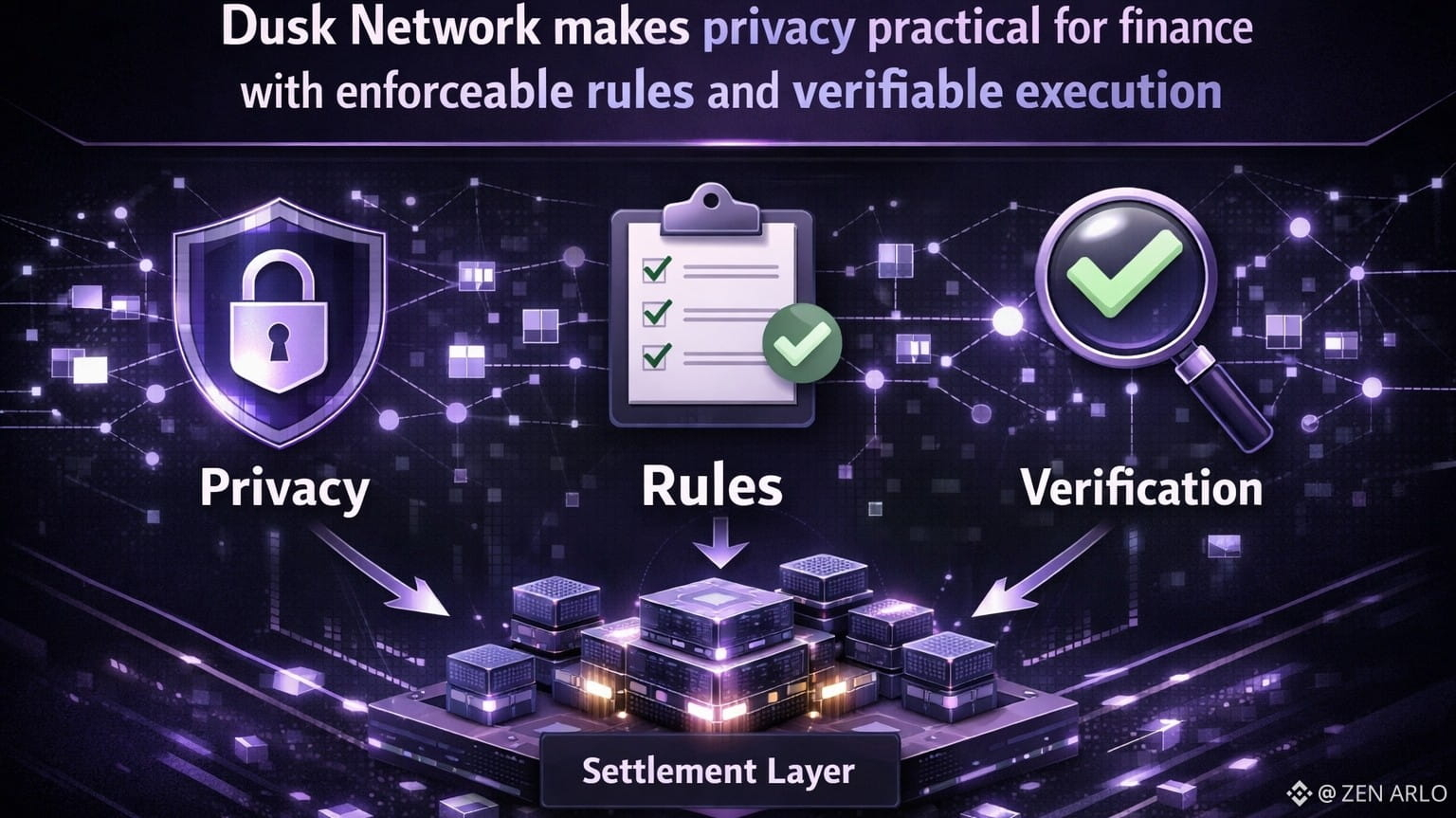
In practical terms, this architecture supports a wide range of applications that blur the line between traditional finance and next-generation decentralized systems. Institutional DeFi applications lending, automated market makers, structured products can enforce regulatory rules directly on-chain without exposing proprietary data. Markets for tokenized securities can be native to the protocol, with compliance obligations such as eligibility checks embedded into the lifecycle of a digital bond or equity token. Confidential payment and settlement rails between institutions become feasible, supporting delivery-versus-payment workflows where assets and cash settle concurrently with finality. And because the identity layer (such as Dusk’s Citadel protocol) can support self-sovereign identity, participants can prove compliance with KYC/AML rules without surrendering unnecessary personal data, a remarkable evolution in both privacy and regulatory design.
Dusk has also evolved beyond purely theoretical aspirations. In recent years, the project has marked key milestones, including launching public testnets such as DayBreak, where community members and developers could interact with the network and experiment with privacy-enabled smart contracts, demonstrating real progress toward a fully functional mainnet. Partners within the regulated financial industry are beginning to build on this foundation; for example, collaborations with Dutch stock exchange NPEX and stablecoin provider Quantoz are bringing MiCA-compliant settlement tokens and regulated secondary markets closer to reality, showcasing how regulated assets and blockchain technology can intersect without friction. Integration initiatives, such as with Chainlink’s cross-chain interoperability standards, further extend Dusk’s reach, enabling tokenized assets and their associated data to move securely across networks while preserving control and compliance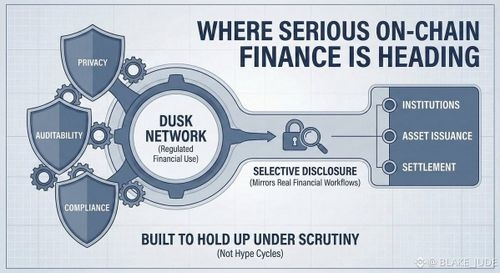
What sets Dusk apart from older privacy coins like Monero or Zcash is that it is not solely focused on hiding transaction details; rather, it is a purpose-built financial infrastructure where privacy is a means to an end, not the end itself. The aim is not secrecy for the sake of secrecy, but trusted confidentiality that allows institutions and individuals alike to participate in digital markets with the same expectations of privacy they have in traditional banking, while still satisfying the strictest legal frameworks. This nuanced balance of privacy, compliance, and decentralization positions Dusk as a promising platform for the future of regulated decentralized finance a world where institutional rigor and cryptographic innovation coexist, offering new possibilities for how financial markets function in the digital age
