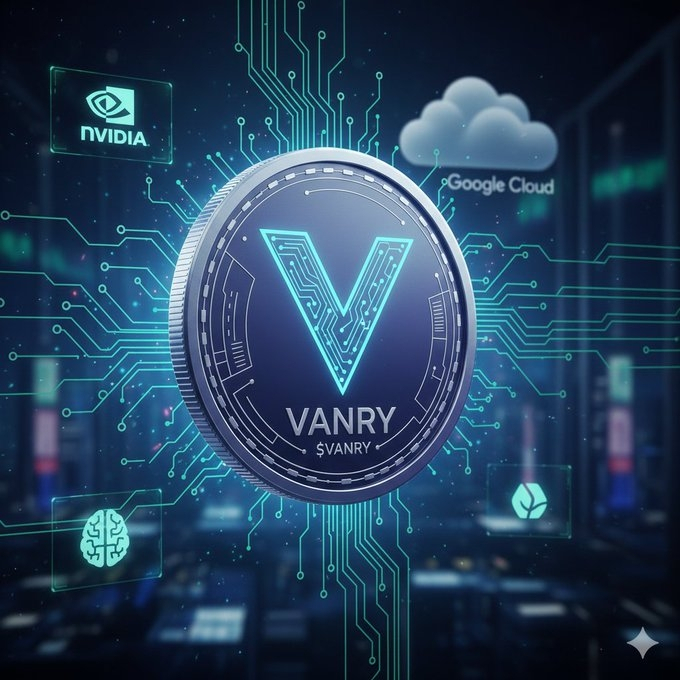
Vanar Rejects AI Plug-Ins — Native Architecture Is Where Real Value Lives
Anyone who has stayed in Web3 long enough knows this truth: ever since Ethereum unlocked smart contracts and reshaped value creation, the entire industry has been hunting for the next foundation-level upgrade that can carry the future. The arrival of AI didn’t just add another narrative—it clearly pointed out the direction for the next generation of blockchains.
Yet here’s the disappointment: most projects misunderstood the assignment.
Even major ecosystems with deep liquidity and massive user bases are simply adding AI on top of old frameworks. This “AI-enhanced” approach follows the same legacy path—patching features onto chains that were never designed for AI in the first place. Almost no one is willing to slow down and rebuild infrastructure that is AI-native from the ground up.
After closely observing the Web3 × AI intersection for nearly two years, I’ve become convinced of one thing:
The standard for judging a top-tier public chain has changed.
It’s no longer about TPS, buzzwords, or who shouts the loudest. The real winners are chains that are structurally ready for AI.
That’s exactly why $VANRY stood out to me among a sea of so-called “AI chains.” Vanar doesn’t rely on external AI attachments or surface-level integrations. Its architecture is AI-first by design, avoiding the common trap of bolt-on solutions. This is not cosmetic innovation—it’s foundational. And that’s why I’m confident not only in its long-term value, but also in actively engaging with its ecosystem.
Let’s be honest: many current “AI public chains” are fooling themselves. They take decades-old transaction and DeFi frameworks, glue an AI module on top, and call it innovation. It looks modern, but under the hood it’s fragile—slow inference, messy resource allocation, and security gaps everywhere. AI becomes a decorative feature, not a core capability.
Vanar took a completely different route.
From consensus design to memory structure to execution environments, every layer was built around what AI Agents actually need. On-chain inference, automated execution, and closed-loop settlement aren’t optional extras—they’re embedded into the system’s DNA. No forced compatibility, no late-stage patching. AI Agents can operate smoothly and securely, exactly how infrastructure in the AI era should function.
There’s also a major misconception floating around: people think “AI-ready” just means faster blocks or higher TPS. That’s missing the point entirely.
For AI Agents to work on-chain, they require:
Native memory
Verifiable on-chain inference
Autonomous execution
End-to-end settlement
Miss even one of these, and AI on-chain is just talk.
Vanar addressed this head-on with a full-stack solution:
myNeutron provides native on-chain memory, giving AI Agents a stable and persistent state layer.
Kayon enables transparent, explainable on-chain inference, eliminating black-box decision-making.
Flows ensures automated, uninterrupted execution of complex processes, paired with native settlement.
This isn’t whitepaper storytelling—it’s product-driven delivery.
What’s even more forward-thinking is that Vanar doesn’t lock itself into a single-chain mindset. It recognizes reality: users, developers, and liquidity already live in mature ecosystems like Ethereum and Base. An AI-first chain isolated on its own island—no matter how advanced—is still limited.
That’s why Vanar opened cross-chain access to Base, breaking the walls of a closed ecosystem. Once connected, AI Agents can move freely between Vanar and other networks, tapping into broader liquidity and real demand. This instantly expands the role of $VANRY, from a single-chain utility into multi-ecosystem AI service payments and cross-chain settlement.
In a crowded L1 landscape where block space is no longer scarce, survival doesn’t come from hype—it comes from execution. Vanar stays focused on real AI infrastructure needs, especially the hardest part: commercial settlement.
AI Agents can’t rely on clunky wallet approvals or manual authorization. Automation demands native, compliant, seamless payment rails. Vanar solved this at the protocol level, turning autonomous payments and global settlement into built-in capabilities—not demo features. This is what allows AI to actually function as an economic actor.
Because of this, $VANRY moves beyond speculation. Its value is directly tied to real AI activities—inference, memory usage, and Agent execution. That linkage is what gives it durability.
Crypto narratives rise and fall fast. When the noise fades, only infrastructure that works remains. Vanar’s value has never depended on hype cycles—it’s anchored to tangible demand in the AI economy. As AI Agents scale and enterprise on-chain AI accelerates, infrastructure that was prepared early will naturally capture sustained demand.
That’s why I believe this deeply:
Execution beats narrative. Readiness beats hype.
With an AI-first foundation, real products, cross-chain reach, and a complete settlement framework, Vanar is building what the AI era actually requires. And $VANRY is the key link between real usage and value capture.
This isn’t just another upgrade—it’s a blueprint for how Web3 evolves alongside AI. And that’s why I remain confident that Vanar will emerge as a defining force in the AI × Web3 landscape.