
The blockchain world has grown incredibly fast. Layer 1s promise security, Layer 2s promise speed and countless sidechains promise lower fees and specialized functionality. But here’s the catch: these networks don’t naturally talk to each other. They’re like islands in a vast digital ocean, each with its own language, rules and currency. Without bridges, moving assets between them is messy, slow and risky.That’s where Plasma Coin comes in. Think of it as a bridge built specifically for stablecoins, the digital dollars of crypto. While most blockchain projects were focused on tokens or smart contract platforms, stablecoins quietly became the backbone of real-world crypto use.
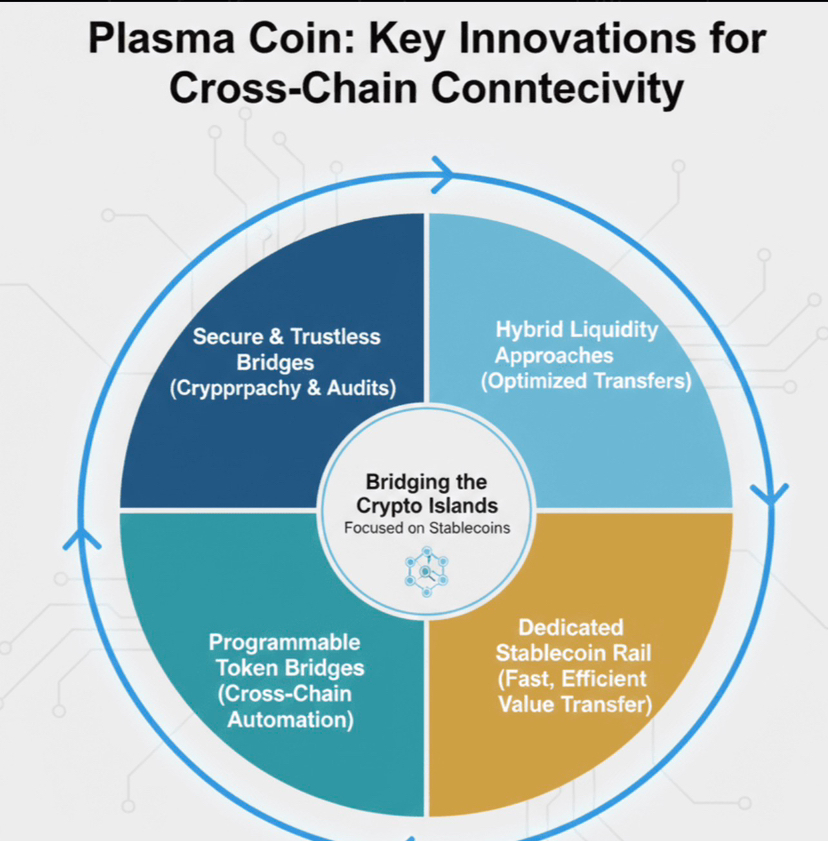 People use them to pay salaries, send remittances and store value without worrying about volatility. Yet, most chains weren’t designed with stablecoins in mind. Fees spike, transactions lag and moving funds across chains is often an adventure in frustration. Plasma fixes that.Plasma isn’t just a bridge. It’s a dedicated rail for stablecoins, designed to move value quickly, safely and efficiently. Unlike traditional bridges, which often retrofit cross-chain functionality as an afterthought, Plasma was built from the ground up to solve the problems of liquidity, security and usability. It combines smart contracts, cryptographic proofs and off-chain relayers to ensure that your assets are always under control, no middlemen, no blind trust. For me, this is the real magic: it lets users own their funds fully while giving developers the tools to build across multiple chains.Let’s break down how this works, but in plain language.
 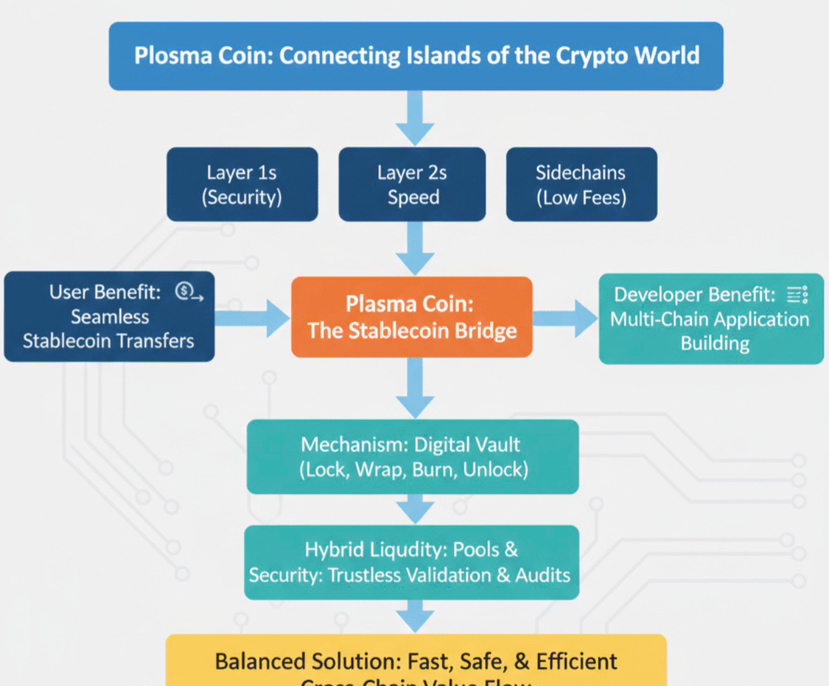 Imagine you have a dollar on one blockchain, Ethereum, for example but you want to use it on another chain, like Avalanche, to take advantage of lower fees or faster transactions. Plasma acts like a digital vault. Your dollar is locked safely on Ethereum, and a corresponding “wrapped” version appears on Avalanche. When you’re done, the wrapped version is burned, and your original dollar is unlocked. This keeps everything balanced and ensures nothing gets lost in the process.Some bridges rely on liquidity pools instead of wrapped tokens. Think of these as pre-stocked vending machines: you deposit one token on one chain and instantly receive the equivalent from a pool on another chain. It’s fast, but it only works if the pools are healthy.
 Plasma understands the nuances of both approaches and applies them in ways that maximize efficiency without sacrificing safety.Security is always top of mind. Bridges are tempting targets for hackers because they hold large amounts of value. History has shown us that a single exploit can cost billions. Plasma addresses this with trustless validation and rigorous audits, making the system resilient while maintaining speed. From my perspective, this is what separates it from almost every other bridge: it’s engineered for stability first, speed second, rather than the other way around.Beyond just moving money, Plasma transforms how capital and applications interact across chains.
  Developers can design apps that split operations across networks, settling high-value transactions on a secure Layer 1 while handling everyday operations on a fast Layer 2. Users benefit from lower fees and higher efficiency without even noticing the underlying complexity. Stablecoins move where they’re most useful, DeFi capital flows smoothly and arbitrage opportunities keep markets balanced. It’s the kind of flexibility that turns siloed chains into a connected ecosystem.What excites me most is Plasma’s support for programmable token bridges. These aren’t just about transferring dollars, they can carry instructions. That means an action on one chain can automatically trigger a smart contract on another chain. Imagine locking collateral on one network and instantly minting a derivative token on another. The possibilities for multi-chain applications are enormous, and it’s all possible without forcing users to manually juggle different chains.Of course, no system is perfect. Transaction finality varies across networks, which means bridges need to be careful not to act too early or risk errors. Phishing attacks remain a real threat and users must stay vigilant. But Plasma’s design mitigates many of these risks through transparency, clear audit trails and reliance on cryptography rather than promises. From my perspective, this combination of practicality and security is what makes it stand out.Looking forward, Plasma Coin isn’t just solving today’s problems, it’s preparing for the multi-chain world of tomorrow. Chains that communicate natively, decentralized apps that exist across networks seamlessly and users who can move stablecoins without friction. Zero-knowledge proofs, decentralized validators and light clients will further strengthen trustless operations, making cross-chain activity almost as safe as operating on a single chain.In essence, Plasma Coin is more than a bridge. It’s the connective tissue for the next-generation digital economy, enabling money, data, and value to flow freely while keeping users in control. It turns fragmented chains into a cohesive ecosystem where liquidity is accessible, DeFi is composable and innovation isn’t limited by network boundaries.For anyone serious about multi-chain crypto, Plasma is a glimpse into a future where stablecoins truly function as money, not just tokens and where Web3’s promise of self-sovereignty, composability, and efficiency becomes reality. From my viewpoint, this is not just infrastructure, it’s the foundation for the future of digital finance.