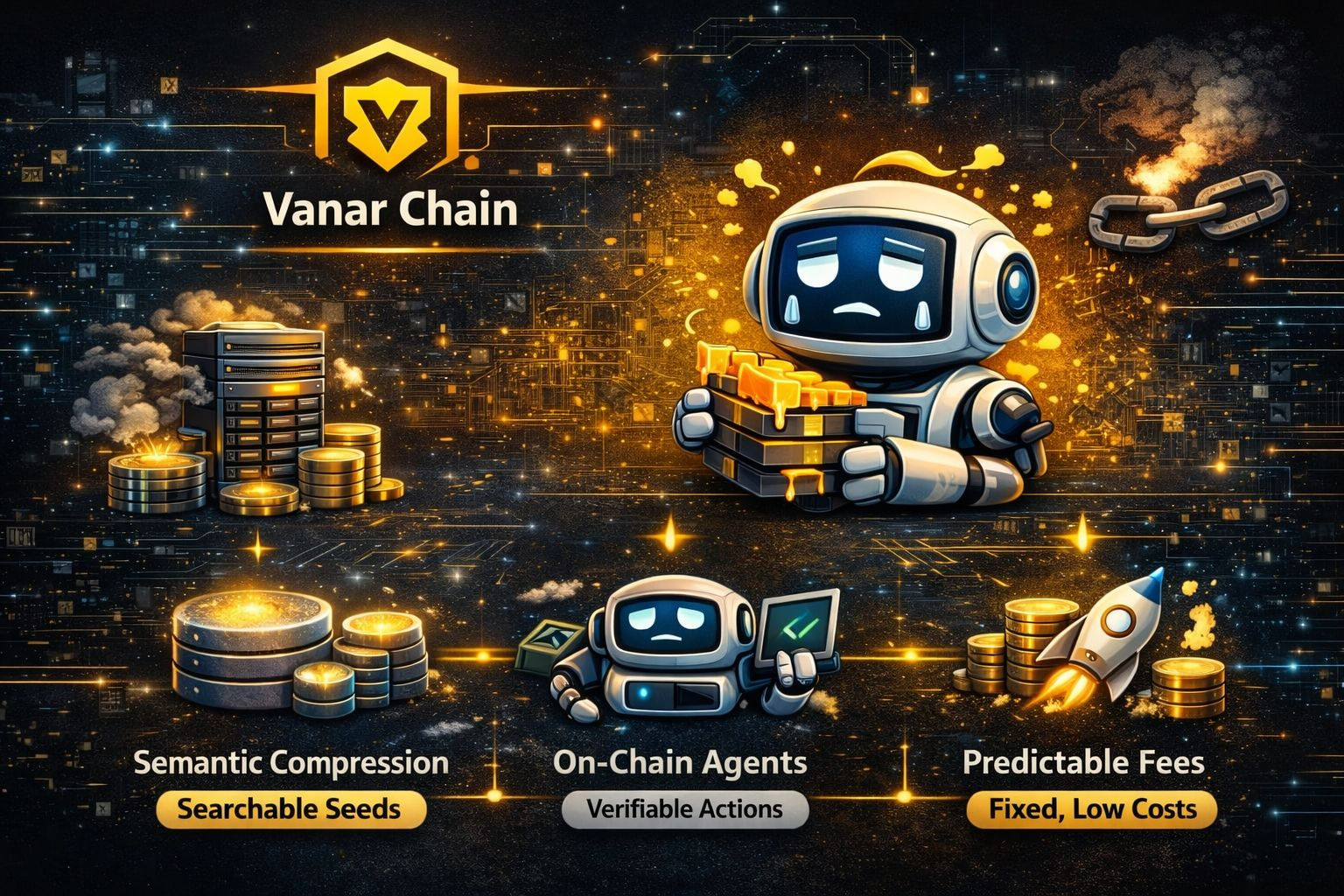
When I watched an AI agent “scale,” it didn’t break with fireworks. It just got slower. Replies got thin. Memory got strange. Costs crept up. Then the agent did the one thing humans hate most: it forgot why it was talking to you in the first place. That’s the AI scalability problem most crypto talk skips. It’s not only “more compute.” It’s the trio: memory, data weight, and trust. Agents need context that lasts longer than a chat tab. They need to read and write data without turning every step into a cloud bill. And they need a way to prove what they saw and why they acted, so “the model said so” isn’t the final answer. Most stacks today solve one piece and break the other two. Put memory off-chain and you get speed, but you also get a choke point and a trust gap. Put memory on a normal chain and you get trust, but you pay for every byte like it’s gold. Add inference on top and you’re juggling three systems: the chain, a storage network, and an AI service. It works, kind of. But it scales like a food truck trying to serve a stadium. Vanar Chain is taking a different swing. The idea is blunt: if AI apps stall because chains can’t hold meaning, then build rails that can. Vanar positions itself as an AI-native Layer 1 with an integrated stack: the base chain for fast, low-cost transactions, a semantic data layer called Neutron, and an on-chain logic engine called Kayon. Neutron is the piece that makes people squint. Instead of treating data as dumb blobs, it aims to compress and restructure files into compact “Seeds” that stay queryable by meaning. You feed in a document, and the output is not “here’s a hash, good luck.” The goal is a smaller object that still carries the facts in a form an agent can search, compare, and reuse. Vanar even claims aggressive compression, like turning a 25MB file into about 50KB by mixing semantic, heuristic, and algorithmic layers. Why does this matter for scalability? Because agent “memory” is mostly a storage problem wearing a compute hat. The expensive part isn’t only thinking. It’s hauling context around, again and again, for every step. If you can shrink context and keep it verifiable, you cut the weight of the workload. Less data to move. Less data to keep. Less chance that an agent’s “memory” is quietly edited in some private database. Then comes Kayon. Vanar describes it as a logic engine that can query Seeds, validate data, and apply rules in real time especially for compliance-heavy flows like payments and tokenized assets. Think of it as guardrails that live closer to the chain, not bolted on in a server you can’t audit. That’s important because AI systems at scale will need rules. Not vibes. Rules. When an agent moves money or touches regulated data, you want to know what policy it followed, and you want that trail to be checkable after the fact. AI scalability is also a network problem. Lots of small calls. Lots of micro-actions. “Check this, then do that.” This kind of workload hates fee spikes and mempool games. Vanar’s docs highlight fixed fees and FIFO-style processing to keep costs predictable, even when demand changes. Predictable fees don’t sound exciting, but they’re the difference between “we can budget agents at scale” and “we can’t ship this.” On the dev side, Vanar leans into familiarity. It’s EVM-compatible and, in technical writeups, is described as based on Go Ethereum. That means Solidity teams can test the thesis without rewriting their whole toolchain. And for AI builders, friction matters. They already have enough unknowns: model drift, prompt bugs, data quality, evals. If the chain adds extra pain, they’ll leave. Compatibility isn’t glamour. It’s oxygen. So what’s the verdict? Vanar is aiming at a real bottleneck: AI apps don’t scale when memory is fragile, data is heavy, and trust is outsourced. A vertically integrated stack chain plus semantic storage plus on-chain logic matches the shape of the problem better than “just add an oracle” does. But the bar is high. Semantic compression has to be usable, not just impressive in a demo. On-chain logic engines can get complex fast, and complexity is where bugs breed. Proof-of-Reputation style systems also raise questions about who earns reputation, how it’s measured, and how decentralized validation stays over time. If Vanar can show boring proof agents that remember more, cost less, and can be audited then it starts to look like infrastructure, not a token story. If not, it’s another smart idea that never survives contact with users.