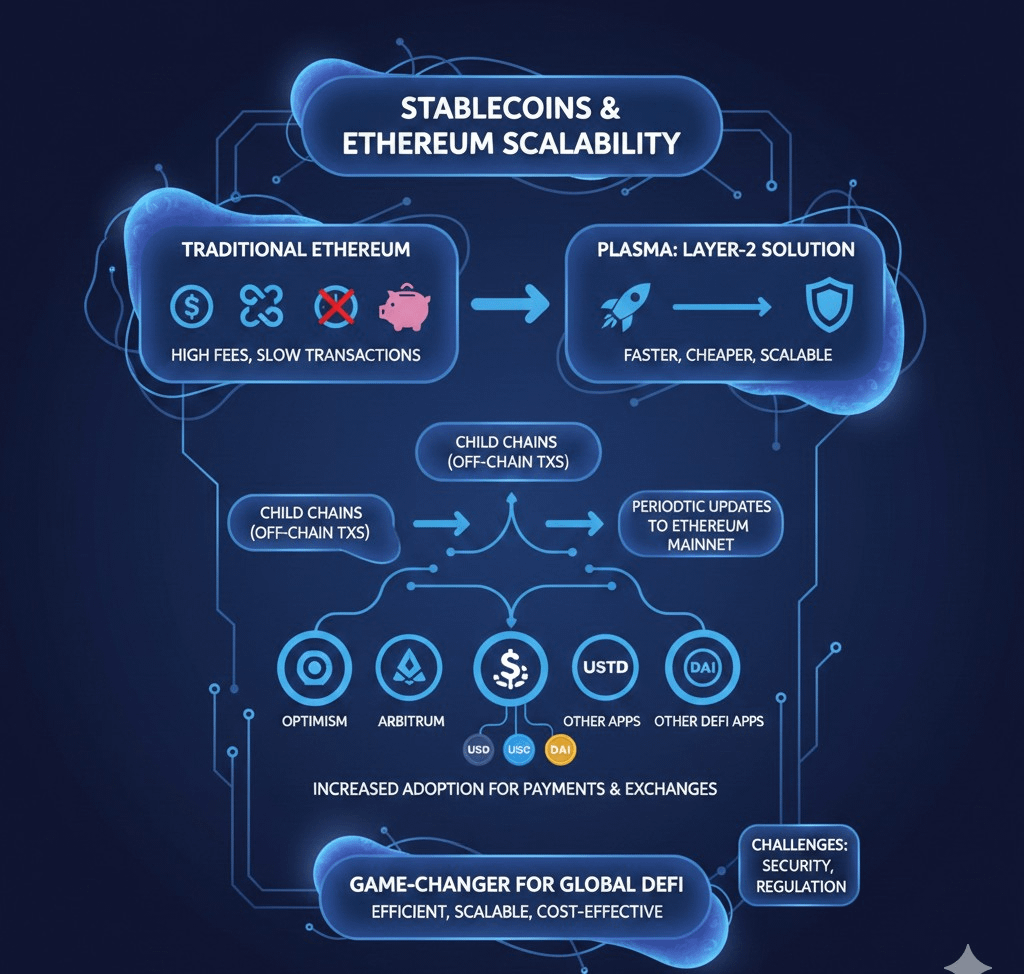
Stablecoins are digital assets pegged to the value of traditional currencies like the US Dollar. They have become essential in decentralized finance (DeFi) by offering a stable medium of exchange within the blockchain ecosystem. However, the Ethereum network, the main platform for stablecoins, faces challenges in terms of high transaction fees and slow processing times, especially during periods of congestion. This is where Plasma, a Layer-2 scaling solution, becomes crucial.
@Plasma is designed to enhance Ethereum’s scalability by processing transactions off-chain while still relying on the security of the main Ethereum network. Plasma achieves this by using child chains, where transactions occur faster and cheaper, periodically sending updates back to Ethereum. This mechanism reduces the load on Ethereum’s mainnet, enabling quicker and more cost-efficient transactions, which is essential for stablecoin payments that require rapid processing.
By using @Plasma stablecoins can operate at scale without the delays or fees that currently make Ethereum unsuitable for high-volume transactions. This shift is already visible, with growing adoption of Plasma-based solutions like Optimism and Arbitrum, where stablecoins are being utilized in various DeFi applications. These solutions not only increase transaction speed but also reduce fees, allowing for broader use in everyday payments and financial services.
The adoption of Plasma for stablecoin transactions is a game-changer, providing an infrastructure for global payments and decentralized exchanges that is efficient, scalable, and cost-effective. While there are still challenges, including security concerns and regulatory hurdles, the potential for Plasma to revolutionize stablecoin settlement is clear.