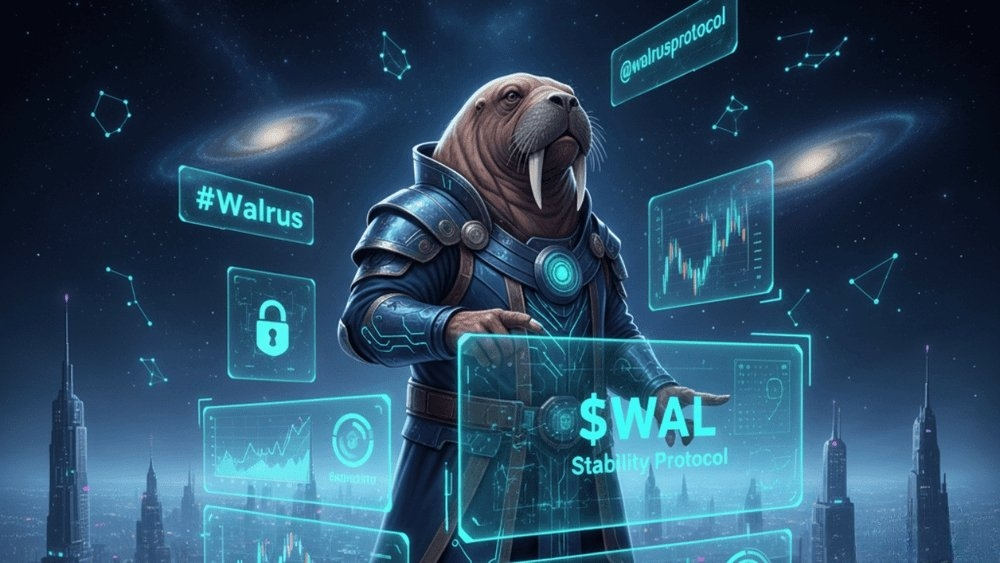
Most of us never notice the moment we hand over pieces of our lives to the internet. We upload photos, store documents, save ideas, and trust that they will still be there tomorrow. For years, the cloud has felt like a safe place, yet it has always belonged to someone else. Behind every file sits a server owned by a company that can change policies, restrict access, or disappear without warning. The convenience has been real, but so has the quiet loss of control. Walrus enters this story at a time when people are beginning to ask a simple but powerful question. What if our data truly belonged to us?
Walrus is a decentralized storage protocol built on the Sui blockchain, designed to give people and applications a new way to store information without relying on centralized platforms. At its heart, it is not just a technical system but a shift in how we think about ownership. Instead of placing our memories and creations in one company’s hands, Walrus distributes them across a network of independent nodes. This network is powered by participants who store data, verify its availability, and maintain the integrity of the system through shared incentives. The native token WAL acts as the lifeblood of this ecosystem, allowing users to pay for storage, stake for network security, and participate in governance decisions that shape the protocol’s future.
To understand the emotional weight behind Walrus, it helps to look at how much of our lives now exist digitally. Creators store years of work online. Developers build applications that depend on reliable storage. Businesses keep critical records in the cloud. Families preserve memories through photos and videos. Yet the systems that hold all of this information are often fragile in ways we do not notice until something goes wrong. Accounts get suspended. Platforms shut down. Data is lost or altered. Each of these moments reminds us how dependent we are on systems we do not control.
Walrus aims to reduce that dependency by building storage that is decentralized, verifiable, and resilient. When data is uploaded to the network, it is broken into smaller pieces and distributed across multiple storage providers using advanced techniques such as erasure coding and blob distribution. This means that even if some parts of the network go offline, the data can still be reconstructed and accessed. The design focuses on durability and efficiency, making it suitable for storing large files, application data, and even entire decentralized websites. Because it is built on the Sui blockchain, Walrus benefits from fast transaction speeds and high throughput, allowing developers to integrate storage directly into smart contracts and applications.
This integration changes how storage functions within Web3. Instead of being an external service, storage becomes part of the application’s logic. A decentralized game can store assets permanently without relying on centralized servers. An AI project can store training data in a verifiable and censorship-resistant way. A digital artist can mint and store work knowing it cannot be quietly removed. These use cases are not just technical improvements. They represent a deeper sense of security and permanence for the people behind the data.
The WAL token plays a central role in making this system sustainable. Users pay for storage using WAL, creating demand for the token. Storage providers stake WAL to participate in the network and earn rewards for maintaining data availability. Token holders can also vote on proposals that affect pricing, upgrades, and network policies. This governance model allows the community to guide the protocol rather than leaving decisions to a single company. It creates an ecosystem where users, developers, and node operators all have aligned incentives to keep the network reliable and fair.
Walrus has gained attention from investors and developers who see decentralized storage as a crucial layer of the future internet. As artificial intelligence, gaming, and decentralized finance continue to grow, the demand for reliable and scalable storage is increasing. Traditional cloud services can handle large amounts of data, but they do not offer the same level of transparency or ownership. Walrus positions itself as an alternative that combines performance with decentralization, aiming to support everything from enterprise applications to personal storage needs.
What makes Walrus particularly compelling is the emotional shift it represents. For years, people have accepted that the internet is convenient but not truly theirs. Decentralized storage challenges that assumption. It suggests that the digital spaces where we store our work, memories, and ideas can be owned collectively rather than controlled centrally. It offers a sense of permanence in a world where digital content often feels temporary.
Imagine a photographer who has spent decades capturing moments. Instead of worrying about platform policies or subscription fees, their work lives on a network designed to preserve it. Imagine a developer building an application that cannot be taken offline by a single authority. Imagine a community storing its shared knowledge in a place that remains accessible regardless of corporate decisions. These scenarios are not just technical achievements. They are emotional milestones in the evolution of the internet.
Walrus is still growing, and like any emerging technology, it faces challenges. Adoption takes time. Performance must continue to improve. The ecosystem must expand with more applications and users. Yet the direction is clear. The internet is moving toward a model where ownership, privacy, and decentralization are not optional features but foundational principles.
In the end, Walrus is about more than storage. It is about trust and control in a digital age. It is about giving people confidence that the things they create and care about will not vanish without warning. It is about building an internet that remembers, protects, and respects the value of human expression. As the decentralized world continues to grow, Walrus stands as a reminder that technology can be designed not just for efficiency but for people.
@Walrus 🦭/acc #walrus $WAL