
I once caught myself opening the @DuskNetwork explorer with no goal other than watching blocks finalize. No noise. No drama. Just consensus doing its job. That moment reminded me why I still fixate on base layers not because they’re flashy, but because once real users arrive, nothing else matters.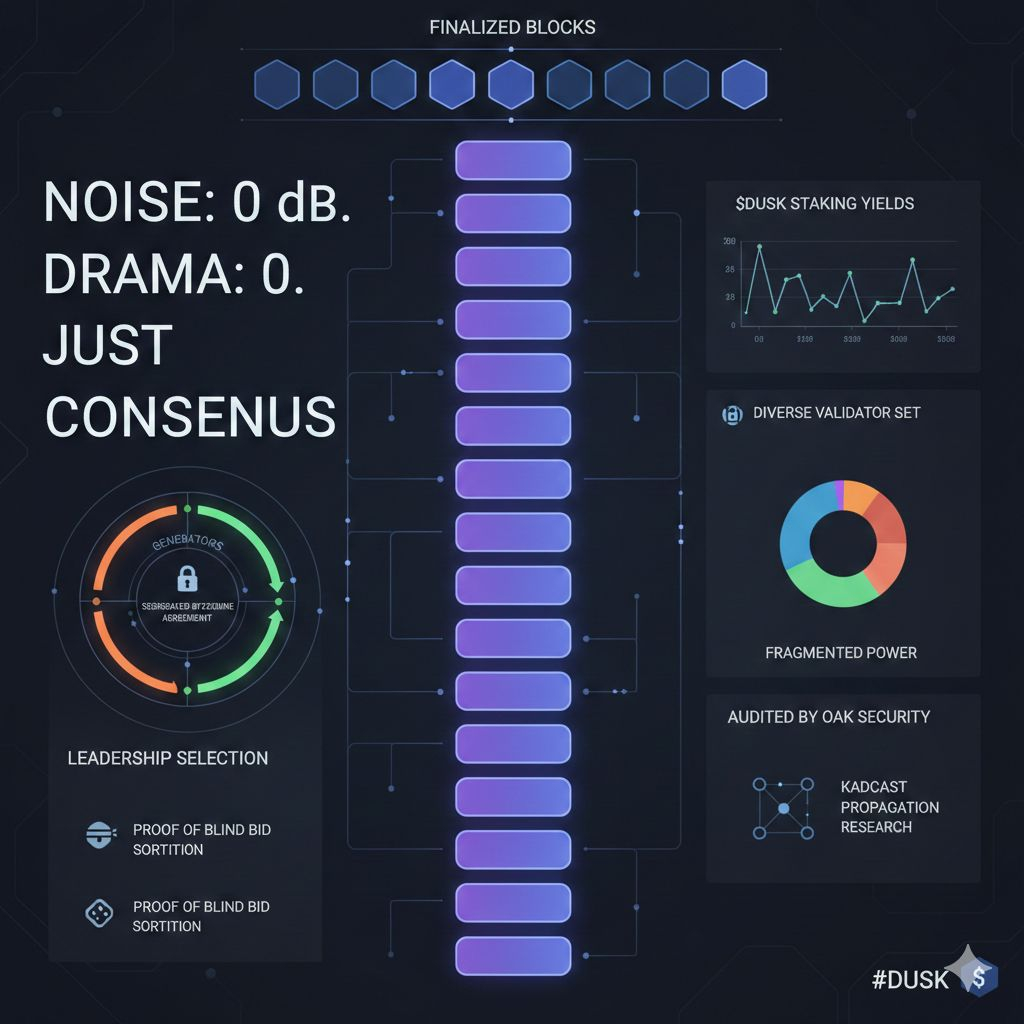
Most chains don’t fail from a lack of attention. They fail when activity finally shows up and the protocol underneath was never built to absorb stress. With Dusk, what’s compelling isn’t the confidential finance angle everyone talks about, it’s how validator power is deliberately fragmented to reduce the attack surface when actual value starts settling on-chain.
Dusk runs a committee-based Proof of Stake model called Succinct Attestation, and the key idea is role separation. Through Segregated Byzantine Agreement, one committee (Generators) proposes blocks while another (Provisioners) verifies and finalizes them. Leadership isn’t predictable either block proposers are selected via Proof of Blind Bid, and committees are formed through sortition.
This matters because security usually breaks where power becomes obvious. Many networks accidentally create permanent attack targets by making future leaders easy to identify. Dusk doesn’t pretend attacks disappear, but it makes them more expensive and harder to coordinate, especially social or economic attacks aimed at a fixed validator elite.
Then there’s the economic layer. $DUSK secures staking and pays fees, backed by a long-term emission schedule to keep the network secure before fee markets fully mature. The real issue isn’t APY — it’s whether incentives remain strong enough to keep validators diverse so the network never leans on a handful of oversized operators.
I’m less interested in “perfect code” than in process. Humans fail. Operations matter. That’s why audits and discipline count. Dusk’s consensus and economics were reviewed by Oak Security, and its Kadcast propagation research tackles something many chains only discover under load: communication delays can break assumptions faster than exploits.
At the end of the day, blockchain security isn’t just cryptography. It’s managing uncertainty. Unpredictable leadership, rotating committees, and a validator set that survives boring markets. When narratives fade, resilience is what’s left and the real test for Dusk will be how it performs when usage stops being theoretical.
