Dusk has always felt like it was built by people who weren’t trying to win an argument on social media. Founded in 2018, it comes from a time when the industry was quieter, rougher around the edges, and far more obsessed with whether blockchains could survive contact with the real world. That mindset never left. You can feel it in the way the network is designed, almost like it expects to be challenged, audited, and questioned by people who don’t care about crypto narratives at all.
Most blockchains talk about finance as an abstraction. Dusk treats it like a legal and operational reality. Regulated finance isn’t some distant phase on a roadmap; it’s the starting assumption. That alone puts it at odds with much of the ecosystem, where regulation is either ignored or treated as a problem for later. But later always comes. And when it does, systems that weren’t built for scrutiny tend to crack in ugly ways.
What really defines Dusk is how it handles privacy without pretending compliance doesn’t exist. Crypto loves transparency until transparency becomes a liability. Full visibility sounds great in theory, right up until you realize no serious institution wants its internal operations broadcast to the world. At the same time, regulators won’t accept opaque systems they can’t audit. Most networks pick a side and hope it’s enough. Dusk sits in the uncomfortable middle, trying to make both coexist, and that tension shapes everything it does.
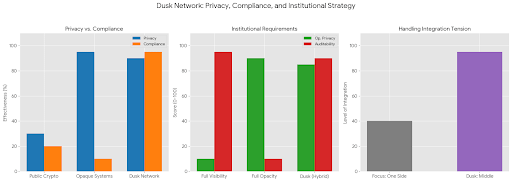
Zero-knowledge proofs aren’t used here as a flashy selling point. They’re used because they’re necessary. Dusk allows participants to prove specific facts without revealing the underlying data. You can show that you’re eligible, compliant, or authorized without exposing your entire identity or transaction history. That might sound obvious, but in practice it’s one of the hardest problems in blockchain design. It’s also one of the most important if on-chain finance is ever going to move beyond experiments and into real markets.
The identity layer, Citadel, makes this painfully clear. Instead of forcing users to repeatedly submit full KYC details to every application, Citadel enables selective disclosure. You prove what’s needed once, then reuse that proof when required. When you really think about it, it exposes how broken the current system is. We’ve normalized handing sensitive documents to dozens of platforms and hoping none of them get hacked. That’s not innovation. That’s desperation dressed up as convenience.
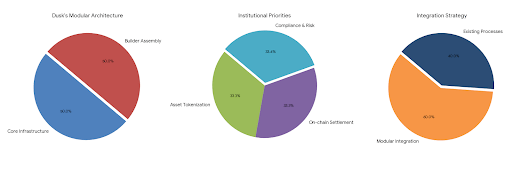
Dusk’s modular architecture is another quiet but critical choice. It doesn’t try to dictate how applications should behave. It provides the core infrastructure and lets builders assemble what they need on top. For institutions, that flexibility is non-negotiable. They don’t want to rebuild their entire stack just to tokenize assets or experiment with on-chain settlement. They want systems that integrate cleanly with existing processes, without introducing new risks that compliance teams will immediately reject.
Of course, this approach isn’t glamorous. Dusk doesn’t move at the pace of meme-driven ecosystems. It doesn’t generate explosive growth charts overnight. There’s a real cost to building slowly and deliberately, especially in a market that rewards noise more than substance. Sometimes it feels like patience is treated as a flaw. But if you zoom out, that restraint starts to look less like hesitation and more like realism.
The uncomfortable truth is that most DeFi infrastructure today isn’t compatible with regulated finance at scale. It either exposes too much or hides too much. Dusk is betting that the future won’t tolerate either extreme. It’s betting on a world where privacy protects users, auditability protects markets, and rules aren’t patched in after things go wrong.
Whether that future arrives sooner or later is anyone’s guess. What’s clear is that Dusk isn’t trying to outrun regulation or outshout competitors. It’s building for the moment when on-chain finance has to grow up, when excuses stop working, and when infrastructure is judged not by hype, but by whether it holds up under real pressure. That’s not an easy bet to make. But it might be the only honest one left.