Most blockchains treat transaction fees like the weather: sometimes calm, sometimes chaotic, and everyone just adjusts. Vanar takes a different approach. It doesn’t leave costs to chance, speculation, or market memes. Instead, it treats transaction pricing as an engineered system, a control loop. It may sound boring at first, but solving this problem is one of the hardest in crypto. When fees spike unpredictably, micro-payments fail, subscriptions stall, and even basic consumer apps become stressful to use. Vanar asks a deeper question: how do you keep fees stable without deceiving users or compromising the network’s economic balance?
Vanar begins to feel less like a conventional Layer-1 blockchain and more like an operating system for on-chain spending. Instead of promising low fees only when the network is idle, it fixes a fiat-denominated cost per transaction and adjusts the internal protocol fees based on the real-time market price of VANRY. This turns vague marketing claims into an actual mechanism: a protocol that continuously works to maintain predictable costs. Think of it as thermostat logic. The system reads a signal the price of VANRY and tweaks the fee to hit a target. These adjustments happen in a continuous loop, every few minutes, in sync with block production, ensuring the system responds to volatility and market swings in real time.
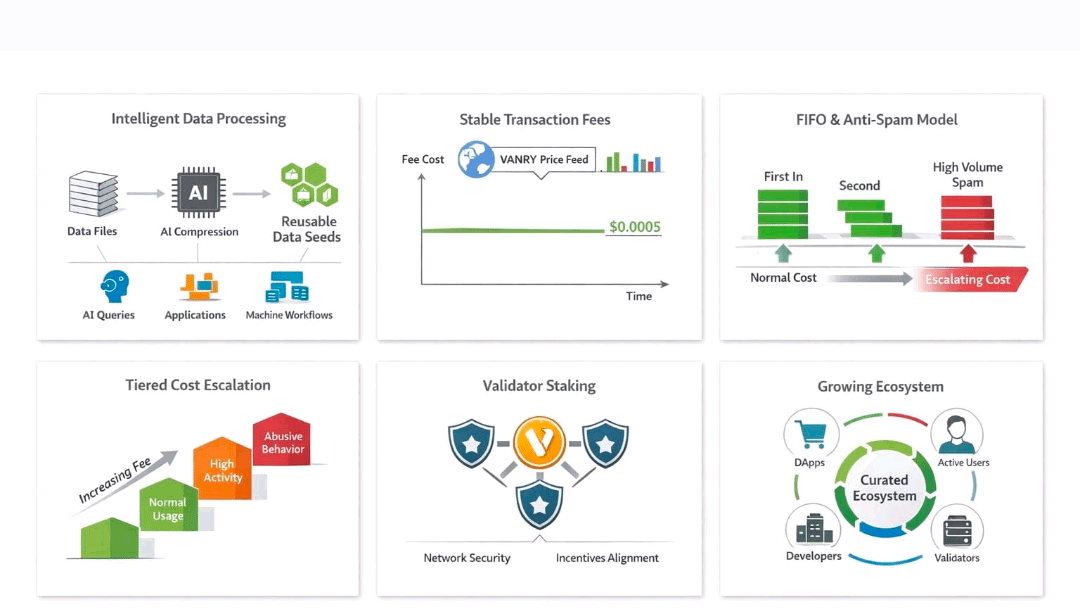
Price manipulation is a real concern. A single, misaligned price feed could let attackers pay less than they should or destabilize the network’s economics. Vanar solves this by using redundancy and cross-validation, pulling pricing data from multiple sources including centralized exchanges, decentralized exchanges, CoinGecko, CoinMarketCap, and Binance. Multi-source validation is not a small detail; it acknowledges that price is an attack surface, and securing it is essential for the control loop to function correctly.
FeePerTx is not just a number on a user interface. It is protocol truth, recorded directly in the block headers. This means anyone builders, auditors, indexers can reconstruct exactly what the chain believed to be the correct fee at any point in time. This makes Vanar machine-friendly. Humans can tolerate uncertainty and pause to make decisions, but AI agents or automated systems that execute hundreds of small actions per second need predictable costs to plan effectively. Vanar’s control loop transforms fees from a chaotic, human-oriented problem into infrastructure capable of supporting continuous, automated operations.

Token continuity is also handled with care. VANRY replaces TVK without a disruptive brand reset. By framing the swap as continuity rather than replacement, Vanar minimizes community fear of dilution or arbitrary redistribution. Token transitions are moments that can easily damage trust, but Vanar consciously manages this risk, maintaining stability during the handoff.
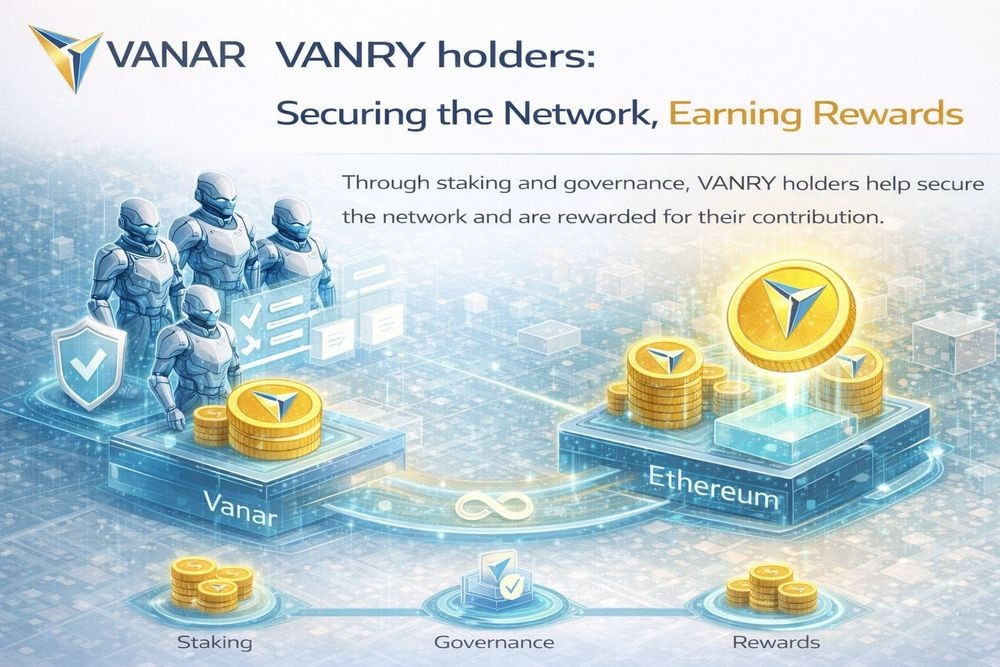
Governance is central to the system. Adjusting fees in real time is not only an engineering problem it is a decision-making problem. Vanar has proposed governance mechanisms that allow token holders to vote on cost calibration rules and incentive structures embedded in smart contracts. These votes are not abstract discussions—they guide actual protocol parameters. Builders want stable costs, validators want sustainable rewards, and users want cheap transactions. Governance balances these interests, keeping the control loop responsive, resilient, and aligned with all participants.

Fixed fee systems are not magic. Auction-based markets self-correct quickly because they are entirely market-driven. Controlled pricing models must respond to volatility and resist manipulation. Vanar addresses these challenges with frequent updates, multi-source validation, and protocol-level enforcement. Mismatched control loops or poorly implemented governance could create drift, where fees no longer reflect reality, but Vanar treats these as engineering challenges, not philosophical debates.
In the long term, Vanar is attempting something profound: turning blockchain fees into a service that is predictable, verifiable, and machine-scalable. This is not just about cheap transactions; it is about creating a foundation where businesses, AI agents, and mainstream applications can rely on blockchain as part of their operational infrastructure. Micro-transactions, subscriptions, automated processes, and continuous payment flows can now plan budgets with confidence, removing the uncertainty that has plagued crypto for years. Vanar’s economic control plane protocol-level fee adjustments, multi-source validation, on-chain fee verification, and governance oversight represents an investment in the automated, continuous, and reliable economy of the future.

If Vanar succeeds, the result is a blockchain where costs behave more like a cloud service than a speculative market. Predictable, auditable, machine-friendly, and socially stable, Vanar could redefine what it means for a blockchain to be “usable” at scale, enabling real-world applications to operate seamlessly, without fear of fee spikes or economic unpredictability. Vanar is not just building a chain it is building infrastructure for a world of continuous, small, and automated transactions, where economics becomes a service, not a gamble.