
The moment didn’t announce itself as a problem.
Nothing broke. Nothing failed. Nothing asked for help.
What caught my attention was how quickly the transfer stopped needing me.
I was moving a stablecoin for a routine obligation. Not trading. Not positioning. Just settling something that had to be settled. I expected the usual pause before execution, checking balances, glancing at the network, making sure the mechanics wouldn’t interrupt intent.
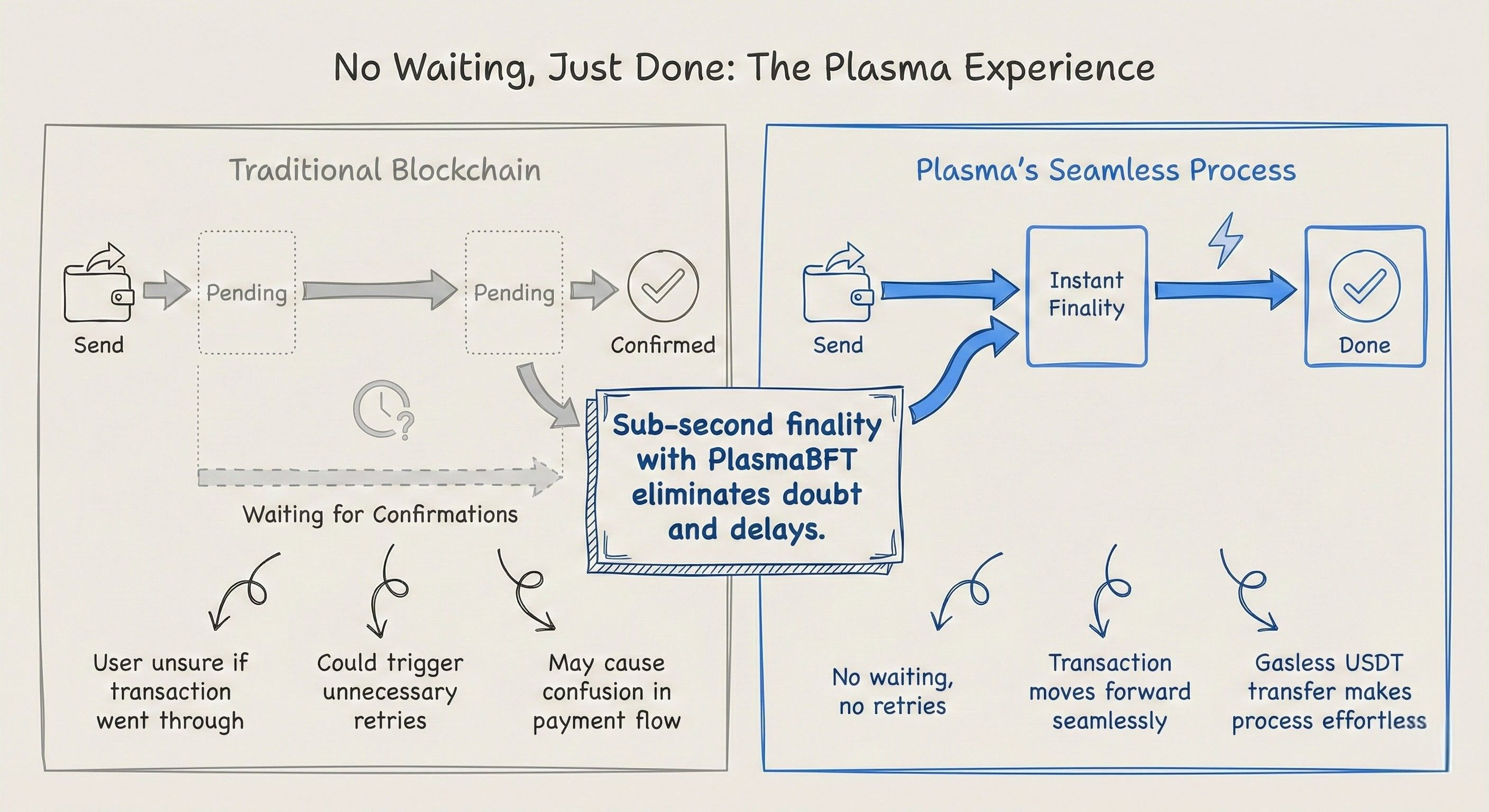
But the hesitation never formed.
The transfer closed fast enough that my habits didn’t activate. I didn’t refresh. I didn’t prepare a second plan. I didn’t hover near the screen waiting for reassurance. The action completed before uncertainty could settle in.
That absence was the signal.
Most systems give you time to adapt around doubt. Stablecoins, especially, tend to inherit behaviors from speculative environments, extra checks, contingency thinking, waiting for “enough” confirmation to feel safe. Over time, those behaviors harden into ritual. Settlement becomes something you supervise instead of something you finish.
That’s where Plasma started to feel different to me.
What stood out wasn’t speed in isolation. It was sub-second finality arriving early enough to interrupt learned hesitation. The transaction concluded before my behavior bent around it. The system didn’t invite me into a negotiation with time.
The check that usually pulls me out of intent wasn’t even about speed. It was the moment where I try to predict whether the other side will accept this as done. Not “did it send,” but “will they treat it as settled without asking me for another round of proof?” That’s the part that normally stretches the process into a waiting posture.
I noticed what didn’t happen next.
The transfer didn’t pull me into gas decisions. I wasn’t asked to hold an extra asset just to move a stable one. The workflow stayed focused on settlement instead of drifting into mechanics. The system treated the interaction for what it was, payment, not speculation.
On most EVM-compatible chains, execution takes center stage. It’s flexible, expressive, powerful, but settlement is treated like an afterthought. The burden of certainty gets pushed onto users and teams, who compensate with caution and delay.
From my perspective, gasless USDT transfers aren’t interesting because they’re convenient. They matter because they remove a category of decision-making that never belonged in settlement to begin with. Stablecoin-denominated gas aligns cost with purpose. If the point is to move a stablecoin, the system shouldn’t ask you to think like a trader to do it.
Plasma keeps the familiarity of the EVM, which matters more than people admit, especially for established teams and institutions. But it narrows the experience around stablecoins intentionally. It doesn’t pretend every transaction carries the same intent.
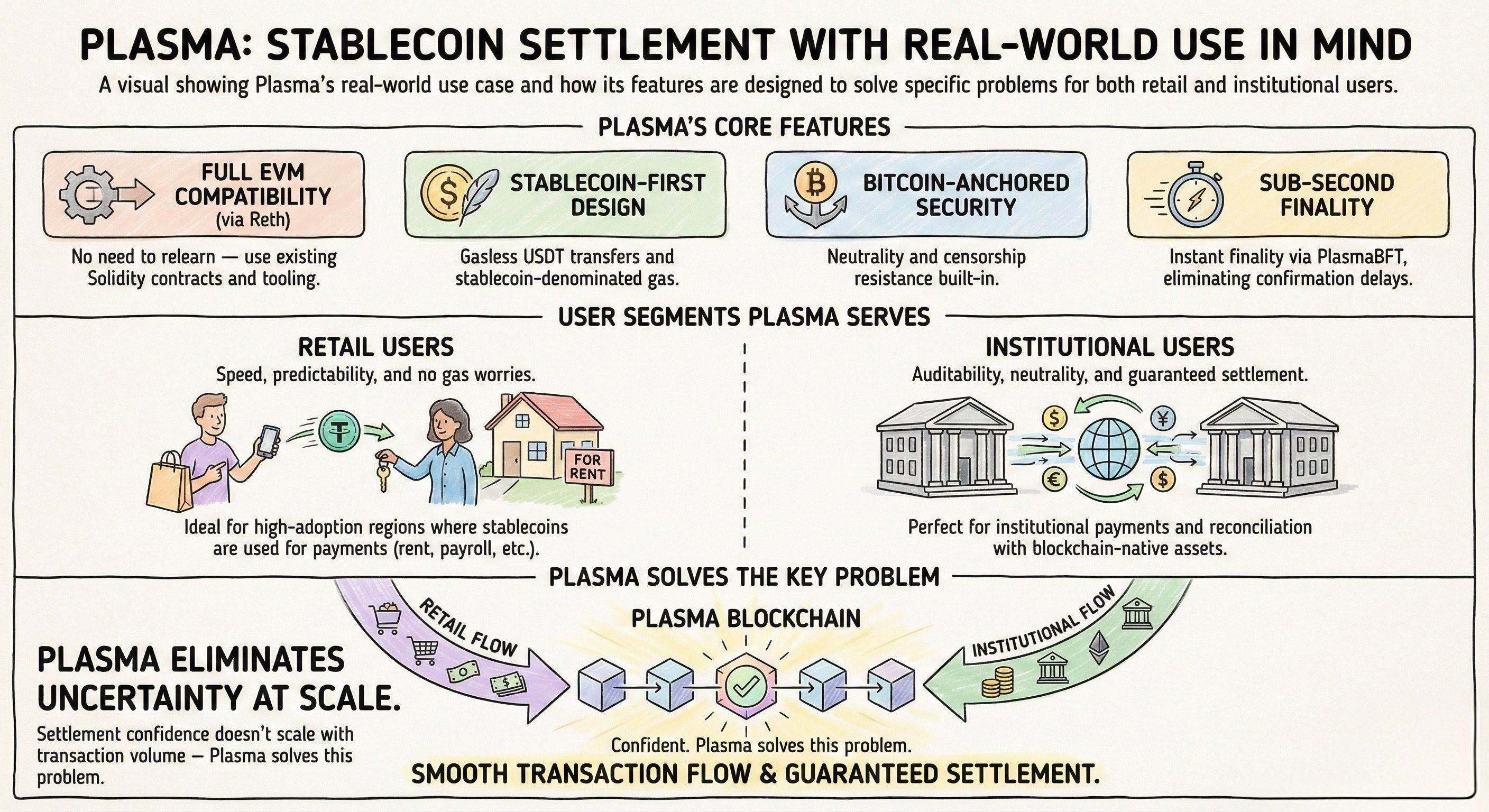
I saw this again under light repetition. Multiple transfers. Different destinations. Nothing dramatic happened. Nothing stalled. But finality stayed consistent. The loop closed decisively every time.
PlasmaBFT doesn’t perform speed theatrics. It simply finishes settlement quickly enough that doubt never becomes a habit.
There’s also a quieter layer that only becomes obvious over time. Bitcoin-anchored security doesn’t make the system louder or more expressive. It makes it harder to casually interfere with. That kind of neutrality matters once you think beyond individual users. Payments infrastructure doesn’t just need to work, it needs to stay boring in the right ways, and stubborn when pressure shows up.
The more I sat with it, the clearer the real issue became.
The problem was never that stablecoin transfers were slow.
The problem was that infrastructure kept asking users to compensate for uncertainty.
By treating stablecoins as first-class settlement instruments, Plasma removes decisions that never needed to exist. The transaction ends, and the workflow can behave like it believes that ending. The pressure stops living in the gap where people add “just in case” steps and call it caution.
Plasma $XPL doesn’t feel like it’s trying to attract attention. It feels like it exists to keep settlement honest, to make sure payments conclude before hesitation has time to take root.
At some point, the question stops being whether a stablecoin can move.
It becomes whether settlement should ever feel uncertain at all.
Plasma doesn’t answer that loudly. It doesn’t need to.
It just keeps finishing the job before doubt shows up.
And once you experience that, going back to systems that normalize waiting starts to feel like a choice, not a constraint.