
I didn’t discover Vanar Chain through an announcement or a headline. It came up the way practical things usually do, in the background of a conversation about why so many blockchain products still struggle outside their own circles.
What stood out wasn’t ambition. It was restraint.
Most chains introduce themselves by explaining what they are trying to replace. Vanar didn’t do that. It showed up already assuming the world had systems, habits, and industries that weren’t waiting to be re-educated. That assumption alone felt unusually grounded.
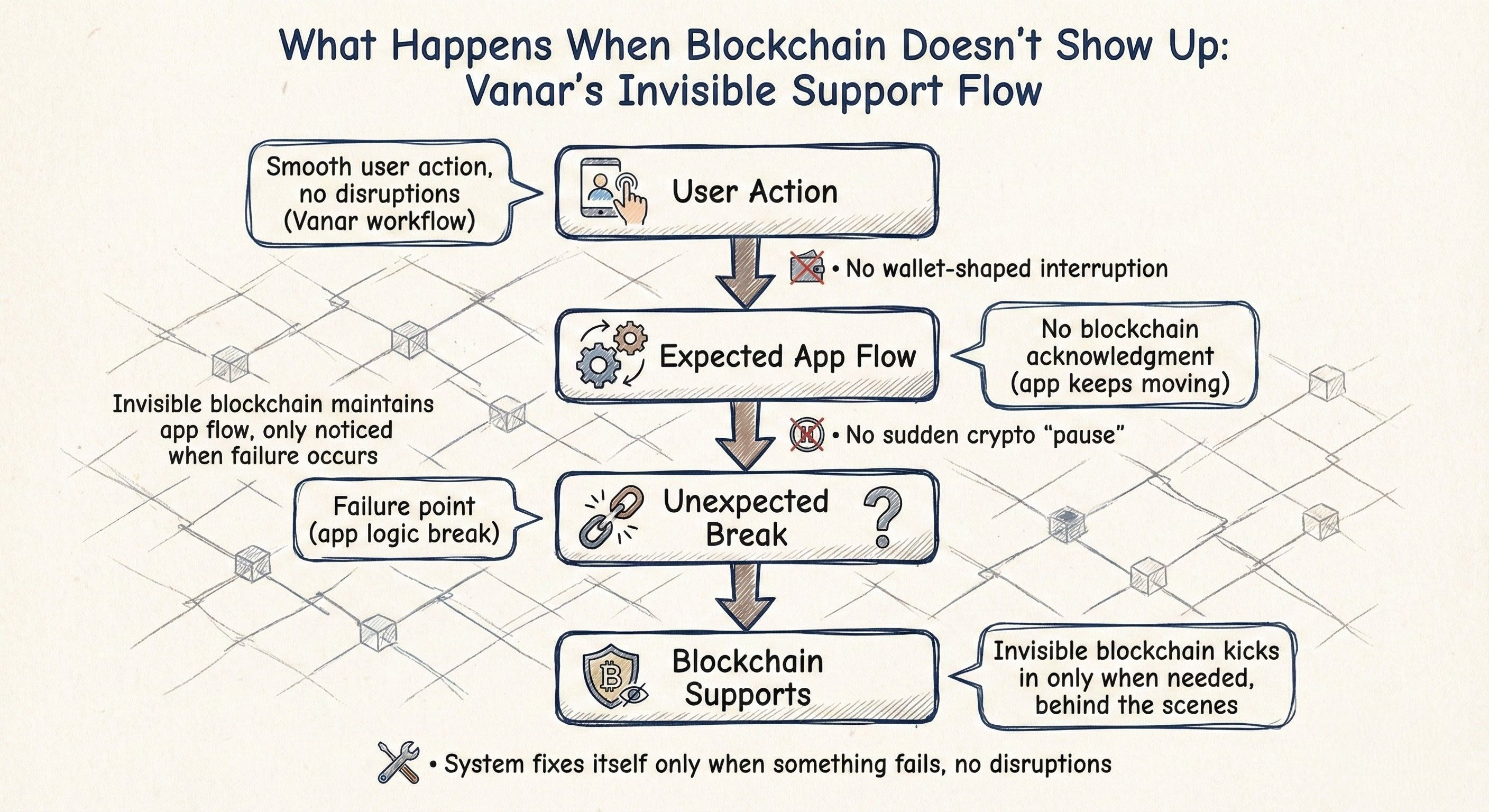
As I spent more time around Vanar Chain, the difference became clearer. Vanar doesn’t behave like infrastructure that wants attention. It behaves like infrastructure that expects to be ignored and designs for that outcome intentionally.
That’s a harder problem than it sounds.
Real-world adoption doesn’t fail because people hate technology. It fails because technology often asks people to care at the wrong moments. To learn new mental models. To accept friction where none existed before. To adjust workflows that already function well enough.
Vanar seems to start from the opposite question: where would blockchain be tolerated if it didn’t announce itself at all?
You see this most clearly in how Vanar positions itself around entertainment, games, and brands. These environments already run on momentum. Attention is finite. Flow matters more than ideology. When blockchain inserts itself too loudly into these systems, it doesn’t feel empowering, it feels intrusive.
Vanar avoids that trap by not trying to be impressive.
There’s no sense that the chain wants credit for being there. It fits into existing digital experiences the way infrastructure is supposed to: supporting, not starring. Whether it’s environments connected to Virtua Metaverse or interactions routed through the VGN Games Network, the common pattern is familiarity. The experience behaves the way users already expect it to behave.
That familiarity is doing more work than most people realize.
Blockchain has spent years trying to convince people to adapt. Vanar quietly adapts instead. It doesn’t ask users to understand why something works, only that it does. That decision removes a layer of cognitive effort that most chains still treat as unavoidable.
What I found interesting is how little Vanar tries to oversell this approach. There’s no obsession with buzzwords or exaggerated claims. The system doesn’t pretend it’s reinventing everything. It’s designed to coexist with what already exists. workflows, platforms, and consumer behavior that were never built with blockchain in mind.
That’s where the real pressure shows up.
Designing for the “next 3 billion users” isn’t about scale in the abstract. It’s about tolerance. How much friction can be removed before users stop noticing the technology altogether? How much complexity can be absorbed by the system so that people don’t have to absorb it themselves?
Vanar’s structure suggests that these questions were taken seriously early on. Not as marketing language, but as design constraints. The chain doesn’t chase novelty. It chases normalcy.
Even the presence of VANRY reflects that posture. The token exists as part of an ecosystem, not as the headline. It doesn’t try to define the experience. It supports it quietly, in the background, the way infrastructure should.
What stays with me is how unambitious Vanar feels in the best possible way.
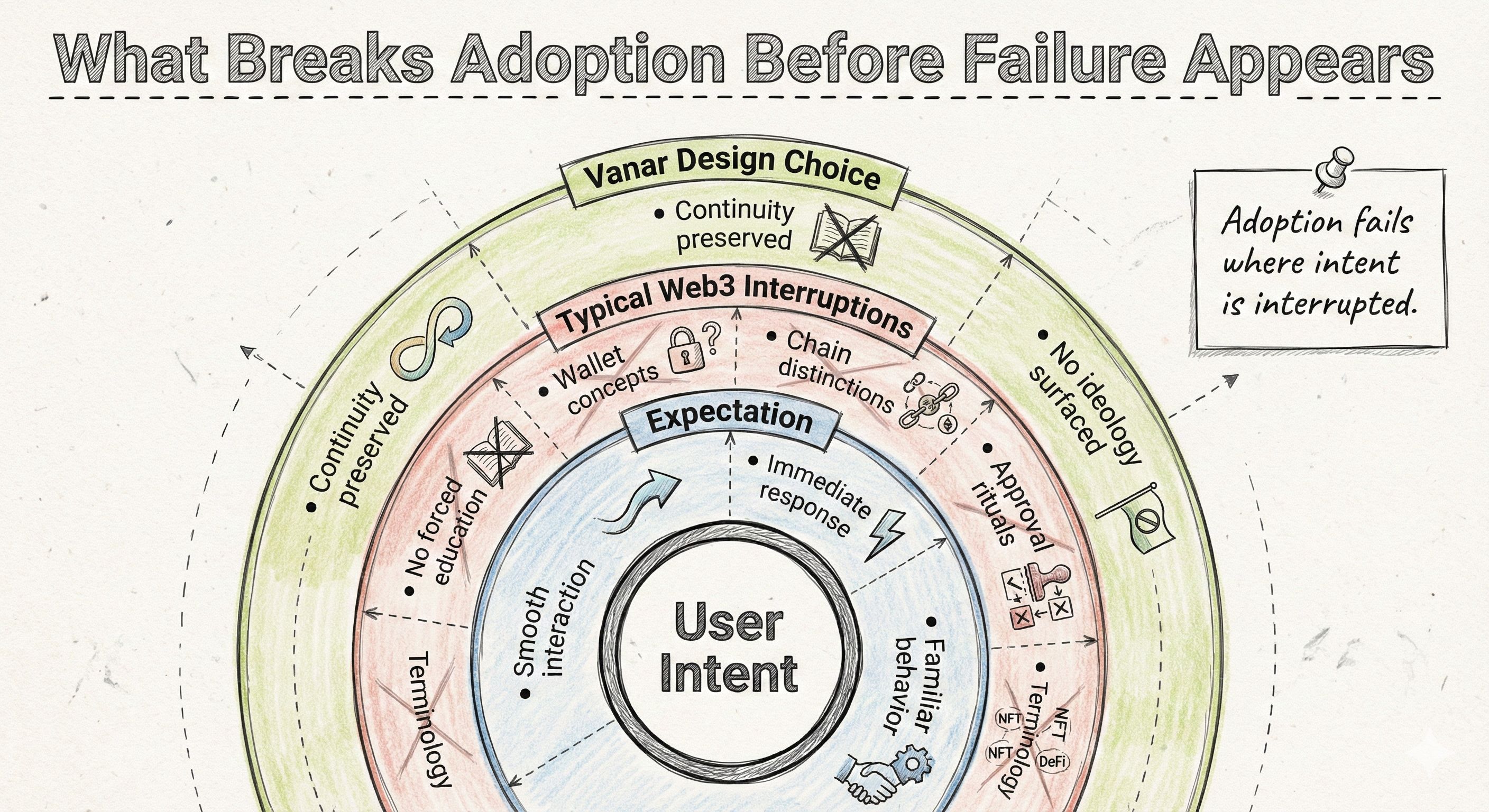
It isn’t trying to shock the system. It’s trying to fit inside it. That’s a much slower path, but it’s also the only one that resembles how real adoption actually happens. Systems don’t change overnight. They absorb new tools gradually, as long as those tools don’t demand constant attention.
Vanar seems built for that reality.
Not a revolution that asks to be noticed, but a framework that works precisely because most people never have to think about it at all.
And in a space that still confuses visibility with value, that might be its most practical decision yet.