After spending time studying Dusk Network closely — not just reading summaries, but tracing its design decisions and technical structure piece by piece — what stayed with me was not excitement or spectacle. It was a sense of restraint. The project feels measured, almost conservative in its ambitions. It does not try to reinvent finance overnight or present itself as a cure-all for the shortcomings of traditional systems. Instead, it approaches a narrower and more difficult question: how can blockchain infrastructure actually function inside regulated financial markets without breaking the rules those markets depend on?
That question alone separates Dusk from many other layer-one networks.
Most public blockchains were built with openness as a virtue. Every transaction is visible, every balance is transparent, and anyone can inspect the full history of activity. This radical transparency works well for open communities, but it clashes with the practical realities of institutional finance. Banks do not publish their trades in real time. Asset managers cannot expose client positions to competitors. Securities markets operate on controlled disclosure, not complete visibility. In this context, the default design of traditional blockchains becomes a liability rather than a strength.
Dusk begins from this friction and treats it as the core problem to solve.
The network is structured as a layer-one blockchain, but its priorities are different from the typical focus on speed or volume alone. Its emphasis is privacy, compliance, and deterministic settlement. The goal is to create an environment where financial instruments — shares, bonds, funds, and other regulated assets — can exist on-chain without forcing institutions to sacrifice confidentiality or regulatory obligations. In other words, the blockchain should adapt to finance, not the other way around.
This philosophy shows up clearly in the way Dusk handles transactions. Instead of assuming that all data must be public, the protocol incorporates cryptographic techniques that allow transactions to be validated without revealing sensitive information. Ownership, balances, or trade details can remain hidden from the general public while still being provably correct. At the same time, authorized parties such as auditors or regulators can be granted access when necessary. This selective disclosure model feels closer to how real markets operate: private by default, accountable when required.
What makes this approach notable is that privacy is not treated as an optional add-on. It is built into the foundation of the network. Many systems try to bolt privacy features on top of an otherwise transparent ledger. Dusk instead treats confidentiality as a first-class property of the protocol itself. That choice reduces the need for complex workarounds and signals a recognition that institutions will not adopt infrastructure that exposes their internal operations to the world.
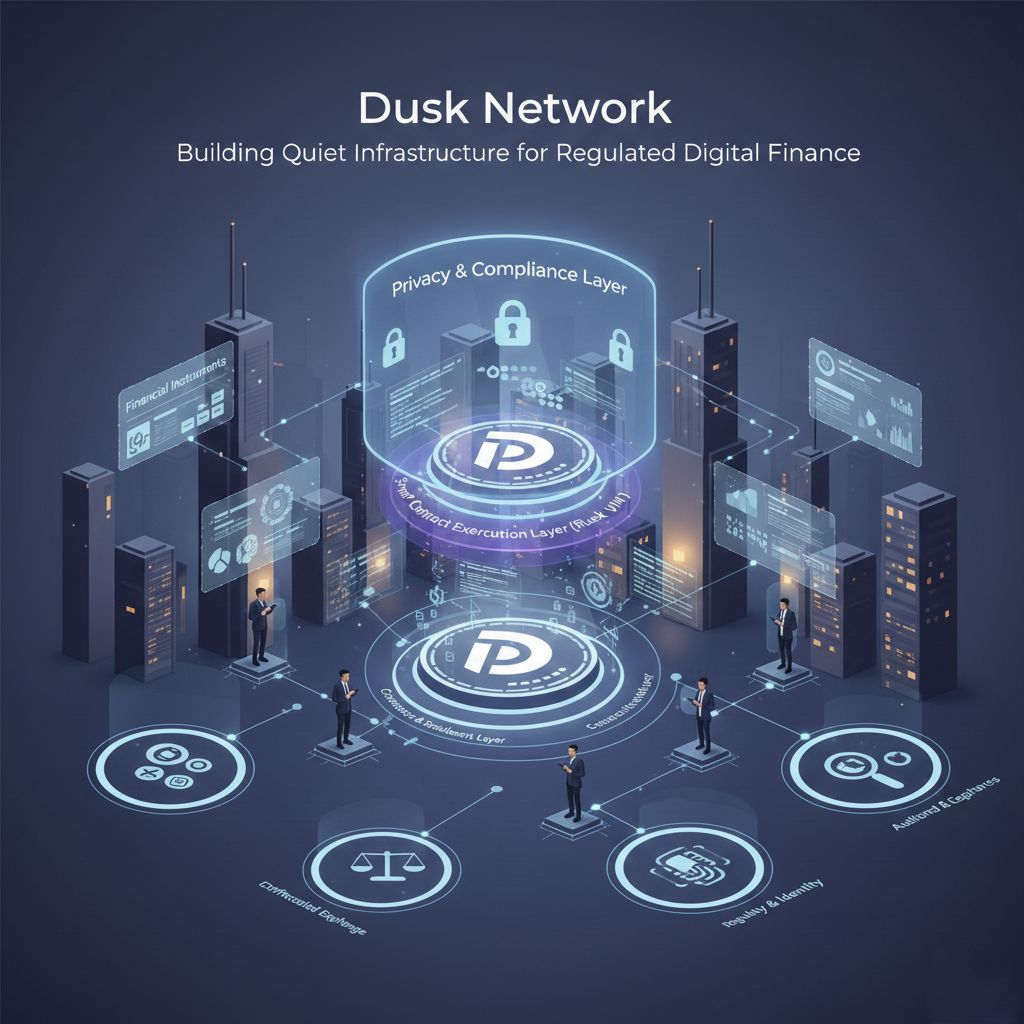
The architecture also reflects a practical mindset. Rather than packing every function into a single monolithic chain, Dusk separates responsibilities into layers. One layer focuses on consensus and settlement, ensuring that transactions reach finality quickly and cannot be reversed. Another layer handles smart contract execution in a way that is familiar to developers who already understand established tools. A further environment is optimized for privacy-sensitive applications that require stronger confidentiality guarantees.
This modular design mirrors the structure of traditional financial infrastructure. Clearing, settlement, and execution are typically handled by different systems with different constraints. By echoing this separation, Dusk avoids forcing every application into the same technical mold. It becomes easier to tailor performance, privacy, or compliance characteristics depending on what the application demands.
Settlement finality, in particular, seems like an understated but important focus. In many financial contexts, uncertainty about whether a transaction can be rolled back is unacceptable. Trades need to be considered complete at a known moment in time. By emphasizing fast and definitive settlement, Dusk aligns itself with the operational expectations of exchanges and clearing houses rather than the looser assumptions common in early blockchain networks.
Identity is another area where the project takes a grounded view. Regulated finance rarely allows completely anonymous participation. There are requirements around investor eligibility, jurisdiction, and reporting. Dusk’s approach allows participants to prove specific attributes about themselves without revealing full personal details. Instead of broadcasting identity data, users can demonstrate that they meet certain criteria. This balances compliance with privacy and avoids creating large pools of exposed personal information.
When looking at the network’s progress over time, the development path has been steady rather than dramatic. Test environments matured into more complete deployments. Execution layers became more capable. Tools for developers improved. These are not headline-grabbing events, but they matter more than announcements. Infrastructure tends to advance quietly, and Dusk’s milestones reflect that kind of incremental construction. The system has moved from concept to a functioning chain where contracts can run and assets can be issued under the constraints the design set out to respect.
What stands out is that each milestone reinforces the same theme: making the chain usable for real financial workflows, not just experiments. The emphasis remains on stability, predictability, and regulatory compatibility. There is little sense of chasing trends. Instead, the work resembles engineering more than marketing.
After following the project closely, I’ve come to think of Dusk less as a typical crypto network and more as a piece of digital plumbing. It is meant to sit underneath applications, mostly unnoticed, doing the unglamorous job of recording ownership, enforcing rules, and settling transactions with discretion. That may not inspire the loudest conversations, but it is exactly what serious financial systems require.
Whether Dusk ultimately becomes a widely adopted foundation for regulated digital assets will depend on factors beyond technology alone. But as an exercise in design discipline, it offers something valuable: a reminder that not all blockchain innovation needs to be louder or faster. Sometimes it just needs to fit the real world a little better.
Reading it through that lens, Dusk feels less like a pitch and more like infrastructure patiently taking shape — quiet, deliberate, and built with the expectation that trust is earned through reliability rather than promises.