
Most stablecoin systems don’t break under load.
They bend under hesitation.
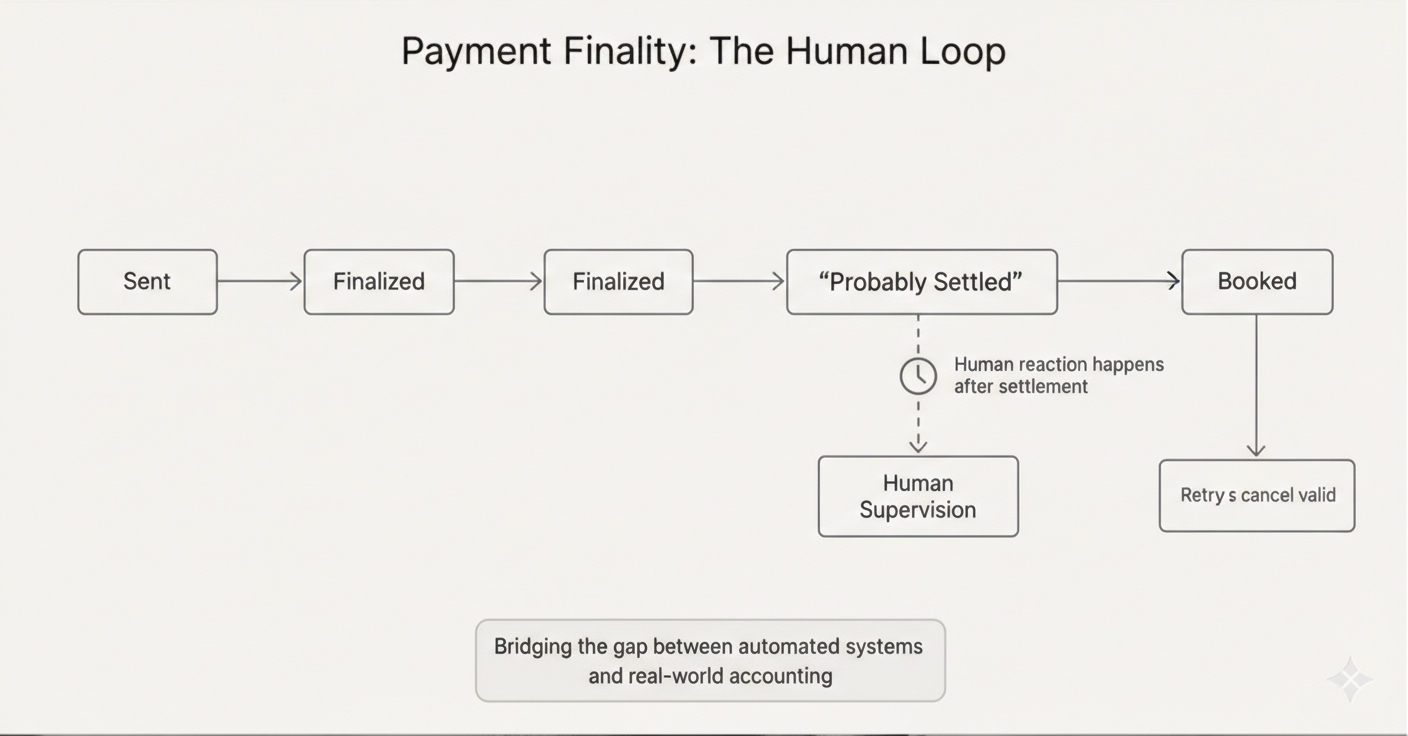
A USDT transfer leaves the wallet. The interface updates. PlasmaBFT finalizes the block. On-chain, the story is already over. But in operations, the story hasn’t even reached the part where people are allowed to stop paying attention.
That gap is where work appears.
Not visible work. Not logged work. The kind of work that lives in open tabs, follow-up messages, and someone quietly deciding not to move on yet. Nothing has failed, so no alert fires. Nothing has reverted, so no task is assigned. The payment sits in a state that feels done enough to ignore and uncertain enough to watch.
That state is expensive.
In payments, failure creates resolution paths. Pending creates behavior. Someone refreshes. Someone screenshots. Someone asks for confirmation even though they shouldn’t need to. The transaction stops being money and turns into a coordination problem shared across people who were never meant to coordinate.
Gasless USDT flows amplify this effect.
When users don’t manage gas, they internalize a simple model: press send, walk away. Any delay after that isn’t interpreted as processing. It’s interpreted as contradiction. The system promised closure and then hesitated to deliver it.
So humans adapt.
The sender disengages too early. The receiver waits longer than planned. Ops refuses to book until something undeniable appears. Support starts receiving “proof” that isn’t proof yet. Nobody is wrong. The system just asked humans to bridge a gap it didn’t close cleanly enough on its own.
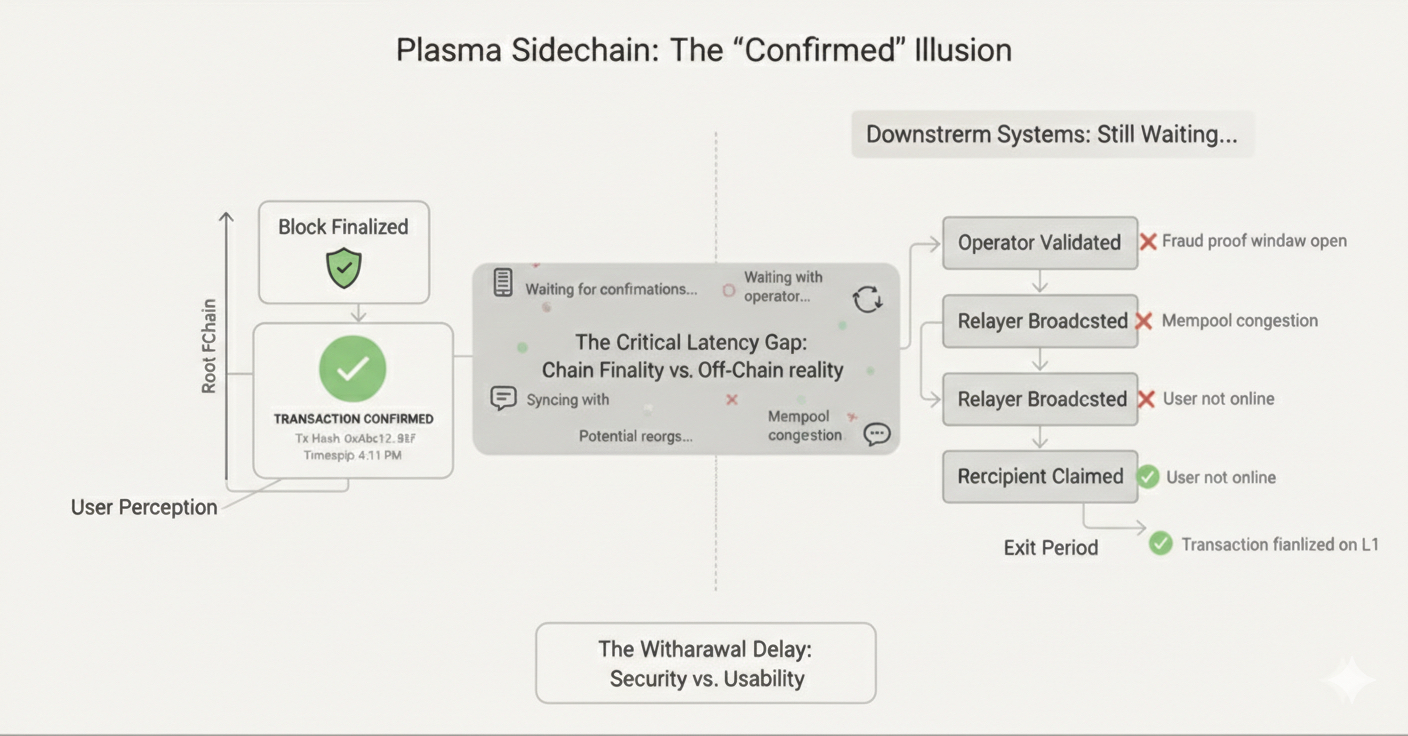
This is not a throughput issue.
It’s not a security issue.
It’s not even a latency issue in the way dashboards measure latency.
It’s an attention issue.
Plasma’s sub-second finality matters here not as a benchmark, but as a compression tool. The shorter the span between irreversible ordering and human-trustworthy closure, the less room there is for compensating behavior to emerge. Fewer retries. Fewer checks. Fewer internal messages asking “are we okay to move?”
The moment humans feel allowed to disengage, the payment actually settles.
Bitcoin anchoring operates on a different axis. It doesn’t help in the minute where someone is waiting to book a transfer, and it doesn’t need to. Its job is to reassure long-horizon participants that the system they’re building on won’t be quietly bent by censorship or policy drift. That trust accrues over years, not seconds.
But Plasma doesn’t confuse the two.
Long-term neutrality doesn’t solve short-term anxiety. And short-term anxiety is what destroys payment confidence long before anything technically breaks.
What clears a payment isn’t the word “secure.”
Secure doesn’t close a ledger entry.
Secure doesn’t stop someone from hovering.
What clears a payment is a signal that arrives early enough, clearly enough, and singularly enough that nobody feels the need to explain it later.
Once people start writing “still pending,” the system hasn’t failed. But it has shifted labor onto humans who shouldn’t be doing it. The cost isn’t monetary at first. It’s cognitive. Attention gets consumed. Trust gets rationed. The next payment is approached with caution instead of routine.
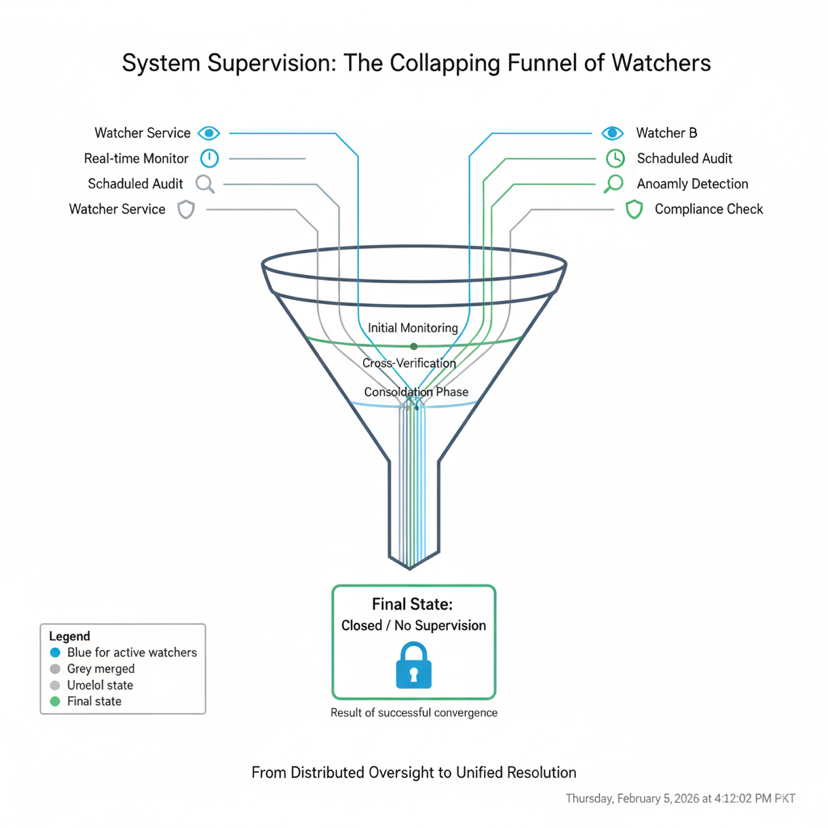
Plasma’s real test isn’t whether transactions finalize.
They already do.
The test is whether finality feels boring.
Boring enough that ops stops watching.
Boring enough that treasury books without checking twice.
Boring enough that nobody remembers the transaction five minutes later.
That’s when stablecoin settlement becomes infrastructure instead of an event.
Until then, the system technically works.
But it quietly trains everyone to hover.
And in payments, hovering is the most expensive state of all.