

There is a gap between what blockchains can do in theory and what financial system need in real life. In theory, code cam replace paperwork and settlement can happen in seconds. In real life, institutions always ask the same questions they have asked always. Who can see this trade? Who can audit it? How do we integrate it with existing tools? How do we keep users safe from unnecessary exposure? Most network answer one part well and struggle with the rest.
Dusk is built around that gap. Dusk is a Layer 1 blockchain founded in 2018 and designed for regulated and privacy focused financial infrastructure. It does not treat regulation as a side story. It treats it as part of the environment. That choice shapes everything, from how applications are expected to behave to how privacy is handled. A network aiming at finance, cannot only be fast. It must be understandable, auditable, and predictable. It has to feel like a system that can carry responsibility.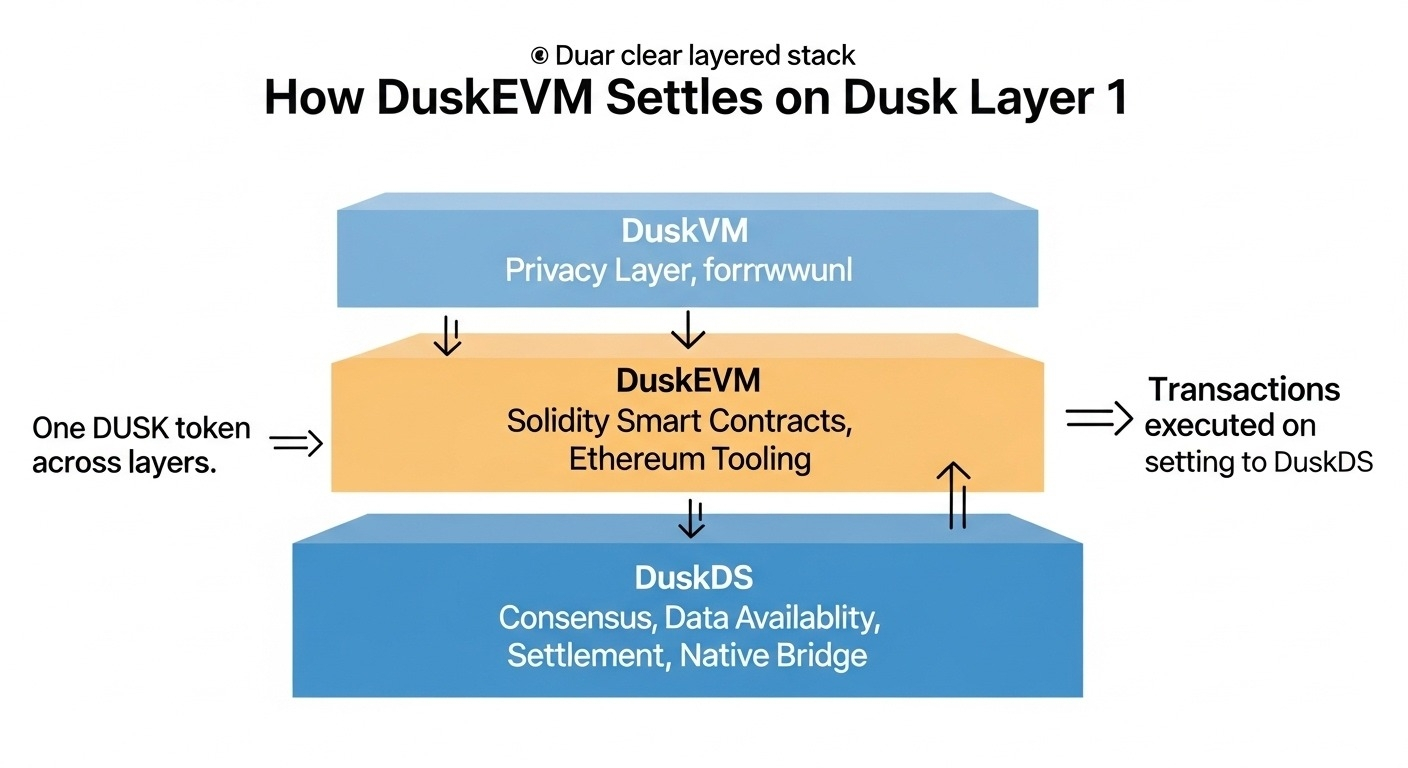
This is where DuskEVM enters the picture. DuskEVM is Dusk’s EVM compatible application layer. In simple terms, it is designed so developers and institutions can deploy standard Solidity smart contracts while settling on Dusk’s Layer 1. In the Ethereum ecosystem, solidity is used as the most common programming language for smart contracts. EVM stands for Ethereum Virtual Machine, which is the standard environment where those contracts run. EVM compatibility matters because it lowers the learning curve. It helps builders use almost familiar tools and patterns instead of starting from zero.
That familiarity sounds like a small thing, but it is often the difference between an idea and an ecosystem. When developers already know how to write, test, and deploy a contract, they can focus on the product rather than the platform. When wallets and service providers already understand the basic structure, integration becomes less of a special project. When exchanges and custodians see standard tooling, they face fewer unknowns. A lot of the time, adoption does not fail because the technology is weak. It fails because the integration cost is too high.
Dusk’s broader architecture helps explain why DuskEVM is not just a convenience layer. Dusk has described an evolution toward a modular stack with three layers. DuskDS is the consensus, data availability, and settlement layer. DuskEVM is the execution layer where Solidity applications can live. DuskVM is a forthcoming privacy layer intended for deeper privacy preserving applications. Modular simply means each layer specializes. Settlement stays focused on finality and core network integrity. Execution stays focused on running applications efficiently. Privacy has space to be engineered without forcing every app into the same shape.
If you are new to these terms, settlement is the moment a transaction becomes final. It is the point where the network agrees that something happened and it will not be undone. Data availability means the system keeps the data needed for verification accessible so the network can be audited and validated. Execution is where the application logic runs, where smart contracts do what they are written to do. In finance, these ideas map to real needs. Settlement is the final receipt. Availability is the ability to prove it later. Execution is the workflow that makes the market usable.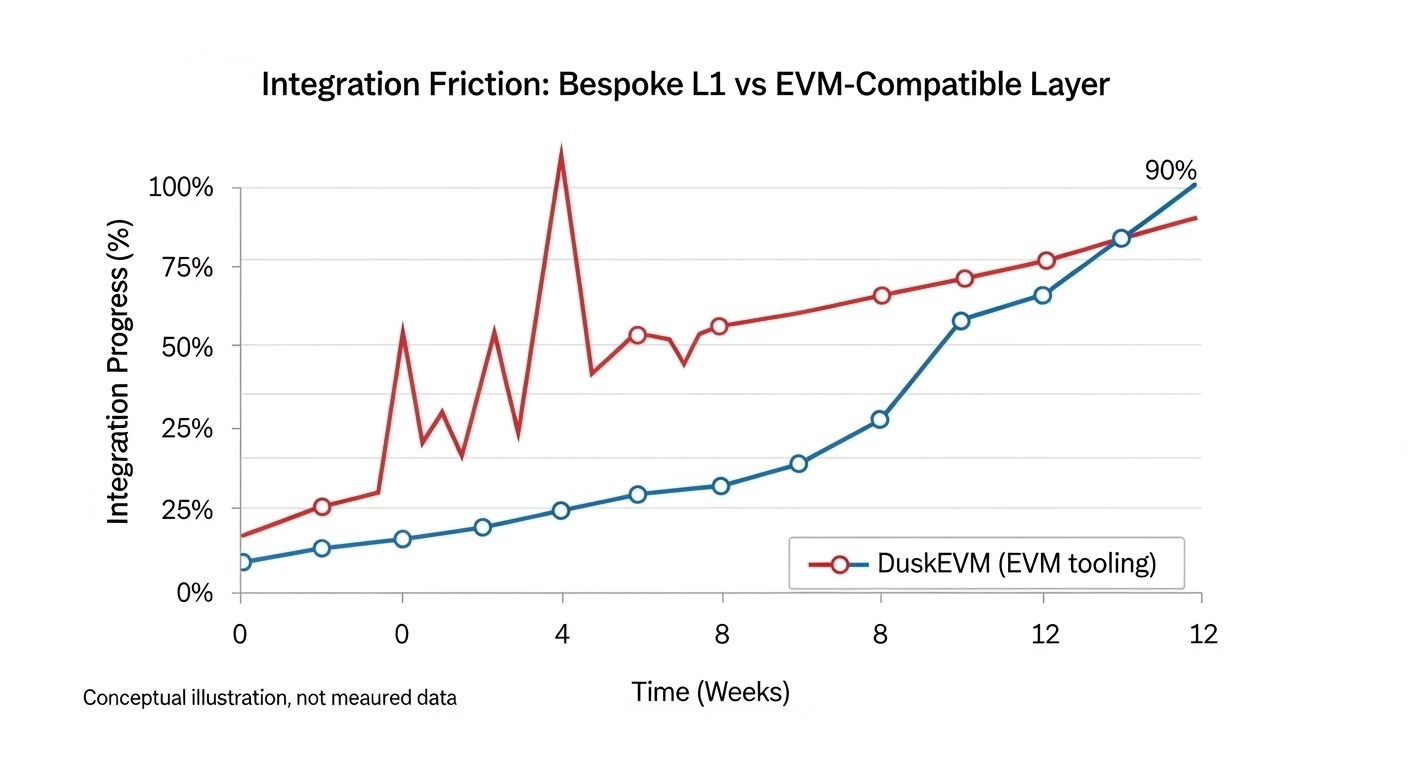
Now imagine what happens when you place an EVM environment on top of a settlement layer built for financial infrastructure. It changes what a developer can do and what an institution can accept. Developers can build in familiar ways, but the underlying settlement can still be designed with privacy and auditability in mind. Institutions can explore on chain applications without asking the entire market to expose itself to public scrutiny. That matters for regulated assets because markets need both transparency and discretion, depending on who is looking and why.
This is also why Dusk’s concept of compliant privacy matters alongside DuskEVM. Privacy in finance is not only about hiding. It is about controlling what is visible and to whom. Many people want privacy because they do not want their balances and habits to be public. Institutions want privacy because trading intent and exposure can be exploited. Regulators want the ability to audit when required. These goals can conflict if the system is designed for only one of them. Dusk’s approach is to treat privacy and auditability as features that can coexist.
Hedger is part of that approach. Hedger is described as a privacy engine built for the EVM execution layer, designed to enable confidential transactions while keeping an audit path possible when needed. It combines zero knowledge proofs and homomorphic encryption. In beginner language, zero knowledge proofs allow you to prove something is correct without revealing the private details behind it. Homomorphic encryption allows certain operations to be performed on encrypted values without exposing them. The point is not to create mystery. The point is to keep sensitive numbers private while still proving that rules were followed.
When you connect DuskEVM and privacy, you get an idea that is simple but powerful. Privacy becomes something that can live inside a developer friendly environment. It does not require a total rebuild of how applications are written. It does not force every team to become a cryptography lab before they can ship a product. If the tools feel familiar, more builders can participate. If privacy can be added without breaking everything else, more real use cases can emerge.
The same logic applies to real world assets. RWAs are traditional financial instruments represented on chain. Bringing them on chain is not only a technical problem. It is a legal and operational problem. DuskTrade is planned as a real world asset application built with NPEX, a regulated Dutch exchange, and Dusk has framed this as part of bringing regulated financial instruments on chain in a compliant way. The detail that matters here is not excitement. It is structure. Regulated venues work inside frameworks. They need auditability. They need controlled disclosure. They need integrations that do not take forever. A modular stack with an EVM application layer is one way to reduce friction while keeping the system aligned with regulated reality.
Dusk also describes a single DUSK token fueling all layers, and a validator run native bridge moving value between layers without wrapped assets or custodians. For beginners, the bridge is simply the system that lets value move between layers. A native bridge means it is part of the network design rather than an external dependency. Avoiding wrapped assets and custodians can reduce complexity. It can also reduce points of trust that regulated systems often want to minimize. The more direct the rails, the easier it is to explain and operate.
None of this is a promise that everything becomes perfect overnight. Building financial infrastructure is slow for good reasons. Integrations take work. Compliance requires discipline. Privacy systems require careful engineering and testing. But the direction is coherent. DuskEVM is a practical attempt to meet developers and institutions where they already are, using Solidity and familiar tooling, while settling on a Layer 1 designed with privacy and regulatory needs in mind. It is not trying to win by being the loudest. It is trying to win by being usable, defensible, and easier to integrate.
If the next era of on chain finance is going to include regulated assets, then the winning systems may be the ones that feel normal. Normal to developers who want to build without friction. Normal to institutions that need privacy without losing accountability. Normal to markets that need settlement that feels final and data that can be verified. In that sense, DuskEVM is not just an execution layer. It is a bridge between the language builders speak today and the kind of finance the world is slowly demanding tomorrow.